
If you are learning IP addressing or subnetting, you will often come across /24. It is one of the most commonly used IPv4 network prefixes, especially in local networks and private IP address configurations. But what is a 24 subnet, and how many devices can it support?
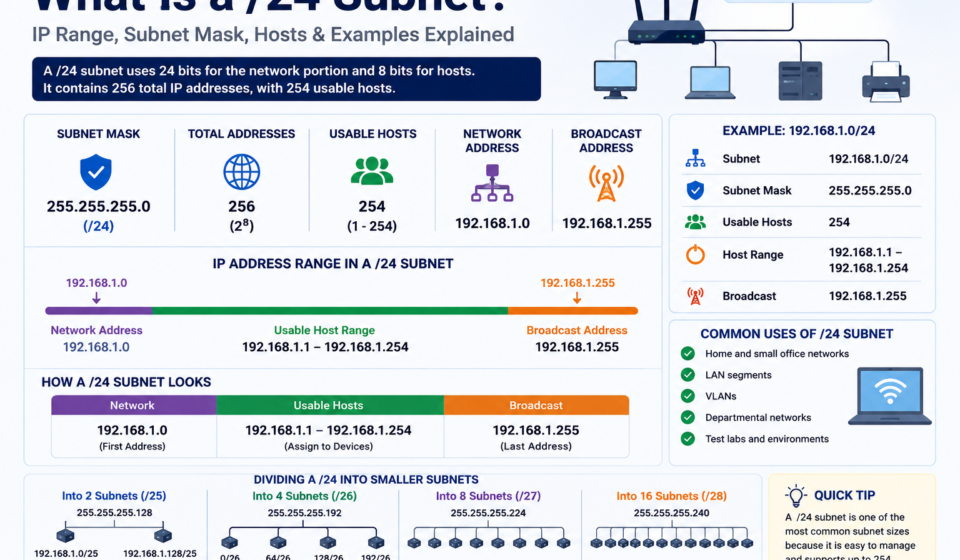
A /24 subnet uses 24 bits for the network portion of an IPv4 address and leaves 8 bits for host addresses. Its traditional subnet mask is 255.255.255.0, and it contains 256 total IPv4 addresses.
In this guide, we will explain how a /24 subnet works, its IP address range, subnet mask, usable hosts, network and broadcast addresses, and how you can divide a /24 into smaller subnets.
What Is a /24 Subnet?
A /24 subnet is an IPv4 network that uses the first 24 bits of a 32-bit IPv4 address as the network prefix. Microsoft explains that subnet address ranges can be specified using CIDR notation.
The /24 notation is called CIDR notation.
For example:
192.168.1.0/24
The /24 means:
- 24 bits are used for the network portion.
- 8 bits remain for the host portion.
- There are 256 total IPv4 addresses.
- A traditional
/24has 254 usable host addresses.
The subnet mask for /24 is:
255.255.255.0
If you are new to subnetting, you can first read our guide on What Is a Subnet? before going deeper into /24 networks.
What Is the Subnet Mask for a /24?
The subnet mask for a /24 network is:
255.255.255.0
In binary, the mask is:
11111111.11111111.11111111.00000000
The first 24 bits are set to 1, which represents the network portion.
The final 8 bits are set to 0, which represents the host portion.
Therefore:
255.255.255.0 = /24
The subnet mask tells devices where the network portion ends and the host portion begins.
For a deeper explanation of subnet masks, see our guide on What Is a Subnet Mask?.
How Many IP Addresses Are in a /24?
A /24 leaves 8 bits for hosts.
The total number of addresses can be calculated using:
2^8 = 256
Therefore, a /24 contains:
256 total IPv4 addresses
However, in a traditional IPv4 subnet, two addresses are normally reserved:
- The network address
- The broadcast address
So the traditional number of usable host addresses is:
256 - 2 = 254
Therefore, a standard /24 provides:
256 total addresses and 254 traditionally usable host addresses.
What Is the IP Range of a /24?
A /24 network contains 256 consecutive IPv4 addresses. IPv4 subnet ranges:
For example:
192.168.1.0/24
has the range:
192.168.1.0 through 192.168.1.255
The addresses can be divided as follows:
| Address | Purpose |
|---|---|
| 192.168.1.0 | Network address |
| 192.168.1.1 | Usable host |
| 192.168.1.2 | Usable host |
| … | … |
| 192.168.1.254 | Usable host |
| 192.168.1.255 | Broadcast address |
This means the commonly usable host range is:
192.168.1.1 – 192.168.1.254
What Is the Network Address of a /24?
The network address identifies the /24 network itself.
For example:
192.168.10.25/24
belongs to the network:
192.168.10.0/24
The network address is:
192.168.10.0
The final octet is the host portion in a /24.
Because the host portion contains 8 bits, it can have values from 0 through 255.
The value 0 represents the network address in this example, while 255 represents the broadcast address.
What Is the Broadcast Address of a /24?
The broadcast address is the final address in a traditional IPv4 subnet.
For:
192.168.10.0/24
the broadcast address is:
192.168.10.255
A broadcast packet can be used to communicate with hosts within the local IPv4 broadcast domain.
Therefore:
- Network address →
192.168.10.0 - Usable host range →
192.168.10.1–192.168.10.254 - Broadcast address →
192.168.10.255
Why Does a /24 Have 254 Usable Hosts?
A /24 has 8 host bits.
Using the standard formula:
2^8 = 256
This gives 256 total addresses.
Traditionally, two addresses are not assigned to ordinary hosts:
- The network address
- The broadcast address
Therefore:
256 - 2 = 254
So a standard /24 provides 254 traditionally usable IPv4 host addresses.
This traditional calculation is useful for understanding conventional IPv4 subnetting, although special cases such as point-to-point /31 networks have different rules.
/24 Subnet Example
Consider this network:
10.0.0.0/24
The subnet mask is:
255.255.255.0
The address range is:
10.0.0.0 – 10.0.0.255
The network address is:
10.0.0.0
The usable host range is:
10.0.0.1 – 10.0.0.254
The broadcast address is:
10.0.0.255
A company could use this subnet for a small office network.
For example:
- Router →
10.0.0.1 - Server →
10.0.0.10 - Printer →
10.0.0.20 - Employee computer →
10.0.0.50 - Network camera →
10.0.0.100
All of these addresses can belong to the same /24 subnet.
What Does 192.168.1.0/24 Mean?
192.168.1.0/24 represents a specific IPv4 network.
The first 24 bits define the network, while the final 8 bits are available for hosts.
The subnet mask is:
255.255.255.0
The range is:
192.168.1.0 – 192.168.1.255
The traditional usable host range is:
192.168.1.1 – 192.168.1.254
This type of private IPv4 network is commonly seen in home routers, small offices, labs, and internal networks.
What Does 10.0.0.0/24 Mean?
10.0.0.0/24 is another example of a /24 network.
The subnet mask is:
255.255.255.0
Its complete range is:
10.0.0.0 – 10.0.0.255
Its traditional usable host range is:
10.0.0.1 – 10.0.0.254
The important point is that /24 describes the size of the network prefix. The specific first three octets can vary depending on the IP address block.
What Does 172.16.0.0/24 Mean?
Another example is:
172.16.0.0/24
Its subnet mask is still:
255.255.255.0
Its range is:
172.16.0.0 – 172.16.0.255
And the traditional usable host range is:
172.16.0.1 – 172.16.0.254
The /24 prefix determines the network size regardless of which private network range is being used.
How Does a /24 Compare With Other Subnets?
The prefix length determines how large an IPv4 subnet is.
Here is a quick comparison:
| CIDR | Subnet Mask | Total Addresses | Traditional Usable Hosts |
|---|---|---|---|
| /16 | 255.255.0.0 | 65,536 | 65,534 |
| /20 | 255.255.240.0 | 4,096 | 4,094 |
| /22 | 255.255.252.0 | 1,024 | 1,022 |
| /23 | 255.255.254.0 | 512 | 510 |
| /24 | 255.255.255.0 | 256 | 254 |
| /25 | 255.255.255.128 | 128 | 126 |
| /26 | 255.255.255.192 | 64 | 62 |
| /27 | 255.255.255.224 | 32 | 30 |
| /28 | 255.255.255.240 | 16 | 14 |
| /30 | 255.255.255.252 | 4 | 2 |
| /32 | 255.255.255.255 | 1 | 1 specific address |
A smaller prefix number generally means a larger network, while a larger prefix number means a smaller network.
For example:
/16 is larger than /24.
/24 larger than /28.
/28 is larger than /32.
/24 vs /25
A /24 can be divided into two /25 networks.
A /24 has:
256 total addresses
A /25 has:
128 total addresses
For example:
192.168.1.0/24
can be divided into:
192.168.1.0/25
and:
192.168.1.128/25
The first /25 covers:
192.168.1.0 – 192.168.1.127
The second covers:
192.168.1.128 – 192.168.1.255
Each /25 traditionally provides 126 usable host addresses.
/24 vs /26
A /24 can also be divided into four /26 subnets.
Starting with:
192.168.1.0/24
the four /26 networks are:
192.168.1.0/26192.168.1.64/26192.168.1.128/26192.168.1.192/26
Each /26 contains 64 total addresses.
Traditionally, 62 addresses can be assigned to hosts in each subnet.
This can be useful when an organization wants to separate a larger network into smaller segments.
How to Divide a /24 Into Smaller Subnets
One of the main benefits of a /24 is that it can easily be divided into smaller networks.
Suppose you have:
192.168.100.0/24
and want four separate networks.
You can use /26.
The resulting subnets are:
Subnet 1
192.168.100.0/26
Range:
192.168.100.0 – 192.168.100.63
Usable hosts:
192.168.100.1 – 192.168.100.62
Subnet 2
192.168.100.64/26
Range:
192.168.100.64 – 192.168.100.127
Usable hosts:
192.168.100.65 – 192.168.100.126
Subnet 3
192.168.100.128/26
Range:
192.168.100.128 – 192.168.100.191
Usable hosts:
192.168.100.129 – 192.168.100.190
Subnet 4
192.168.100.192/26
Range:
192.168.100.192 – 192.168.100.255
Usable hosts:
192.168.100.193 – 192.168.100.254
This allows the original /24 network to be divided into four smaller network segments.
How Many /26 Subnets Fit Inside a /24?
A /24 contains 8 host bits.
A /26 leaves 6 host bits.
The difference is:
26 - 24 = 2
Therefore:
2^2 = 4
So a /24 can be divided into four /26 subnets.
The same principle can be used to calculate other subnet divisions.
For example:
/24→ 2/25networks/24→ 4/26networks/24→ 8/27networks/24→ 16/28networks/24→ 32/29networks/24→ 64/30networks
Is a /24 Good for a Small Business?
A /24 can be suitable for a small network when up to roughly 254 ordinary host addreses are needed within the same traditional IPv4 subnet.
For example, a small office might use a /24 for:
- Employee computers
- Printers
- IP phones
- Network cameras
- Access points
- Servers
- Other network-connected devices
However, network size should be planned according to actual requirements. Larger environments may benefit from multiple subnets for segmentation, security, routing, and management.
Advantages of a /24 Subnet
A /24 is popular for several reasons.
Simple to Understand
The first three octets represent the network portion, while the final octet is used for hosts.
Easy IP Management
The address range is straightforward to calculate.
Supports Many Devices
A traditional /24 provides 254 usable host addresses.
Easy to Subnet
A /24 can be divided into smaller networks such as /25, /26, /27, and /28.
Common in Private Networks
Private networks frequently use /24 blocks because they provide a convenient balance between address capacity and network organization.
Disadvantages of a /24 Subnet
A /24 is not always the best choice.
If the network has only a few devices, a /24 may provide significantly more addresses than needed.
A large number of hosts in one subnet can also make network segmentation more difficult if everything is placed into a single broadcast domain.
In larger organizations, administrators may divide the network into multiple smaller subnets for security, performance, and management reasons.
Frequently Asked Questions
What is a 24 subnet?
A /24 subnet is an IPv4 network with a 24-bit network prefix and 8 host bits. It contains 256 total addresses and traditionally provides 254 usable host addresses.
What is the subnet mask for a /24?
The subnet mask for a /24 is:
255.255.255.0
How many hosts can a /24 support?
A traditional /24 provides 254 usable host addresses because the network and broadcast addresses are normally reserved.
How many IP addresses are in a /24?
There are 256 total IPv4 addresses in a /24 block.
What is the range of a /24?
The exact range depends on the network address. For example:
192.168.1.0/24
ranges from:
192.168.1.0 to 192.168.1.255
Is /24 the same as 255.255.255.0?
Yes. In IPv4 CIDR notation:
/24 = 255.255.255.0
Is /24 bigger than /26?
Yes. A /24 contains 256 total addresses, while a /26 contains 64.
Can a /24 be divided into smaller subnets?
Yes. A /24 can be divided into /25, /26, /27, /28, and other smaller subnet blocks depending on the addressing requirements.
Conclusion
A /24 subnet is one of the most common and useful IPv4 subnet sizes. It uses the subnet mask 255.255.255.0, contains 256 total addresses, and traditionally provides 254 usable host addresses.
For example:
192.168.1.0/24
has a network address of 192.168.1.0, a traditional usable host range of 192.168.1.1–192.168.1.254, and a broadcast address of 192.168.1.255.
Understanding /24 networks gives you a strong foundation for learning more advanced subnetting. Once you understand how a /24 works, you can easily move on to smaller networks such as /25, /26, /27, and /28.
If you are building your networking knowledge, understanding the relationship between IP addresses, subnet masks, CIDR prefixes, and host ranges is essential for working with IPv4 networks.