
If you work with computer networks, IP addresses, or network security, you have probably heard the term subnet. But what is a subnet, and why is subnetting important?
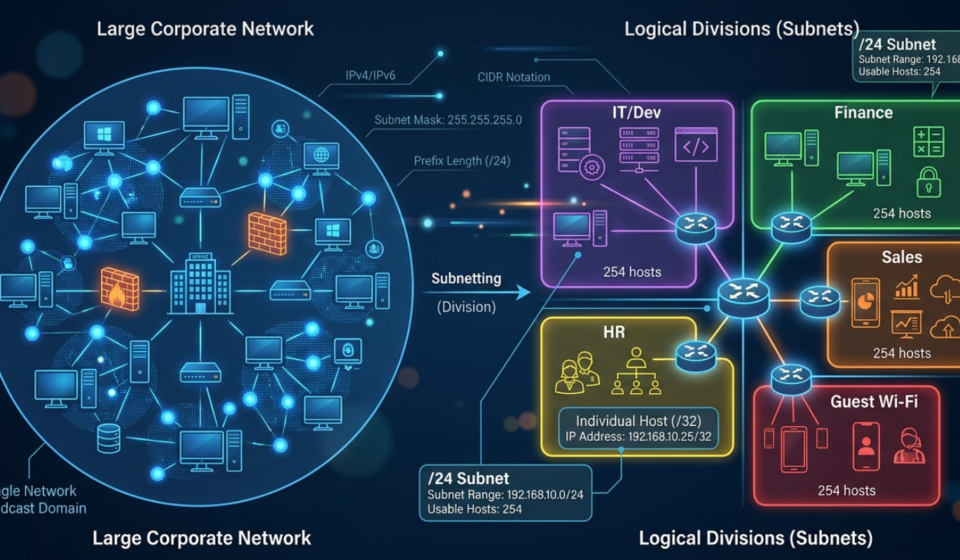
A subnet is a smaller logical section of an IP network. Instead of treating an entire network as one large group, administrators can divide it into smaller networks called subnets. This makes it easier to organize devices, manage IP addresses, improve network performance, and control access between different parts of a network.
In this guide, we will explain what is a subnet in simple terms, including subnet masks, CIDR notation, /24 subnets, /32 subnets, and practical examples.
What Is a Subnet?
A subnet, short for “subnetwork,” is a logical division of a larger IP network. It allows a network administrator to separate a large network into smaller, more manageable sections.
For example, imagine a company has hundreds of computers connected to one network. Instead of placing every device in the same network segment, the company can create separate subnets for departments such as:
- Human Resources
- Finance
- Sales
- IT
- Guest Wi-Fi
Each subnet can have its own range of IP addresses while still being part of the larger network.
In simple terms, what is a subnet can be answered as: a subnet is a smaller network created by dividing a larger IP network into logical sections.
Subnetting is commonly used in IPv4 and IPv6 networks, although the calculations and addressing methods can differ.
What Is a Subnet in an IP Address?
When someone asks what is a subnet in an IP address, they are usually asking how an IP address identifies both a network and a specific device within that network.
An IPv4 address contains 32 bits and is normally written as four decimal numbers separated by periods.
For example:
192.168.1.25
The IP address alone does not tell us exactly which portion represents the network and which portion represents the individual device. The subnet mask or CIDR prefix provides that information.
For example:
192.168.1.25/24
Here, /24 indicates that the first 24 bits identify the network portion, while the remaining 8 bits are available for host addresses.
Therefore, the subnet helps determine whether two devices belong to the same local network.
What Is a Subnet Mask?

A subnet mask is a 32-bit value used with an IPv4 address to identify the network portion and host portion of an IP address.
For example:
IP address: 192.168.1.25
Subnet mask: 255.255.255.0
The subnet mask 255.255.255.0 is equivalent to /24 in CIDR notation.
The mask tells networking devices which bits belong to the network and which bits can identify individual hosts.
A simple way to understand what is a subnet mask is to think of it as a boundary between the network and device portions of an IP address.
Common Subnet Masks
Some commonly used IPv4 subnet masks include:
| CIDR | Subnet Mask | Total Addresses |
|---|---|---|
| /8 | 255.0.0.0 | 16,777,216 |
| /16 | 255.255.0.0 | 65,536 |
| /24 | 255.255.255.0 | 256 |
| /25 | 255.255.255.128 | 128 |
| /26 | 255.255.255.192 | 64 |
| /27 | 255.255.255.224 | 32 |
| /28 | 255.255.255.240 | 16 |
| /29 | 255.255.255.248 | 8 |
| /30 | 255.255.255.252 | 4 |
| /32 | 255.255.255.255 | 1 |
The number of usable host addresses can be lower than the total number of addresses, particularly in traditional IPv4 subnetting because the network and broadcast addresses are normally reserved.
Understanding CIDR Notation
CIDR stands for Classless Inter-Domain Routing. It provides a compact way to represent an IP address together with its network prefix.
You may see an address written like this:
192.168.1.25/24
The /24 is the prefix length.
It means the first 24 bits are used for the network portion and the remaining 8 bits are available for host addressing.
The larger the prefix number, the smaller the IPv4 address block generally becomes.
For example:
/16= larger network/24= medium-sized common LAN subnet/28= smaller subnet/30= very small subnet/32= one individual IPv4 address
What Is a /24 Subnet?
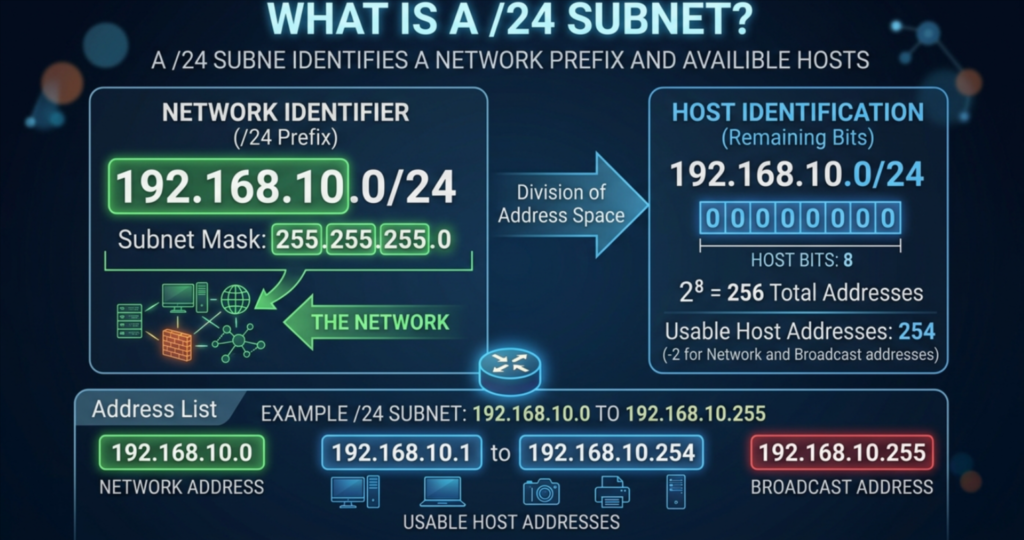
If you are wondering what is a 24 subnet, a /24 subnet is an IPv4 network where 24 of the 32 bits are used for the network prefix.
A typical example is:
192.168.1.0/24
The equivalent subnet mask is:
255.255.255.0
A /24 contains 256 total IPv4 addresses, ranging from:
192.168.1.0 to 192.168.1.255
In traditional IPv4 subnetting:
192.168.1.0is the network address.192.168.1.1through192.168.1.254are commonly usable host addresses.192.168.1.255is the broadcast address.
Therefore, a traditional /24 provides 254 usable host addresses.
Example of a /24 Network
Suppose a small business uses:
192.168.10.0/24
Its address range is:
192.168.10.0 – 192.168.10.255
The company could assign addresses such as:
192.168.10.10— office computer192.168.10.20— printer192.168.10.30— server192.168.10.40— network camera
All of these devices can belong to the same /24 subnet.
What Is a /32 Subnet?
Another common question is what is a 32 subnet?
A /32 represents a single IPv4 address. All 32 bits are part of the network prefix, leaving zero host bits.
The subnet mask for /32 is:
255.255.255.255
For example:
203.0.113.25/32
represents exactly one IPv4 address.
Unlike a /24, a /32 does not provide a range of 256 addresses. It identifies one specific address.
Where Are /32 Addresses Used?
/32 addresses are frequently used for:
- Host routes
- Loopback addresses
- Firewall rules
- Access control lists
- Routing policies
- VPN configurations
- Monitoring specific IP addresses
- Identifying a single destination
For example, a firewall rule might allow traffic from:
203.0.113.25/32
This means the rule applies specifically to that one IPv4 address.
/24 vs /32: What Is the Difference?
The main difference between /24 and /32 is the number of addresses represented.
| Feature | /24 | /32 |
|---|---|---|
| Prefix length | 24 bits | 32 bits |
| Subnet mask | 255.255.255.0 | 255.255.255.255 |
| Total IPv4 addresses | 256 | 1 |
| Typical usable hosts | 254 | 1 specific address |
| Common use | LAN/network segment | Individual host or route |
A /24 is useful when you need a network containing multiple devices. A /32 is useful when you need to identify one specific IPv4 address.
How Does Subnetting Work?
Subnetting works by borrowing bits from the host portion of an IP address and using them as additional network bits.
Consider a /24 network:
192.168.1.0/24
It has 8 host bits remaining.
If you divide it into /26 subnets, you use 2 additional bits for subnetting.
This creates:
2² = 4 subnets.
Each /26 contains:
2⁶ = 64 total addresses.
The four subnet ranges are:
192.168.1.0/26192.168.1.64/26192.168.1.128/26192.168.1.192/26
Each subnet can then be used for a different group of devices or network segment.
Why Is Subnetting Important?
Subnetting provides several advantages for network administrators.
1. Better Network Organization
Large networks can be separated into smaller logical groups. For example, a company can create different subnets for employees, servers, printers, and guest devices.
2. Efficient IP Address Management
Subnetting allows organizations to allocate IP addresses according to their actual requirements instead of assigning unnecessarily large address ranges.
3. Improved Network Performance
Smaller network segments can reduce unnecessary broadcast traffic and make network management more efficient.
4. Better Security
Subnets can help isolate sensitive systems. For example, a company might keep database servers on a separate subnet from employee workstations.
Access between subnets can then be controlled using routers, firewalls, and access control policies.
5. Easier Troubleshooting
When a large network is divided into logical sections, network administrators can isolate problems more easily.
If one subnet experiences an issue, administrators can investigate that segment without necessarily affecting the entire network.
Subnet vs IP Address
An IP address identifies a device or network interface, while a subnet defines the network boundaries associated with that address.
For example:
192.168.1.25/24
Here:
192.168.1.25is the IP address./24specifies the network prefix.192.168.1.0/24represents the subnet.
Two devices may have different IP addresses but still belong to the same subnet.
For example:
192.168.1.10/24
and
192.168.1.20/24
are both part of:
192.168.1.0/24
How Many Hosts Can a Subnet Have?
For traditional IPv4 subnetting, the number of host bits determines the number of addresses.
The basic formula is:
2^host bits
For example, a /24 has 8 host bits:
2^8 = 256
That gives 256 total addresses, with 254 commonly usable host addresses in a conventional subnet.
A /26 has 6 host bits:
2^6 = 64
So it contains 64 total addresses and typically 62 usable host addresses.
A /30 has 2 host bits:
2^2 = 4
It traditionally provides 2 usable host addresses.
A /32 has zero host bits:
2^0 = 1
So it represents one IPv4 address.
Common Subnet Sizes
Here are several CIDR prefixes you may encounter:
/16
A /16 is significantly larger than a /24 and provides 65,536 total IPv4 addresses.
It may be suitable for larger private networks or organizations that need a substantial address space.
/24
A /24 provides 256 total addresses and is one of the most commonly discussed subnet sizes.
It is frequently used for smaller networks and LAN segments.
/28
A /28 provides 16 total addresses and is useful when a small group of hosts needs its own network block.
/30
A /30 provides four total addresses and has traditionally been used for point-to-point links where two usable addresses are required.
/32
A /32 identifies one IPv4 address and is commonly used for host-specific routing and access-control rules.
Subnetting Example
Imagine a company has been given this network:
192.168.100.0/24
The company wants four separate departments to have their own subnets.
The administrator can divide the /24 into four /26 networks.
The resulting networks are:
| Subnet | Address Range | Typical Usable Hosts |
|---|---|---|
| 192.168.100.0/26 | .0 – .63 | 62 |
| 192.168.100.64/26 | .64 – .127 | 62 |
| 192.168.100.128/26 | .128 – .191 | 62 |
| 192.168.100.192/26 | .192 – .255 | 62 |
For example:
- HR →
192.168.100.0/26 - Finance →
192.168.100.64/26 - Sales →
192.168.100.128/26 - IT →
192.168.100.192/26
This gives the organization four logically separated networks.
Frequently Asked Questions
What is a subnet in simple terms?
A subnet is a smaller logical network created by dividing a larger IP network into sections. Subnets make IP address management, network organization, routing, and security easier.
What is a subnet mask?
A subnet mask identifies which portion of an IPv4 address represents the network and which portion represents the host. For example, 255.255.255.0 is the subnet mask associated with /24.
What is a 24 subnet?
A /24 subnet has a 24-bit network prefix and 8 host bits. It contains 256 total IPv4 addresses and traditionally provides 254 usable host addresses.
What is a 32 subnet?
A /32 represents one IPv4 address because all 32 bits are part of the prefix. Its subnet mask is 255.255.255.255.
Why do networks use subnets?
Networks use subnets to organize devices, improve address allocation, reduce broadcast domains, simplify management, and support security and routing policies.
Is a /24 bigger than a /32?
Yes. A /24 represents 256 IPv4 addresses, while a /32 represents only one IPv4 address.
Conclusion
Understanding subnetting is essential for anyone working with IP networks. A subnet divides a larger network into smaller logical sections, making network administration more organized and efficient.
The subnet mask determines the boundary between the network and host portions of an IPv4 address, while CIDR notation such as /24 and /32 provides a concise way to describe that boundary.
A /24 is commonly used for networks containing multiple devices, while a /32 identifies a single IPv4 address. Once you understand these concepts, it becomes much easier to understand IP addressing, routing, firewalls, VPNs, and network security.
If you’re learning networking, start with the relationship between an IP address, subnet mask, and CIDR prefix. These three concepts form the foundation for understanding how IPv4 networks are divided and managed.