
Artificial intelligence is changing how organizations work. Businesses use AI to write content, analyze information, automate repetitive tasks, support customer service, generate software code, and assist with important decisions. These applications can save time and improve productivity, but they can also introduce risks related to data privacy, security, accuracy, fairness, and accountability.
The main challenge is that not every AI application creates the same level of risk. Using AI to brainstorm blog topics is different from using it to screen job applicants, evaluate financial applications, or support decisions that affect people’s rights.
Organizations need a practical way to distinguish between these activities and decide how much oversight each one requires.
AI risk tiering is a method for classifying AI use cases according to their potential impact and risk. It helps organizations determine which applications need basic checks, which require specialist review, and which may need strict safeguards or should not proceed.
In this guide, you will learn how AI risk tiering works, which factors to assess, how to create a risk classification model, and how to connect risk levels with appropriate approval and monitoring procedures.
What Is AI Risk Tiering?
AI risk tiering is the process of placing AI systems or use cases into defined risk categories based on factors such as their purpose, the information they process, the people they affect, and the consequences of an error.
Each tier has its own review requirements and safeguards.
For example, a company might classify an AI writing assistant used for internal brainstorming as low risk. An AI tool that analyzes confidential customer information may require additional privacy and security checks. A system that influences hiring decisions or access to important services may need a much more detailed assessment.
The exact number of tiers depends on the organization. Some businesses use three levels, while others use four or more. There is no single internal tiering model that every organization must follow.
The important principle is to match the level of governance to the potential risk.
A well-designed system helps organizations:
- Identify high-impact AI applications.
- Apply consistent review criteria.
- Assign appropriate approval responsibilities.
- Determine which safeguards are required.
- Prioritize limited governance resources.
- Document risk decisions.
- Monitor AI systems after deployment.
Risk tiering should evaluate the actual use case, not simply the product name. The same AI tool may be suitable for a low-risk task but require stronger controls when used for a different purpose.
Why Is AI Risk Tiering Important?
Without risk classification, organizations may treat every AI request in the same way. This can lead to unnecessary delays for simple applications and insufficient oversight for more consequential systems.
A risk-based approach helps solve this problem.
1. Focus attention on the most important risks
Governance teams often have limited time and resources. Risk tiering helps them identify which applications deserve the most attention.
A simple content drafting tool may need only an approved-tool check and human review. A system processing sensitive personal information may require a more detailed examination of data handling, security, accuracy, and applicable legal obligations.
2. Make approval decisions more consistent
Different departments may have different opinions about whether an AI tool is safe to use.
A documented classification model gives reviewers common criteria. Similar use cases can follow similar review paths, while meaningful differences can justify different controls.
3. Support responsible AI adoption
Organizations should not have to choose between adopting AI and managing risk.
A tiered approach can make appropriate low-risk experimentation easier while ensuring that higher-impact applications receive the necessary attention.
4. Improve accountability
Each risk tier can have a defined approval authority, required safeguards, and a responsible system owner.
This makes it easier to determine who approved a use case, what risks were considered, and which conditions must remain in place.
5. Support compliance and documentation
Risk classification can help organizations organize their governance records and identify use cases that require further legal or compliance review.
However, an internal risk tier does not automatically determine whether a system meets a legal requirement. Applicable laws may define their own categories, thresholds, and obligations.
What Factors Should You Assess When Classifying AI Risk?
A reliable classification process considers several dimensions rather than relying on a single score.
1. Purpose of the AI system
Start by asking what the system is intended to do.
Is it generating ideas, summarizing public information, recommending actions, making predictions, or influencing decisions about people?
The purpose matters because the consequences of an error can vary significantly.
An AI assistant that suggests possible meeting titles presents a different level of concern from a system that helps determine whether someone receives a loan or qualifies for a job.
2. Data sensitivity
The type of information an AI system processes is another important factor.
Consider whether the system handles:
- Public information.
- Internal business documents.
- Confidential commercial information.
- Personal information.
- Financial or health-related records.
- Source code or security configurations.
- Information protected by law or contract.
Sensitive data may require stronger access controls, approved processing arrangements, data minimization, and privacy review.
3. Potential impact on people
Assess who could be affected if the system produces an incorrect, biased, or harmful output.
Could the system influence employment, education, financial opportunities, access to services, safety, or other important interests?
The greater the potential consequences, the more carefully the organization should evaluate the use case.
4. Degree of automation
Determine whether the AI system merely provides suggestions or takes actions automatically.
Consider three common situations:
- Decision support: AI provides information for a person to consider.
- Human-reviewed automation: AI produces an output or recommendation that a person must review before action.
- Automated action: AI triggers decisions or actions with limited or no human intervention.
These categories are useful starting points, but human involvement alone does not guarantee that a system is safe. Reviewers should also consider whether the human reviewer has enough information, time, expertise, and authority to challenge the AI output.
5. Accuracy and reliability
AI systems can produce incorrect, incomplete, inconsistent, or misleading outputs.
Ask how harmful an error would be and whether the output can be checked before it is used.
For example, an inaccurate internal brainstorming suggestion may have little impact. An incorrect technical instruction or financial recommendation may create much more serious consequences.
The assessment should consider testing, validation, known limitations, and procedures for correcting mistakes.
6. Security and integration
An AI tool may connect to company databases, customer systems, internal applications, or external services.
These connections can create additional security risks.
Review the tool’s permissions, authentication, access controls, data flows, logging, and ability to execute actions. An application that can change business records or access sensitive systems may need stronger controls than a standalone tool with no internal integrations.
7. Scale and exposure
Consider how many people could be affected and how widely the AI system will be used.
A small internal pilot may have limited exposure, while a system deployed across thousands of customers could amplify mistakes or harmful outcomes.
A pilot should not automatically be classified as low risk simply because it has few users. Its purpose, data, and potential impact still matter.
8. Legal and regulatory requirements
Some AI applications may be subject to specific laws, industry requirements, contractual obligations, or restrictions.
Identify the jurisdictions involved, the organization’s role, and the purpose of the system.
Where necessary, involve legal or compliance specialists. An internal tiering model should complement applicable legal analysis rather than replace it.
A Simple Four-Tier AI Risk Classification Model
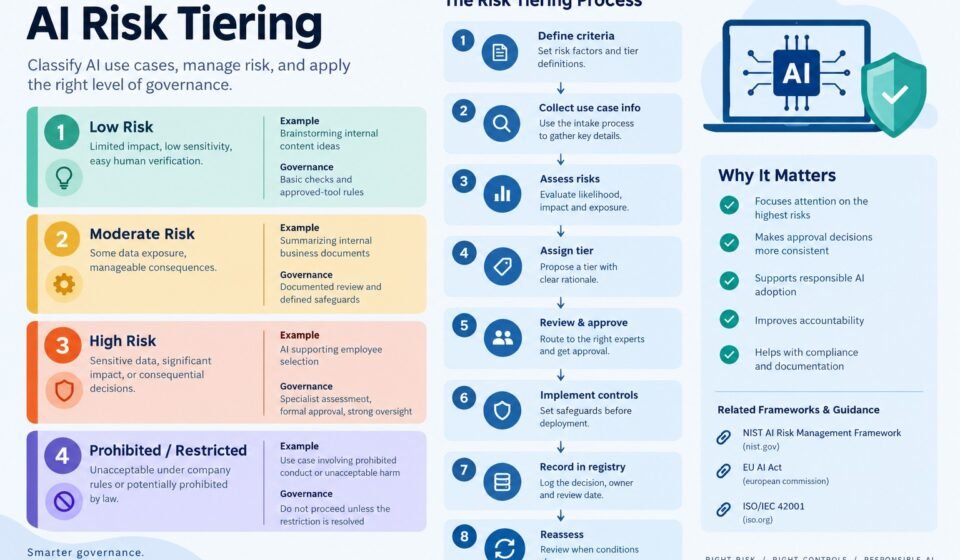
An organization can begin with four internal tiers: low, moderate, high, and prohibited or restricted.
These categories are an example of an internal governance model, not a universal legal classification. Each organization should define the criteria and approval requirements that apply to its own operations.
| Risk tier | Typical characteristics | Example | Governance approach |
|---|---|---|---|
| Tier 1: Low | Limited impact, low sensitivity, easy human verification | Brainstorming internal content ideas | Basic checks and approved-tool rules |
| Tier 2: Moderate | Some business or data exposure, manageable consequences | Summarizing internal business documents | Documented review and defined safeguards |
| Tier 3: High | Sensitive data, significant impact, or consequential decisions | AI supporting employee selection | Specialist assessment, formal approval, strong oversight |
| Tier 4: Prohibited or restricted | Unacceptable under company rules or potentially prohibited by applicable law | A use case involving prohibited conduct or unacceptable harm | Do not proceed unless the specific restriction is resolved and the use is lawfully authorized |
The fourth tier needs particular care. A restricted use case may be prohibited outright, require changes, or need further legal analysis. The organization should clearly distinguish a use case that is prohibited from one that is temporarily restricted pending review.
Tier 1: Low-risk AI use cases
Low-risk applications generally have limited consequences if the system makes a mistake, use non-sensitive information, and allow outputs to be checked easily.
Examples may include brainstorming ideas, rewriting non-confidential text, or organizing public information using an approved tool.
Possible controls include:
- Use of an approved application.
- Basic employee guidance.
- Human review before external publication.
- Restrictions on entering confidential data.
- A record of the tool or use case where required.
Low risk does not mean no risk. Even simple tasks can create problems if employees disclose sensitive information or publish unverified claims.
Tier 2: Moderate-risk AI use cases
Moderate-risk applications may involve internal business information, more complex workflows, or outputs that influence operational decisions.
Examples could include summarizing internal reports or generating recommendations that employees review before acting.
Possible controls include:
- Documented use-case review.
- Verification of important outputs.
- Appropriate access controls.
- Review of vendor data-handling practices.
- A named business owner.
- Periodic checks of performance and continued suitability.
The goal is to manage the additional exposure without requiring the same review process for every moderate-risk application.
Tier 3: High-risk AI use cases
High-risk applications can have significant consequences for people, the organization, or its operations.
Examples may include AI used to support important employment decisions, process highly sensitive data, or influence access to important services.
These examples are not automatically classified as high risk in every jurisdiction or situation. Their classification depends on the actual use case, context, and applicable requirements.
Possible controls include:
- Formal risk assessment.
- Security and privacy review.
- Legal or compliance review where appropriate.
- Documented testing and validation.
- Clearly assigned approval authority.
- Meaningful human oversight.
- Monitoring and incident response procedures.
- Defined conditions for suspension or rollback.
High-risk use cases should not proceed until the required approvals and safeguards are in place.
Tier 4: Prohibited or restricted use cases
Some uses may be prohibited by company policy, applicable law, or contractual obligations.
For example, an organization may prohibit employees from using AI to process certain confidential information through unauthorized services. Certain AI practices may also be prohibited under applicable legislation.
The organization should record why the use is prohibited or restricted, who made the decision, and whether a redesigned proposal could be considered.
Do not assume that a system is legally prohibited merely because it receives the highest internal risk score. Legal classification and internal risk management are related but separate questions.
How to Build an AI Risk Tiering Process Step by Step
A practical process should connect risk classification with the way AI requests are submitted, reviewed, approved, and monitored.
Step 1: Define the classification criteria
Choose the factors that determine risk in your organization.
These may include data sensitivity, impact on people, degree of automation, potential harm, security exposure, deployment scale, and applicable requirements.
Write clear descriptions for each tier so reviewers can apply them consistently.
Deliverable: A documented risk classification guide.
Step 2: Collect information about the use case
Before assigning a tier, gather information about the proposed AI application.
Ask what it does, what information it processes, who uses it, who may be affected, and what happens if the output is wrong.
This information is typically collected through the AI governance intake process.
Do not assign a final tier based only on the name of the AI product or a short description of its intended benefit.
Deliverable: A complete use-case record.
Step 3: Assess the risks
Evaluate each relevant risk dimension.
Consider both the likelihood of a harmful outcome and the severity of its consequences. Where useful, also assess how widely the system is deployed and how difficult it would be to detect or correct a problem.
A simple scoring method can help organize the review, but reviewers should be able to document important concerns that a numerical score may not capture.
Deliverable: A documented risk assessment.
Step 4: Assign a preliminary tier
Use the classification criteria to propose a risk tier.
The person conducting the initial assessment should explain the reasoning behind the classification and identify any missing information.
If the use case involves major uncertainty, significant potential harm, or sensitive data, escalate it rather than automatically assigning a low tier.
Deliverable: A preliminary tier and written rationale.
Step 5: Obtain the required review and approval
Route the request according to its proposed tier.
A low-risk request may need a basic review. A high-risk request may require specialist input, formal approval, and documented safeguards.
The AI governance policy should establish the relevant rules and clarify who has authority to approve each type of use case.
Deliverable: A documented decision and required conditions.
Step 6: Implement controls before deployment
Identify which safeguards must be in place before the AI system can be used.
These might include restricted access, data minimization, output validation, human review, security testing, user training, or monitoring.
Assign responsibility for each control and verify completion where required.
Deliverable: A control checklist and readiness record.
Step 7: Record the tier and decision
Maintain the risk classification, assessment rationale, approval status, safeguards, responsible owner, and review date.
Store this information in the organization’s AI governance registry so relevant teams can find and update it.
The record should distinguish between a proposed tier, an approved classification, and any later reassessment.
Deliverable: An up-to-date governance record.
Step 8: Reassess when conditions change
Risk classification should not remain fixed if the AI use case changes significantly.
Reassessment may be necessary when the system starts using new data, makes more consequential recommendations, connects to additional applications, expands to new users, or begins operating with greater autonomy.
A significant incident or change in applicable requirements may also trigger a review.
Deliverable: A reassessment schedule and clear review triggers.
Should You Use a Numerical AI Risk Scoring System?
Numerical scoring can help organizations compare use cases, but it should not replace professional judgment.
For example, a company might score each risk dimension from 1 to 5, where 1 represents lower concern and 5 represents greater concern.
A simple model might examine:
- Potential harm.
- Data sensitivity.
- Level of automation.
- Security exposure.
- Impact on people.
The organization can use the scores to identify requests that require closer attention. However, it should define the scoring criteria carefully and document how the results map to internal risk tiers.
Avoid treating a simple average as a complete measure of risk. A serious concern involving personal safety, sensitive data, or a legal restriction should not disappear because the scores for other dimensions are low.
A better approach is to combine a structured score with escalation rules and reviewer judgment.
For example, a use case might receive a high tier automatically if it involves a predefined critical risk, regardless of its overall average score.
Numerical scoring is a prioritization tool, not proof that an AI system is safe or compliant.
How to Connect AI Risk Tiering With Governance Frameworks
Organizations can use established guidance to inform their risk classification approach.
NIST AI Risk Management Framework
The NIST AI Risk Management Framework provides guidance for identifying, assessing, managing, and monitoring AI risks.
Its core functions are Govern, Map, Measure, and Manage. These functions can help organizations establish responsibilities, understand AI use cases, evaluate risks, and maintain appropriate controls.
NIST’s framework does not require every organization to use the same four internal tiers described in this article. Businesses should develop a classification model that fits their context.
EU AI Act
The EU AI Act establishes a legal framework for AI in the European Union. It includes different requirements depending on the system, the activity, the organization’s role, and the applicable provisions.
Its legal categories should not be confused with a company’s internal low, moderate, and high-risk labels.
Organizations operating in or serving markets covered by the legislation should determine which requirements apply to their specific use cases and check current implementation dates.
ISO/IEC 42001
The ISO/IEC 42001 AI management system standard provides requirements and guidance for establishing and continually improving an AI management system.
It can support a more structured approach to responsibilities, documented processes, risk management, and continual improvement.
Using the standard does not automatically mean an organization is certified or that every AI use case is compliant with applicable laws.
Common AI Risk Tiering Mistakes to Avoid
Using vague tier definitions
Labels such as low, medium, and high risk are not enough by themselves.
Define what each tier means, which factors matter, and what review requirements apply.
Classifying only by the tool name
An AI product may be used for several purposes with different levels of risk.
Assess the actual activity, data, users, and consequences rather than assigning one permanent tier to the entire product.
Ignoring serious individual risks
An average score can hide a severe issue.
Create escalation rules for critical concerns and make sure reviewers can raise a tier when necessary.
Treating human review as a complete safeguard
Human oversight is useful only when reviewers can meaningfully assess the output and intervene when needed.
Provide appropriate training, access to supporting information, enough time, and authority to challenge the AI system.
Forgetting about reassessment
A use case can change after approval.
Define the events that require a new review and keep the risk record current.
Confusing internal tiers with legal categories
A company-created classification system does not replace legally defined risk categories or obligations.
Document the distinction and obtain specialist advice when the applicable rules are unclear.
How to Measure Whether AI Risk Tiering Is Working
Organizations should evaluate whether their classification process identifies important risks and leads to appropriate controls.
Useful metrics include:
| Metric | Purpose |
|---|---|
| Percentage of known AI use cases with an assigned tier | Measures classification coverage |
| Percentage of high-risk use cases reviewed by the required specialists | Measures review coverage |
| Number of unresolved high-risk findings | Highlights outstanding concerns |
| Percentage of required controls completed before deployment | Measures control readiness |
| Number of overdue risk reassessments | Tracks maintenance |
| Number of classification decisions changed after review | Helps identify unclear criteria |
| Time required to classify requests | Measures process efficiency |
These metrics should be interpreted carefully. For example, a higher number of reclassified use cases may indicate that reviewers are catching mistakes rather than that the process is getting worse.
Use the findings to improve criteria, reviewer training, documentation, and escalation rules.
A Practical 30-Day AI Risk Tiering Implementation Plan
Week 1: Establish the model
- Identify the main AI risks relevant to the organization.
- Choose the internal risk tiers.
- Define classification criteria and escalation rules.
- Assign responsibility for risk decisions.
Week 2: Connect intake with classification
- Update the AI intake form with relevant risk questions.
- Define how requests are screened.
- Create a scoring guide or decision checklist.
- Identify when specialist review is necessary.
3 Week: Test the process
- Select several existing or proposed AI use cases.
- Apply the classification criteria.
- Compare decisions across reviewers.
- Clarify any inconsistent tier definitions.
- Document required safeguards.
Week 4: Implement and monitor
- Record the approved classifications.
- Add relevant records to the AI registry.
- Communicate the process to employees.
- Establish review triggers and performance metrics.
- Schedule the next evaluation of the model.
The 30-day timeline is a starting point. Organizations with complex AI systems or extensive regulatory obligations may need more time to complete their assessments and implement controls.
Frequently Asked Questions
What is AI risk tiering?
AI risk tiering is a process for classifying AI use cases according to their potential risks and consequences. The classification helps determine the level of assessment, approval, safeguards, and monitoring required.
How many AI risk tiers should an organization use?
There is no universal number. Three or four internal tiers can provide a practical starting point for many organizations. The right structure depends on the organization’s activities, risk profile, and governance needs.
Who should assign the AI risk tier?
A designated governance lead or trained reviewer can perform the initial classification. Higher-impact use cases may require review by security, privacy, legal, compliance, technical, or business specialists. The organization should define who has final approval authority.
Is AI risk tiering required by law?
Specific obligations depend on the applicable law, jurisdiction, industry, and AI use case. Some legal frameworks establish their own risk categories and requirements. An internal tiering model may help organize governance, but it does not automatically satisfy legal obligations.
What is the difference between AI risk tiering and AI risk assessment?
Risk assessment identifies and evaluates potential harms, exposures, and safeguards. Risk tiering uses the assessment findings and defined criteria to place a use case into a category that determines the required governance response.
Can an AI tool have different risk tiers?
Yes. The same tool can be low risk for one purpose and higher risk for another. Classification should reflect the specific use case, information processed, degree of automation, affected people, and potential consequences.
How often should an AI system’s risk tier be reviewed?
Review the classification at a frequency appropriate to the risk and whenever a significant change occurs. Changes in purpose, data, system capabilities, affected people, or deployment scale may require reassessment.
Conclusion
AI risk tiering helps organizations manage AI adoption in a consistent and proportionate way. Instead of applying identical controls to every AI application, businesses can classify use cases according to their potential impact and determine which reviews and safeguards are appropriate.
Start by defining clear tiers, collecting reliable information about each use case, assessing relevant risks, and documenting the reasoning behind each classification. Connect the results to approval decisions, required controls, an AI registry, and ongoing monitoring.
The most effective model is one that employees and reviewers can understand and apply consistently. It should also be flexible enough to respond when AI systems, business needs, or applicable requirements change.
When risk tiering works together with policy, intake, and documentation, it becomes an important part of a practical AI governance program.


[…] For a detailed classification method, see our guide to AI risk tiering. […]