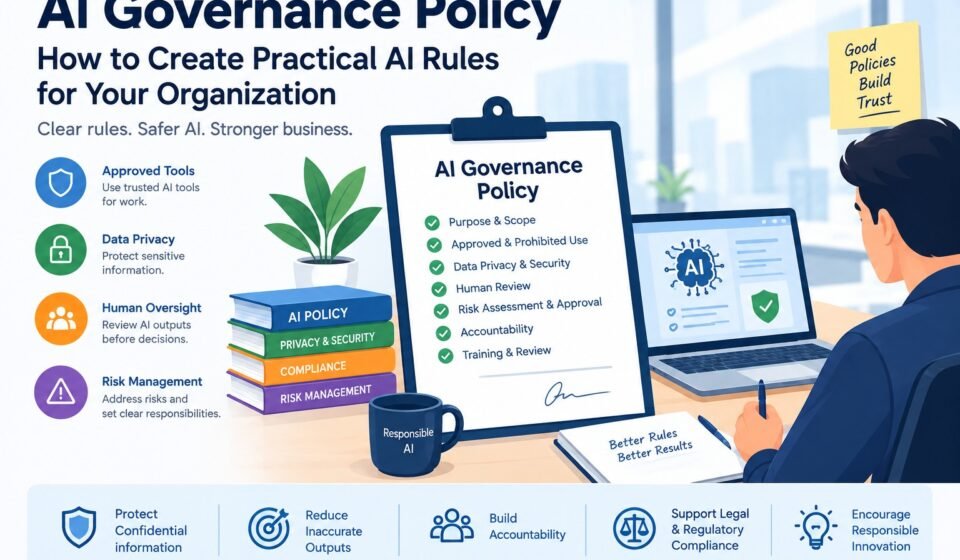

Artificial intelligence is becoming part of everyday business operations. Companies use AI tools to write content, analyze data, support customers, automate repetitive tasks, develop software, and help employees make decisions. These tools can improve productivity, but they can also create risks related to privacy, security, accuracy, bias, and accountability.
Without clear rules, employees may use unapproved AI tools, share confidential information with external platforms, or rely on AI-generated answers without checking whether they are correct. These problems can affect customer trust, business operations, and regulatory compliance.
An AI governance policy helps organizations establish clear expectations for how AI should be selected, used, monitored, and managed. It explains what employees can do with AI, which activities require approval, and who is responsible when something goes wrong.
The goal is not to stop employees from using AI. Instead, the goal is to help them use it responsibly while allowing the organization to benefit from new technology.
In this guide, you will learn what an AI governance policy is, why businesses need one, what it should include, and how to create a practical policy that employees can understand and follow.
What Is an AI Governance Policy?
An AI governance policy is a written set of rules, responsibilities, and procedures that guides how an organization uses artificial intelligence.
It establishes expectations for the development, purchase, deployment, and use of AI systems. It can apply to public AI tools, internal AI applications, third-party software with AI features, and custom machine learning systems.
For example, an organization might allow employees to use an approved AI assistant to summarize public information. However, the same organization might prohibit employees from entering customer records, passwords, confidential contracts, or sensitive business information into an unapproved public AI service.
The policy explains these differences so employees do not have to guess what is acceptable.
A practical policy usually addresses:
- Approved and prohibited AI uses.
- Data privacy and information security.
- Human review of AI-generated content and decisions.
- AI risk assessment and approval.
- Responsibilities of employees, managers, and technical teams.
- Monitoring, documentation, and incident reporting.
- Training and periodic policy reviews.
An AI policy is not simply a document stored on a company website. It should guide real decisions and connect with the organization’s existing security, privacy, compliance, and operational processes.
Why Does Your Organization Need an AI Governance Policy?
AI tools are easy to access, and employees may begin using them before management understands where they are being used. This can create a gap between official company practices and everyday work.
A clear policy helps close that gap.
1. Protect confidential information
Employees may unknowingly share sensitive information with AI tools. Depending on the service and its settings, submitted information may be processed or retained under the provider’s terms.
A policy should explain which data employees can enter into approved AI systems and which information must never be shared without authorization.
2. Reduce inaccurate AI outputs
AI systems can produce incorrect facts, invented references, misleading summaries, or unreliable recommendations.
A policy should identify situations where employees must verify AI-generated information before using it. This is especially important for financial reports, legal documents, technical instructions, public communications, and decisions that affect people.
3. Establish accountability
When an AI system produces a harmful or incorrect result, the organization needs to know who owns the system and who is responsible for reviewing its outputs.
A policy should assign responsibilities instead of allowing teams to assume that someone else is managing the risk.
4. Support legal and regulatory compliance
AI-related obligations depend on the organization’s location, industry, use case, and the type of AI system involved.
A policy helps organizations identify applicable requirements and assign responsibility for meeting them. However, having a policy alone does not guarantee compliance with every law or regulation.
5. Encourage responsible innovation
Employees should understand which AI tools and activities are approved. Clear rules reduce unnecessary uncertainty and make it easier to experiment with AI in appropriate, controlled ways.
6. Improve visibility across the organization
When teams document the AI systems they use and the purposes they serve, management can identify duplicate tools, unmanaged risks, and opportunities for improvement.
This visibility is an important starting point for a broader governance framework.
What Should an AI Governance Policy Include?
A useful policy should be clear enough for employees to understand and detailed enough for teams to apply consistently.
The following sections provide a practical structure.
1. Purpose and scope
Start by explaining why the organization has an AI policy and who must follow it.
The scope may include:
- Full-time and part-time employees.
- Contractors and consultants.
- Departments using AI tools.
- Third-party AI applications purchased by the organization.
- AI systems developed internally.
- AI features built into existing business software.
The policy should also explain whether it applies to personal AI accounts used for company work.
Example policy statement:
“This policy establishes requirements for the responsible selection, development, purchase, and use of AI systems in company activities. All employees and authorized contractors must follow the policy when using AI for business purposes.”
Keep the opening section short. Employees should be able to understand the purpose without reading several pages of technical language.
2. Definitions of AI-related terms
Not every employee understands technical AI terminology. A short definitions section can prevent confusion.
Consider defining the following terms:
- Artificial intelligence: Systems that perform tasks such as generating content, recognizing patterns, making predictions, or supporting decisions.
- Generative AI: AI that creates outputs such as text, images, audio, video, or code.
- AI system owner: The person or team responsible for an AI system’s business purpose, operation, and oversight.
- AI risk assessment: A process for identifying and evaluating possible harms associated with an AI use case.
- Human oversight: Review or intervention by an appropriately qualified person.
- Sensitive data: Information that requires special protection under company policy or applicable law.
Definitions should reflect the organization’s actual use of AI rather than attempting to cover every possible technical term.
3. Approved AI tools
Employees need to know which tools they are permitted to use for work.
Create a process for reviewing and approving AI applications before employees use them with company information.
The review may consider:
- The provider’s security controls.
- Data collection, retention, and deletion practices.
- Whether submitted data may be used to train models.
- Access controls and account management.
- Integration with existing company systems.
- Contractual terms and privacy obligations.
- Business purpose and expected benefits.
Maintain a current list of approved tools and explain how employees can request approval for a new one.
The policy should also distinguish between using an AI tool for general tasks and using it to process confidential or regulated information. Approval for one purpose does not automatically mean approval for every purpose.
4. Acceptable and prohibited AI use
This is one of the most important parts of the policy.
Employees should see practical examples of acceptable use, restricted activities, and prohibited behavior.
| Activity | Example policy approach |
|---|---|
| Drafting internal documents | Allow with employee review |
| Summarizing public information | Allow using approved tools |
| Writing code | Allow with security and code review |
| Processing customer data | Require an approved tool and appropriate authorization |
| Making high-impact decisions about people | Require specific assessment, safeguards, and applicable approvals |
| Uploading confidential files to unapproved tools | Prohibit |
| Publishing AI-generated factual claims without verification | Restrict or require review |
| Using AI for fraud or unauthorized surveillance | Prohibit |
These examples are starting points, not universal rules. The organization should adjust them according to its industry, legal obligations, risk tolerance, and business needs.
A policy should avoid vague language such as “use AI responsibly” without explaining what responsible use means in practice.
5. Data privacy and information security
AI governance must connect with the organization’s existing privacy and security requirements.
The policy should explain how employees can protect information when using AI tools.
Include rules covering:
- Personal information and customer records.
- Employee and HR information.
- Financial data.
- Confidential contracts and business plans.
- Source code, credentials, and security configurations.
- Information subject to contractual or legal restrictions.
Employees should use approved tools and only share information they are authorized to disclose.
Where possible, use anonymized, synthetic, or minimized data for testing. Remove unnecessary identifying details before sharing information with an AI system, while recognizing that removing names alone may not make data anonymous.
The policy should also explain how to report suspected data exposure and who must be contacted if confidential information is entered into an unauthorized AI service.
6. Human review and accountability
AI outputs should not automatically be treated as accurate or suitable for every business purpose.
The required level of human review should depend on the consequences of an error.
For example:
- A draft social media caption may need a basic editorial review.
- A software change may require testing and code review.
- A financial recommendation may require verification by a qualified professional.
- A decision that significantly affects a person’s rights or opportunities may require formal safeguards, meaningful human oversight, and legal review where applicable.
The policy should identify which decisions cannot be delegated entirely to an AI system.
It should also state that employees remain responsible for work they approve or publish, subject to their roles and the organization’s formal accountability arrangements.
7. AI risk assessment and approval
Not every AI use case requires the same level of review.
A low-risk productivity assistant may need only a basic tool approval. An AI application that processes sensitive data or influences important decisions may require a more detailed assessment.
The policy should define when an assessment is required and who approves the use case.
A typical review may examine:
- The intended business purpose.
- The people affected by the system.
- The data being processed.
- Potential errors and harmful outcomes.
- Privacy and security implications.
- The level of human oversight.
- Applicable legal requirements.
- Testing, monitoring, and fallback procedures.
For a structured approach to classifying these use cases, create a separate AI risk tiering process. This helps the organization match review requirements to the potential impact of each system.
The policy should also explain what happens when a system changes significantly. A new data source, new business purpose, or expanded user group may require reassessment.
8. Transparency and disclosure
Some situations require users, customers, employees, or other affected people to be informed about AI involvement.
The policy should identify when disclosure is expected or legally required.
Examples include AI-generated public content, AI-powered customer support, and certain automated decision-making processes.
Organizations should avoid misleading people about whether they are interacting with AI or whether content has been generated or substantially altered by AI.
Disclosure requirements should be based on the specific context and applicable rules rather than a single blanket statement for every AI use.
9. Documentation and recordkeeping
An organization should maintain enough information to understand what AI systems it uses, why they are used, and how they are controlled.
For each relevant AI use case, record:
- System name and provider.
- Business purpose.
- Responsible owner.
- Data categories involved.
- Risk classification.
- Approval status.
- Required safeguards.
- Review date.
- Known limitations and monitoring requirements.
These records help management identify unapproved systems, duplicated tools, and AI applications that need further review.
A central AI governance registry can make this information easier to maintain and review. The registry should be kept current rather than treated as a one-time inventory.
10. Incident reporting and response
The policy should explain how employees report AI-related problems.
Examples include:
- Confidential information being submitted to an unapproved service.
- AI producing harmful or discriminatory outputs.
- An AI system generating misleading customer information.
- Unexpected system behavior or a security vulnerability.
- An AI tool being used beyond its approved purpose.
The reporting process should identify a contact point, such as the security team, privacy team, system owner, or designated AI governance lead.
It should also explain how the organization will assess the incident, contain the problem, preserve relevant records, and decide whether external notification is necessary.
Employees should know that reporting a concern promptly is more important than trying to hide or independently fix a serious incident.
11. Employee training and awareness
A policy cannot work if employees do not understand it.
Provide training that explains the rules using examples from everyday work. Training should cover data protection, fact-checking, approved tools, human review, and incident reporting.
Different roles may need different training. Developers may need guidance on AI-generated code and security testing, while marketing teams may need guidance on content accuracy and disclosure.
New employees should receive the relevant guidance during onboarding. Existing employees should receive updates when approved tools or requirements change.
12. Policy ownership and review
Assign a person or team responsible for maintaining the policy.
Depending on the organization, this may involve IT, information security, legal, privacy, compliance, risk management, or a cross-functional AI governance group.
The policy should specify:
- Who approves changes.
- Who handles employee questions.
- Who reviews exceptions.
- How compliance is monitored.
- How violations are addressed.
- When the policy is reviewed.
An annual review can be a useful baseline, but a significant incident, new regulation, major technology change, or new high-impact use case may require an earlier review.
How to Create an AI Governance Policy Step by Step
You do not need to write a large policy document before starting. A structured process can help you build a policy that fits the organization’s actual needs.
Step 1: Identify current AI use
Begin by finding out where AI is already being used.
Ask department managers which AI tools employees use, what tasks they perform, and what information they process.
Review existing software contracts and business applications because AI capabilities may be built into tools employees already use.
Do not rely only on an announcement asking employees to report their tools. Combine employee feedback with appropriate reviews of software purchasing, access, and existing systems.
Deliverable: An initial list of AI tools and use cases.
Step 2: Identify key stakeholders
Bring together the teams responsible for the main risks and business requirements.
These may include IT, security, legal, privacy, compliance, HR, procurement, and representatives from business departments.
A small organization may assign several responsibilities to one person. A larger organization may need a formal committee.
Deliverable: A list of policy owners, reviewers, approvers, and contacts.
Step 3: Assess the main risks
Identify the risks associated with the organization’s existing AI use cases.
Consider data sensitivity, potential harm, accuracy, security, human oversight, and the consequences of an incorrect output.
Prioritize the use cases that could cause the greatest harm rather than spending equal time on every tool.
Deliverable: A preliminary list of AI risks and required controls.
Step 4: Draft clear rules
Write the policy using direct language.
Explain what employees can do, what requires approval, what is prohibited, and how to ask questions.
Avoid relying entirely on technical standards or legal terminology. Employees need rules they can apply while completing everyday tasks.
Deliverable: A draft AI governance policy.
Step 5: Establish approval and intake procedures
Create a straightforward way for employees to request approval for new AI tools or new business uses of existing tools.
The request should capture the purpose, expected benefits, data involved, affected users, and proposed safeguards.
This is where an AI governance intake process supports the policy by turning general requirements into a repeatable review process.
Deliverable: A request form and approval workflow.
Step 6: Review and approve the policy
Ask the relevant stakeholders to check the draft.
Confirm that the rules are realistic, consistent with existing company policies, and suitable for the organization’s legal and operational environment.
Obtain formal approval from the designated authority.
Deliverable: An approved policy with an owner and effective date.
Step 7: Communicate and train employees
Publish the policy where employees can find it easily.
Explain the most important rules through short training sessions, examples, FAQs, and internal communications.
Make sure employees know how to check whether a tool is approved and where to report a problem.
Deliverable: A published policy and employee training materials.
Step 8: Monitor and improve
Track whether employees understand and follow the policy.
Review approval requests, reported incidents, policy exceptions, and changes in AI use.
Use these findings to update unclear rules or introduce additional safeguards.
Deliverable: A regular review process with documented improvements.
A Simple AI Governance Policy Example
The following example can help organizations understand how a short policy might be structured. It should be adapted and reviewed before being adopted as a formal company policy.
Purpose
The organization permits responsible use of approved AI tools to improve productivity, support analysis, and assist business operations while protecting people, information, and company resources.
Scope
The policy applies to employees and authorized contractors using AI for company-related work, including AI features embedded in third-party software.
Approved tools
Employees may use tools listed on the organization’s approved AI tools register, subject to any restrictions attached to each tool.
New tools must be reviewed through the designated approval process before they are used with company information.
Data protection
Employees must not enter confidential, personal, regulated, or otherwise restricted information into an AI tool unless the tool and use case have been authorized for that information.
Existing privacy, security, and records-management requirements continue to apply.
Human review
Employees must review AI-generated outputs before using them in business decisions, external communications, or other situations where errors could have meaningful consequences.
Higher-impact use cases require the additional safeguards defined by the organization.
Approval and risk assessment
AI systems must be reviewed according to their purpose, data, and potential impact. Use cases requiring formal approval must not be deployed before approval is granted.
Incident reporting
Employees must promptly report suspected data exposure, unsafe outputs, unauthorized AI use, and other AI-related incidents through the organization’s established reporting process.
Training and review
Employees must complete required AI governance training. The policy owner will review the policy periodically and after significant changes that affect its requirements.
Important: This is a starter example, not a complete legal or compliance template. Organizations should tailor it to their circumstances and obtain appropriate professional review where necessary.
Common Mistakes to Avoid When Writing an AI Policy
Even well-intentioned policies can fail if they are difficult to follow or disconnected from actual business processes.
Making the policy too restrictive
A blanket ban on all AI use may discourage employees from reporting what they are doing and prevent useful innovation.
A better approach is to distinguish approved uses from restricted or prohibited ones, using clear risk-based rules.
Using vague instructions
Statements such as “protect data” or “use AI ethically” are not enough on their own.
Explain which data is restricted, which tools are approved, what must be reviewed, and who grants exceptions.
Treating every AI use the same way
A tool used to brainstorm internal ideas does not necessarily present the same risks as a system used to evaluate job applicants or support medical decisions.
Apply safeguards proportionate to the purpose and potential impact of the use case.
Ignoring third-party software
AI features may appear inside CRM systems, office software, analytics platforms, and customer support tools.
Include these capabilities in the organization’s inventory and approval process.
Publishing the policy without training
Employees may not read a lengthy document or understand how it applies to their jobs.
Provide short examples, practical training, and an accessible way to ask questions.
Failing to maintain records
If nobody knows which systems are approved or who owns them, it becomes difficult to enforce the policy.
Maintain an up-to-date inventory and assign clear ownership.
Never reviewing the policy
AI capabilities, business uses, and regulatory requirements change over time.
Set a review schedule and trigger additional reviews when significant changes occur.
How AI Governance Frameworks Can Support Your Policy
Organizations do not need to develop every governance practice from scratch. Established frameworks can provide useful guidance, although no single framework automatically satisfies every legal requirement.
NIST AI Risk Management Framework
The NIST AI Risk Management Framework provides guidance for incorporating trustworthiness and risk management into AI activities.
Its core functions are Govern, Map, Measure, and Manage. These concepts can help organizations assign responsibility, understand AI use cases, evaluate risks, and respond to identified problems.
A company can use these ideas to strengthen its policy and connect the written rules with practical assessment and monitoring procedures.
ISO/IEC 42001
The ISO/IEC 42001 AI management system standard provides requirements and guidance for establishing, implementing, maintaining, and continually improving an AI management system.
It may be useful for organizations that want a more structured management approach, with defined responsibilities, documented processes, and continual improvement.
Using a standard does not automatically mean an organization is certified. Certification and conformity claims require appropriate assessment.
EU AI Act
The EU AI Act establishes a regulatory framework for AI in the European Union, including obligations that vary according to the role of the organization and the type and risk category of the AI system.
Organizations should determine which provisions apply to their activities and check current implementation dates and requirements. A general AI policy should not be treated as a substitute for a specific legal assessment.
How to Measure Whether Your AI Policy Is Working
Publishing a policy is only the first step. Organizations should also determine whether the policy is being followed and whether it is reducing risk.
Useful indicators include:
| Metric | What it helps measure |
|---|---|
| Percentage of known AI systems with assigned owners | Accountability |
| Percentage of relevant systems reviewed before use | Approval coverage |
| Percentage of employees completing required training | Employee awareness |
| Number of unresolved high-risk findings | Outstanding risk |
| Time needed to review an AI request | Process efficiency |
| Number of overdue policy or system reviews | Maintenance quality |
| Number of reported AI incidents and time to resolve them | Incident management |
These metrics need context. For example, an increase in reported incidents may reflect better reporting rather than worse behavior. Similarly, a high approval rate does not prove that the underlying decisions were appropriate.
Use the metrics to identify gaps and improve controls rather than simply aiming for attractive numbers.
A Practical 30-Day AI Policy Implementation Plan
Smaller organizations can start with a manageable plan and improve it over time.
Week 1: Discover and assign responsibility
- Identify the AI tools and use cases already in use.
- Appoint a policy owner.
- Identify relevant privacy, security, legal, and business stakeholders.
- List the most important risks.
Week 2: Draft and review
- Define the policy’s scope.
- Establish approved and prohibited uses.
- Write rules for data protection and human review.
- Define when formal approval is required.
- Review the draft with relevant stakeholders.
Third Week: Approve and communicate
- Obtain the necessary approval.
- Publish the policy in an accessible location.
- Create a list of approved tools.
- Provide examples of acceptable and unacceptable use.
- Train employees on the essential requirements.
Week 4: Put controls into practice
- Start using a consistent intake and approval process.
- Record the relevant AI systems and their owners.
- Establish incident reporting and policy review procedures.
- Choose a small set of meaningful performance metrics.
- Schedule the first policy review.
Thirty days is a practical starting target, not a guarantee that a complex organization will complete every governance requirement in that time.
Frequently Asked Questions
What is the main purpose of an AI governance policy?
Its main purpose is to establish clear rules and responsibilities for the safe, responsible, and appropriate use of AI. It helps an organization manage risks while allowing employees to use approved AI tools productively.
Is an AI governance policy mandatory?
Whether a specific policy is legally required depends on the applicable laws, industry rules, contracts, and the organization’s role in developing or using AI. Even when a standalone policy is not expressly required, documented governance practices can help manage risk and demonstrate accountability.
Who should be responsible for an AI governance policy?
Responsibility depends on the organization’s size and structure. It may sit with a designated AI governance lead or involve IT, security, legal, privacy, compliance, risk management, and business leaders. One person should be clearly accountable for maintaining the policy.
How long should an AI governance policy be?
There is no universal required length. A small business may begin with a concise policy supported by a tool approval process and practical guidance. Larger or highly regulated organizations may need more detailed policies and supporting procedures.
The policy should be long enough to establish clear responsibilities and controls, but simple enough for employees to use.
What is the difference between an AI governance policy and an AI governance framework?
An AI governance policy sets the organization’s rules and expectations. An AI governance framework is the broader structure that connects those rules with responsibilities, processes, risk assessments, monitoring, documentation, and oversight.
The policy is one component of the overall governance framework.
How often should an AI governance policy be updated?
A scheduled annual review may be a useful starting point. However, organizations should also review it after major changes in AI use, significant incidents, relevant regulatory developments, or changes to the technology and risks involved.
Can a small business create an AI governance policy?
Yes. A small business can begin with a simple policy that covers approved tools, restricted data, human review, authorization for higher-risk uses, and incident reporting. It can add more detailed controls as its AI use grows.
Conclusion
An effective AI governance policy gives employees clear guidance about how to use AI while protecting business information, customers, and the organization. It establishes approved uses, defines responsibilities, explains when human review is needed, and creates a consistent process for assessing risk.
The best starting point is not necessarily a lengthy document. It is a practical set of rules that reflects how your organization actually uses AI and explains what employees should do in common situations.
Connect the policy with a repeatable approval process, risk assessments, employee training, and a current record of AI systems. Review the results regularly and improve the controls as the organization’s needs change.
For the broader picture, read our guide to AI governance quick wins to see how policy, intake, risk tiering, and an AI registry work together as parts of a practical governance approach.



[…] AI governance policy establishes the rules that define which AI activities are permitted, restricted, or prohibited. The […]