
Finding potential B2B customers is easy. Finding the right prospects at the right time is much harder.
Sales teams need more than a person’s name and email address. They need to understand the company, identify decision-makers, check whether the prospect fits their ideal customer profile, discover buying signals, and keep their CRM data accurate.
This is where a lead intelligence platform can help.
Lead intelligence platforms combine contact information, company data, enrichment, behavioral signals, intent data, and other prospect information so sales and marketing teams can make better-informed decisions.
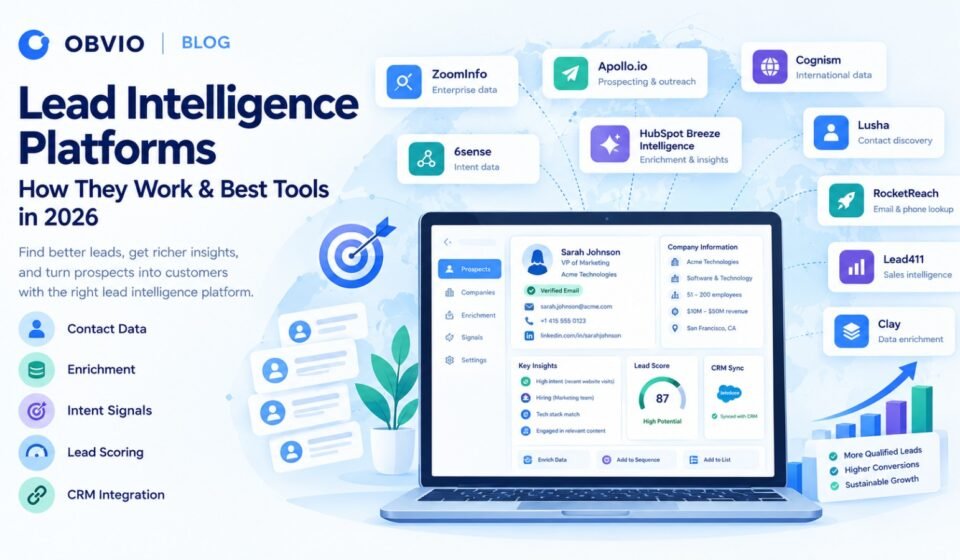
In 2026, the category includes everything from large B2B databases to enrichment platforms and tools focused on intent or account-level signals. Current industry comparisons commonly include platforms such as ZoomInfo, Apollo, Cognism, 6sense, HubSpot Breeze Intelligence, Lusha, RocketReach, Lead411, and Clay.
This guide explains what lead intelligence is, how these platforms work, what features matter, and how to choose the right solution for your business.
Quick Answer
A lead intelligence platform collects and enriches information about potential customers and companies.
Instead of relying only on a basic lead record such as:
John Smith — Marketing Manager — ABC Company
a lead intelligence system can add information such as:
- Company size
- Industry
- Job title
- Work email
- Phone number
- Technology used
- Company location
- Hiring activity
- Website activity
- Buying signals
- Intent information
- Lead or account score
The goal is to give sales teams enough context to decide which prospects deserve attention and why.
What Is a Lead Intelligence Platform?
A lead intelligence platform is software that helps businesses collect, organize, enrich, and analyze information about potential customers.
A traditional lead database may simply provide contact information.
A lead intelligence platform can go further by combining several types of information into one prospect or account view.
For example, a sales representative may discover that a target company:
- Matches the company’s ICP
- Recently expanded its marketing team
- Uses a relevant technology
- Has visited important website pages
- Has researched a related topic
- Has several decision-makers who match the target audience
That information can help the sales representative decide whether the account deserves immediate attention.
The exact capabilities differ between platforms, so businesses should evaluate tools based on the data and workflows they actually need.
How Does Lead Intelligence Work?
Most lead intelligence systems follow a process similar to this:
Collect → Enrich → Analyze → Score → Activate
1. Collect
The platform collects information about companies and contacts from available data sources.
This may include:
- Company websites
- Business directories
- Public professional information
- First-party website activity
- Technology information
- CRM records
- Other data providers
2. Enrich
The platform adds missing information to existing records.
For example, your CRM might contain:
Sarah Johnson — Acme Technologies
An enrichment workflow could add:
- Job title
- Work email
- Phone number
- Company size
- Industry
- Location
- Technology stack
This process is commonly called lead enrichment.
3. Analyze
The system can combine different data points to provide additional context.
For example:
Company fits ICP + relevant technology + recent website activity + hiring activity
This can indicate that an account deserves closer attention.
4. Score
Some platforms allow businesses to assign scores to leads or accounts.
A score can consider factors such as:
- Company size
- Industry
- Job title
- Geography
- Website activity
- Intent
- Engagement
- Technology
- Other ICP criteria
This makes it easier for sales teams to prioritize their prospect lists.
5. Activate
The final step is turning intelligence into an action.
Depending on the platform, this could mean:
- Sending the prospect to a CRM
- Adding the lead to a sales sequence
- Creating a sales task
- Alerting a salesperson
- Enriching an existing CRM record
- Adding the account to an advertising audience
The important point is that intelligence becomes useful when it can influence an actual sales or marketing workflow.
What Data Does a Lead Intelligence Platform Provide?
The exact data available depends on the provider and plan.
However, most platforms focus on several major categories.
Contact Data
Contact information may include:
- Name
- Job title
- Seniority
- Department
- Work email
- Phone number
- Professional profile
The Contact data helps answer:
Who should we contact?
Company Data
Company information can include:
- Company name
- Industry
- Employee count
- Revenue range
- Headquarters
- Locations
- Website
- Company growth information
The company data helps answer:
Is this company a good fit?
Firmographic Data
Firmographic data describes characteristics of an organization.
Common examples include:
- Industry
- Employee count
- Revenue
- Location
- Business type
- Company size
Sales teams can use these fields to filter prospects according to their ICP.
Technographic Data
Technographic data describes the technologies a company uses.
For example, a company may use:
- Salesforce
- HubSpot
- Shopify
- WordPress
- AWS
- Google Cloud
- Marketing automation software
Technographic information can be useful when your product is designed for companies using a particular technology.
Intent Data
Intent data attempts to identify signals that may indicate interest in a product, service, topic, or category.
For example, a company repeatedly researching a particular business problem may deserve more attention than an otherwise identical company showing no relevant activity.
Intent data should be treated as a signal rather than proof that a company is ready to buy.
Behavioral Signals
Behavioral signals can include activities such as:
- Website visits
- Content engagement
- Form submissions
- Product interactions
- Email engagement
- Other measurable digital activity
The availability of these signals varies by platform.
Lead Intelligence vs Contact Data
These terms are related but not identical.
Contact data answers:
Who is the person?
It may include:
- Name
- Phone
- Job title
- Company
Lead intelligence asks a broader question:
Who is this person, does their company fit our target market, and what information can help us prioritize the account?
Lead intelligence can therefore include contact data plus:
- Firmographics
- Technographics
- Intent
- Behavioral signals
- Company changes
- Lead scoring
- Enrichment
This is why a large contact database is not automatically the same thing as a complete lead intelligence platform.
Lead Intelligence vs Sales Intelligence
The two categories overlap heavily.
A lead intelligence platform generally focuses on understanding and enriching leads or accounts.
Sales intelligence can cover a wider sales process, including:
- Prospect research
- Account intelligence
- Contact data
- Buying signals
- Competitive information
- Relationship information
- Sales activity
- Pipeline insights
If you want to compare broader sales intelligence platforms, see our guide to the best B2B sales intelligence tools.
Lead intelligence can therefore be considered one important layer within a broader sales intelligence workflow.
Lead Intelligence vs Lead Scoring
The Lead intelligence and lead scoring also serve different purposes.
Lead intelligence provides information.
Lead scoring uses defined criteria to prioritize that information.
For example:
A lead intelligence system might discover that:
ABC Software has 200 employees, uses HubSpot, and recently hired a VP of Sales.
A scoring system could then assign a higher score because those characteristics match the company’s ICP.
If you are building a structured scoring system, our guide to ICP-based lead scoring provides a useful next step.
Why Do Businesses Use Lead Intelligence Platforms?
Better Prospecting
Sales representatives can search for prospects using multiple filters instead of manually researching every company.
Better Data Quality
Enrichment can help keep CRM records more complete.
Better Lead Prioritization
Sales teams can focus on prospects that better match their ICP or show relevant signals.
Less Manual Research
Instead of collecting company and contact information manually, teams can automate some parts of the research process.
Better Sales Timing
Intent and behavioral signals may help teams identify accounts showing relevant activity.
Better CRM Data
Lead intelligence platforms can enrich existing CRM records with additional information.
Best Lead Intelligence Platforms in 2026
There is no universal best platform. Different products focus on different parts of the lead intelligence workflow.
1. ZoomInfo
ZoomInfo is a major B2B data and intelligence platform with company and contact information alongside broader sales intelligence capabilities.
Best for
Larger organizations and enterprise sales teams.
Useful capabilities
- Contact data
- Company intelligence
- Firmographic information
- Intent signals
- Technographic information
- Account intelligence
- CRM integrations
The platform is particularly relevant for businesses that need a broad B2B intelligence system rather than a simple contact lookup tool.
2. Apollo.io
Apollo combines B2B prospect data with sales engagement capabilities.
Best for
Startups, agencies, SMBs, and mid-market sales teams.
Useful capabilities
- Prospect database
- Contact information
- Company data
- Search filters
- Enrichment
- Sales engagement
- CRM integrations
Apollo can be useful when a business wants prospecting and outreach functionality in one environment.
3. Cognism
Cognism focuses on B2B sales intelligence and international prospecting.
Best for
Organizations with international or European sales requirements.
Useful capabilities
- Contact data
- Company data
- Prospecting
- Enrichment
- Sales intelligence
- CRM integrations
Cognism also emphasizes compliance and data quality, which can be important for businesses operating across multiple markets.
4. 6sense
6sense focuses heavily on account intelligence, intent, predictive analysis, and account-based sales and marketing.
Best for
B2B revenue teams using account-based strategies.
Useful capabilities
- Intent data
- Account identification
- Predictive insights
- Account prioritization
- Buying-stage signals
- Sales and marketing activation
It is generally more relevant to teams that need account-level intelligence rather than simple contact lookup.
5. HubSpot Breeze Intelligence
HubSpot’s Breeze Intelligence brings data enrichment and intelligence capabilities into the HubSpot ecosystem.
Best for
Businesses already using HubSpot as their primary CRM and marketing platform.
Useful capabilities
- Data enrichment
- Company information
- Contact information
- CRM-based workflows
- Prospect research
The main advantage for existing HubSpot users is the ability to keep intelligence close to their existing CRM workflow.
6. Lusha
Lusha focuses on straightforward business contact discovery and prospecting.
Best for
Sales representatives and smaller teams that need quick contact research.
Useful capabilities
- Contact discovery
- Business emails
- Phone information
- Company data
- Prospecting
- CRM integrations
It can be a practical option when the primary requirement is finding business contacts rather than implementing a large account-intelligence system.
7. RocketReach
RocketReach is commonly used for finding professional contact information.
Best for
Individual contact research and prospect lookup.
Useful capabilities
- Email lookup
- Phone lookup
- Professional profiles
- Company information
- Contact discovery
It can be especially useful when a salesperson already knows the target person and needs additional contact information.
8. Lead411
Lead411 combines B2B contact information with additional sales intelligence and buying signals.
Best for
Sales prospecting and lead generation.
Useful capabilities
- Contact data
- Company information
- Prospecting
- Buying signals
- Sales intelligence
- CRM integration
This makes it relevant for teams that want more context than a basic contact database provides.
9. Clay
Clay takes a different approach to lead intelligence.
Instead of acting only as a traditional database, Clay can help teams combine and orchestrate information from multiple data sources.
Best for
RevOps and growth teams building customized enrichment workflows.
Useful capabilities
- Data enrichment
- Multiple data sources
- Automated workflows
- Prospect research
- Lead enrichment
- Custom GTM processes
Its flexibility can be useful for advanced users, although beginners may need more time to understand the workflow.
Lead Intelligence Platform Comparison
| Platform | Primary Strength | Contact Data | Enrichment | Intent/Signals | CRM/Workflow |
|---|---|---|---|---|---|
| ZoomInfo | Enterprise intelligence | Strong | Strong | Strong | Strong |
| Apollo.io | Prospecting + outreach | Strong | Available | Available | Strong |
| Cognism | International prospecting | Strong | Available | Available | Strong |
| 6sense | Account intelligence | Available | Available | Strong | Strong |
| HubSpot Breeze Intelligence | CRM-native intelligence | Available | Strong | Available | Strong |
| Lusha | Contact discovery | Strong | Available | Limited | Available |
| RocketReach | Contact lookup | Strong | Limited | Limited | Available |
| Lead411 | Sales prospecting | Strong | Available | Available | Available |
| Clay | Multi-source enrichment | Via sources | Strong | Via sources | Strong |
Features can vary by plan, region, integrations, and product configuration. Businesses should verify current vendor documentation before purchasing.
How to Choose a Lead Intelligence Platform
Choosing the right platform starts with your actual problem.
1. Define Your ICP
Before comparing software, define your ideal customer profile.
For example:
B2B SaaS companies with 50–500 employees in the United States, targeting VP-level marketing and sales decision-makers.
Your platform should make it easy to identify companies and contacts that match those criteria.
2. Decide What Data You Need
Ask whether you need:
- Email addresses
- Phone numbers
- Company data
- Technographic information
- Intent signals
- Website activity
- Lead scoring
- Data enrichment
- CRM synchronization
Do not pay for features your sales team will never use.
3. Test Data Against Your Market
This is one of the most important steps.
Take a sample of real target companies and compare several providers.
Check:
- Email accuracy
- Job-title accuracy
- Company information
- Geographic coverage
- Phone coverage
- Data freshness
- Duplicate records
A platform that performs well for one industry or country may perform differently for another.
4. Check CRM Integration
Your lead intelligence platform should fit your existing workflow.
If you use a CRM, check whether the platform can:
- Enrich records
- Push contacts
- Update fields
- Prevent duplicates
- Trigger workflows
- Sync relevant information
If your team is also evaluating CRM options, see our guide to the CRM for small B2B sales pipeline.
5. Understand Pricing
Look beyond the headline subscription price.
Check:
- User seats
- Credits
- Export limits
- Enrichment credits
- API access
- Data limits
- Contract length
- Additional integrations
A cheaper platform can become expensive if your team uses large volumes of data.
How Lead Intelligence Fits Into a B2B Sales Pipeline
Lead intelligence is most useful when connected to the complete sales process.
A simple workflow might look like this:
Define ICP
↓
Find matching companies
↓
Identify decision-makers
↓
Enrich contact information
↓
Check buying signals
↓
Score or prioritize accounts
↓
Send qualified leads to CRM
↓
Start relevant outreach
↓
Track engagement
↓
Update lead intelligence
This creates a continuous data loop rather than a one-time prospect list.
Common Lead Intelligence Mistakes
Choosing the Largest Database
A huge database does not guarantee that every record is accurate or relevant.
Focus on the quality of data for your target market.
Ignoring Data Freshness
Professional information changes frequently.
Old data can create:
- Email bounces
- Wasted sales time
- Incorrect personalization
- Duplicate CRM records
Treating Intent as a Guaranteed Purchase Signal
Intent can indicate interest, but it does not guarantee that a company is ready to buy.
Use intent alongside ICP fit and other evidence.
Buying Too Many Tools
A sales team can easily end up with separate tools for:
- Contact data
- Enrichment
- Intent
- Lead scoring
- CRM
- Outreach
- Analytics
Before adding another platform, determine whether an existing tool can solve the problem.
Focusing Only on Volume
More leads do not automatically mean more qualified opportunities.
A smaller list of relevant accounts can be more useful than thousands of poorly matched contacts.
Final Thoughts
A lead intelligence platform is more than a contact database.
The purpose is to combine contact information, company information, enrichment, behavioral signals, intent, and other data so sales and marketing teams can make better decisions.
Different platforms solve different problems.
ZoomInfo and similar enterprise platforms focus on broad B2B intelligence. Apollo combines prospecting with sales engagement. Cognism is relevant for international prospecting, while 6sense focuses heavily on account intelligence and intent. HubSpot Breeze Intelligence is particularly relevant to businesses already using HubSpot, while Clay provides a flexible approach to multi-source enrichment.
The right choice depends on your ICP, geography, sales process, CRM, data requirements, and budget.
Before purchasing, test the platform against real prospects from your own market.
The most useful lead intelligence system is not necessarily the one with the largest database. It is the one that gives your team reliable information they can actually use.
FAQs
What is a lead intelligence platform?
A lead intelligence platform collects and enriches information about potential customers and companies. It can combine contact data, company information, firmographics, technographics, intent signals, behavioral information, and other prospect intelligence.
What is the difference between lead intelligence and contact data?
Contact data tells you who a prospect is and how to contact them. Lead intelligence adds additional context that can help sales teams understand whether the prospect fits their target market and deserves attention.
What is the best lead intelligence platform?
There is no single platform that fits every business. ZoomInfo, Apollo, Cognism, 6sense, HubSpot Breeze Intelligence, Lusha, RocketReach, Lead411, and Clay serve different use cases.
Is lead intelligence useful for small businesses?
Yes. Small businesses can use lead intelligence to identify relevant companies, find decision-makers, enrich contact information, and prioritize prospects. However, smaller teams should avoid paying for advanced features they do not need.
Does lead intelligence replace a CRM?
No. A lead intelligence platform and CRM serve different purposes. Lead intelligence provides and enriches prospect information, while a CRM manages customer and sales relationships.
Is intent data the same as lead intelligence?
No. Intent data is one component of lead intelligence. Lead intelligence can include contact data, company data, firmographics, technographics, behavioral information, intent signals, and other information.
How should I evaluate a lead intelligence tool?
Start with your ICP and target market. Then test data accuracy, geographic coverage, enrichment capabilities, integrations, workflow compatibility, pricing, and data freshness using real prospects from your business.