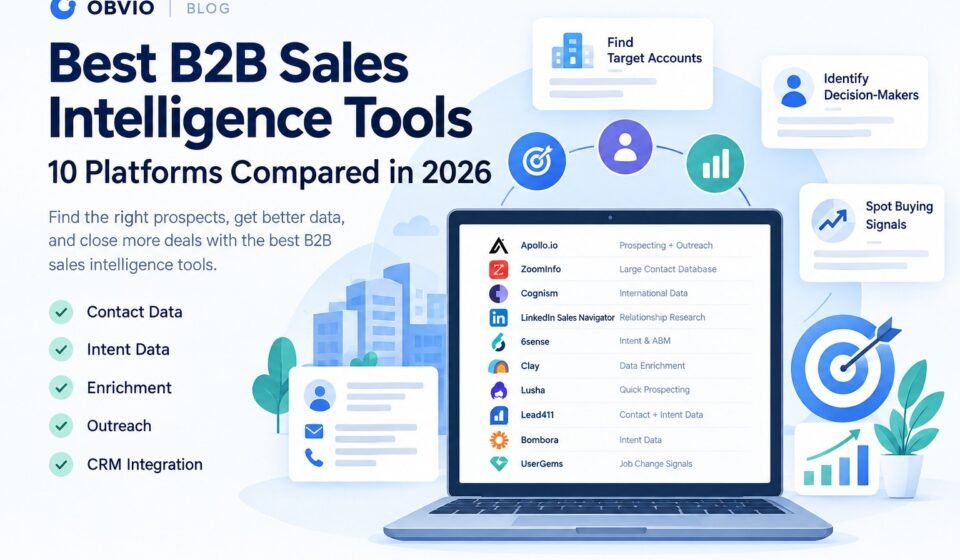

Finding the right prospects is one of the biggest challenges for B2B sales teams. Sales representatives can spend hours searching for companies, finding decision-makers, checking job titles, verifying contact information, and researching buying signals before they even send the first message.
This is where B2B sales intelligence tools can help.
These platforms collect and organize business information such as company details, employee information, job titles, contact data, buying signals, firmographic data, and other prospecting information. Some tools also provide outreach, CRM enrichment, intent data, or workflow automation.
But not every sales intelligence platform does the same thing.
Some are mainly large B2B contact databases. Others focus on buying intent, account-based marketing, data enrichment, or sales engagement.
In this guide, we compare some of the best B2B sales intelligence tools in 2026 and explain what each platform is best suited for.
Quick Answer: What Are the Best B2B Sales Intelligence Tools?
The best tool depends on your sales process, target market, budget, and the type of intelligence you need.
Here are some of the leading options:
| Tool | Best For | Main Strength |
|---|---|---|
| Apollo.io | Small and growing sales teams | Prospecting + data + outreach |
| ZoomInfo | Enterprise sales teams | Large B2B company and contact database |
| Cognism | European and international prospecting | Contact data and compliance-focused workflows |
| LinkedIn Sales Navigator | Account and relationship research | LinkedIn-based prospect discovery |
| 6sense | Enterprise ABM | Intent and predictive account intelligence |
| Clay | Data enrichment and workflows | Flexible enrichment and data orchestration |
| Lusha | Quick prospect lookup | Contact discovery |
| Lead411 | Prospecting and intent data | Contact data + buying signals |
| Bombora | Intent data | Third-party intent signals |
| UserGems | Contact and champion signals | Job-change and relationship signals |
These tools should not all be viewed as direct replacements for one another. Some solve different parts of the sales intelligence process.
What Is B2B Sales Intelligence?
B2B sales intelligence is the process of collecting and analyzing information about businesses and potential buyers to help sales teams identify better prospects.
A sales intelligence platform may provide information such as:
- Company size
- Industry
- Location
- Revenue estimates
- Employee count
- Job titles
- Business email addresses
- Phone numbers
- Technology used by a company
- Hiring activity
- Funding information
- Website activity
- Buying intent
- Job changes
- Company growth signals
The goal is not simply to collect a large database.
The goal is to help sales teams answer questions such as:
Which companies fit our ideal customer profile?
Who is the right decision-maker?
Which accounts may be actively looking for our solution?
Which prospects should our sales team contact first?
This makes sales intelligence an important part of modern B2B prospecting and revenue operations.
How Do B2B Sales Intelligence Tools Work?
Most platforms follow a similar basic process.
1. Collect business data
The platform gathers information about companies, employees, industries, locations, technologies, and other business attributes.
2. Organize and enrich the data
The information is structured into company and contact profiles.
Some platforms can also enrich records that already exist in your CRM.
3. Apply filters
Sales teams can usually search using criteria such as:
- Industry
- Company size
- Country
- Job title
- Revenue
- Technology
- Department
- Location
4. Identify potential buyers
The sales team creates a list of prospects that match its ideal customer profile.
5. Use additional signals
Some platforms provide signals such as:
- Website activity
- Intent data
- Funding events
- Hiring
- Job changes
- Technology changes
- Company growth
6. Send the information into a sales workflow
Depending on the platform, prospects can then be exported to a CRM, enriched, segmented, or added to an outreach sequence.
10 Best B2B Sales Intelligence Tools in 2026
1. Apollo.io
Apollo.io is one of the most practical options for small and growing B2B sales teams.
It combines prospect data with sales engagement capabilities, allowing users to research prospects and manage parts of the outreach process from the same platform.
Apollo is particularly useful for teams that don’t want to purchase separate tools for basic prospect discovery and outbound execution.
Best for
- Startups
- Small sales teams
- SDR teams
- Outbound prospecting
- Companies looking for an all-in-one workflow
Key strengths
- B2B contact discovery
- Company search
- Prospect filters
- Outreach workflows
- Sales engagement
- CRM-related workflows
Apollo’s biggest advantage is the combination of prospecting data and outreach functionality in one environment. Current comparisons also position Apollo as a strong option for startups and SMEs that want an integrated prospecting workflow.
Potential limitation
Teams with highly specialized data requirements may want to compare Apollo’s coverage with dedicated providers before making a decision.
2. ZoomInfo
ZoomInfo is one of the most established names in B2B sales intelligence.
It is particularly relevant to larger organizations that need extensive company and contact information, account intelligence, and additional go-to-market data.
Best for
- Enterprise sales teams
- Large outbound organizations
- Account-based sales
- Detailed company research
- Large prospect databases
Key strengths
- Company intelligence
- Contact discovery
- Account research
- Intent-related capabilities
- CRM enrichment
- Sales and marketing workflows
ZoomInfo is generally positioned toward organizations with larger sales and revenue operations requirements rather than teams looking for a simple low-cost prospecting tool.
Potential limitation
Pricing and packaging can be less straightforward than self-service platforms, so businesses should evaluate the total cost against the amount of data and functionality they actually need.
3. Cognism
Cognism is another major B2B data and sales intelligence platform.
It is particularly interesting for companies selling across Europe and other international markets where data quality, compliance, and phone data are important considerations.
Best for
- European sales teams
- International prospecting
- Compliance-conscious organizations
- Phone-based outbound sales
Key strengths
- B2B contact data
- Company information
- Phone data
- Prospecting
- CRM integrations
- Compliance-focused workflows
Recent 2026 comparisons frequently highlight Cognism for European and UK data coverage and compliance-focused prospecting.
Potential limitation
Cognism may be more than a small sales team needs if the company only requires occasional contact lookups.
4. LinkedIn Sales Navigator
LinkedIn Sales Navigator takes a different approach from traditional contact databases.
Instead of relying only on a large standalone database, it uses LinkedIn’s professional network to help sales professionals discover and research companies and decision-makers.
Best for
- Account research
- Relationship-based selling
- Finding decision-makers
- Social selling
- Enterprise prospecting
Key strengths
- Advanced lead search
- Company search
- Job-title filtering
- Account lists
- Lead recommendations
- Relationship intelligence
It is particularly useful when a sales representative wants to understand a prospect’s professional background before contacting them.
Potential limitation
Sales Navigator works best when it is part of a broader sales process. Teams may still need another source for email verification, phone numbers, enrichment, or automated outreach.
5. 6sense
6sense is better understood as an account intelligence and intent platform rather than simply a contact database.
It focuses heavily on identifying accounts that may be researching products or services and helping revenue teams prioritize those accounts.
Best for
- Enterprise B2B
- Account-based marketing
- Intent-driven sales
- Predictive account intelligence
- Large revenue teams
Key strengths
- Intent signals
- Account identification
- Predictive analytics
- ABM workflows
- Revenue intelligence
6sense is therefore a better fit for organizations that already have a defined sales process and want additional intelligence about which accounts should receive attention.
Potential limitation
Smaller teams that mainly need contact information may find a simpler prospecting platform more practical.
6. Clay
Clay has become particularly useful for teams that want to build flexible data-enrichment and prospecting workflows.
Rather than functioning like a traditional single-source contact database, Clay can be used to combine and orchestrate information from multiple data sources.
Best for
- RevOps teams
- GTM engineers
- Data enrichment
- Custom prospecting workflows
- Advanced outbound systems
Key strengths
- Data enrichment
- Workflow automation
- Multiple data sources
- Custom research
- AI-assisted workflows
Clay is especially useful when a company has a more advanced prospecting process and wants control over how data is collected and enriched.
Potential limitation
It can require more setup and technical understanding than a simple prospect database.
7. Lusha
Lusha focuses on making contact and company information easier to discover for sales and recruiting professionals.
It can be useful when a salesperson needs to quickly find information about a particular company or contact.
Best for
- Individual salespeople
- Small teams
- Quick prospect research
- Contact lookup
Key strengths
- Contact discovery
- Company information
- Prospecting
- Browser-based workflows
- Sales research
Potential limitation
Businesses with large enterprise requirements may need deeper account intelligence and more extensive data workflows.
8. Lead411
Lead411 combines B2B contact data with additional sales intelligence capabilities.
It can be useful for sales teams that want to identify contacts while also considering company and buying signals.
Best for
- B2B prospecting
- Sales teams
- Lead generation
- Intent-driven prospecting
Key strengths
- Contact information
- Company information
- Prospecting
- Buying signals
- Sales intelligence
Potential limitation
As with every contact database, teams should validate data quality for their specific industries and geographic markets before relying on it at scale.
9. Bombora
Bombora is best known for its focus on B2B intent data.
Rather than simply helping you find a person’s email address, intent platforms attempt to identify organizations showing interest in particular topics.
Best for
- Intent-based prospecting
- Account-based marketing
- Demand generation
- Enterprise revenue teams
Key strengths
- Intent signals
- Account research
- Topic-level intelligence
- ABM support
Potential limitation
Intent data is most useful when your team already has a clear ICP and sales process.
If you don’t know which companies you want to sell to, collecting intent signals will not solve the underlying targeting problem.
10. UserGems
UserGems focuses on relationship and people-based buying signals, including job changes and other events that can create new sales opportunities.
This can be valuable when a company has already built a customer or prospect network and wants to identify new opportunities from those relationships.
Best for
- Customer expansion
- Champion tracking
- Job-change signals
- Relationship-based selling
Key strengths
- Job-change alerts
- Contact signals
- Customer relationship intelligence
- Prospect identification
Potential limitation
It is more specialized than an all-purpose contact database.
B2B Sales Intelligence Tools Compared
The most important thing is to choose a platform according to the job you need it to perform.
| Tool | Contact Data | Intent Data | Enrichment | Outreach | Best For |
|---|---|---|---|---|---|
| Apollo.io | Strong | Available | Available | Strong | SMB & mid-market |
| ZoomInfo | Strong | Strong | Strong | Available | Enterprise |
| Cognism | Strong | Available | Available | Available | International/Europe |
| LinkedIn Sales Navigator | Strong | Limited | Limited | Limited | Relationship research |
| 6sense | Available | Strong | Strong | Available | ABM |
| Clay | Via integrations | Via sources | Strong | Via workflows | RevOps |
| Lusha | Strong | Limited | Available | Limited | Quick prospecting |
| Lead411 | Strong | Strong | Available | Available | B2B prospecting |
| Bombora | Limited | Strong | Available | Limited | Intent data |
| UserGems | Contact signals | Strong signals | Available | Via integrations | Job-change signals |
The table should be treated as a high-level comparison because the exact features and availability can vary by plan and change over time.
How to Choose the Right B2B Sales Intelligence Tool
Don’t choose a platform simply because it has the largest database.
Start with your sales process.
1. Define your ICP
Before buying a sales intelligence platform, determine:
- Target industry
- Company size
- Revenue range
- Geography
- Job titles
- Technology requirements
- Business model
This connects directly with your ICP-based lead scoring strategy.
For example, if your ideal customers are SaaS companies with 50–500 employees, your sales intelligence platform should make it easy to identify companies matching those criteria.
2. Check geographic coverage
Data quality can vary significantly between countries.
A tool that works well for US prospecting may not be the best choice for European or other international markets.
Always test your actual target market before committing to a platform.
3. Compare data quality
Don’t only ask:
How many contacts are in the database?
Ask:
How accurate are the contacts that match my ICP?
Important checks include:
- Email accuracy
- Phone accuracy
- Job-title accuracy
- Company information
- Data freshness
- Duplicate records
- Geographic coverage
4. Check CRM integrations
A sales intelligence tool becomes much more useful when it connects properly with your CRM.
Look for integrations with the CRM and sales tools your team already uses.
5. Consider intent signals
If your sales process is account-based, intent data may be more valuable than simply having millions of contacts.
For example:
A database might tell you:
John is VP of Marketing at Company A.
Intent intelligence may help answer:
Is Company A currently researching marketing automation software?
That second piece of information can significantly improve prioritization.
6. Consider your budget
The most expensive platform isn’t automatically the best.
Small teams may benefit from a simpler platform with transparent pricing and prospecting capabilities, while enterprise organizations may need deeper account intelligence and integrations.
Sales Intelligence vs Contact Data
These terms are often used interchangeably, but they are not exactly the same.
Contact data
Contact data answers:
Who can I contact?
It may include:
- Name
- Job title
- Phone
- Company
Sales intelligence
Sales intelligence answers a broader question:
Which prospects should I contact, why should I contact them, and when should I contact them?
It may combine:
- Contact information
- Company information
- Firmographics
- Intent signals
- Job changes
- Technology data
- Funding events
- Website activity
- Account signals
This is why a sales intelligence platform can be more valuable than simply purchasing a large contact list.
Sales Intelligence vs Revenue Intelligence
The Sales intelligence and revenue intelligence are related, but they aren’t identical.
Sales intelligence is generally focused on helping sales teams understand prospects and accounts.
Revenue intelligence takes a broader view of the revenue process.
Revenue intelligence may combine:
- Sales activity
- Pipeline data
- CRM information
- Customer interactions
- Forecasting
- Buyer signals
- Deal information
- Marketing and sales data
Your existing article on Top Revenue Intelligence Platforms for B2B Sales can therefore serve as the next step for readers who want to understand the broader revenue intelligence category.
Common Mistakes When Choosing Sales Intelligence Software
Choosing the largest database
More records do not automatically mean better prospecting.
Your priority should be relevant and usable data.
Ignoring data freshness
People change jobs.
Companies change addresses.
Phone numbers change.
Departments change.
Data freshness matters.
Buying too many tools
A company may purchase:
- Contact database
- Enrichment platform
- Intent platform
- Email finder
- Outreach platform
- CRM
- Data-cleaning tool
The result can be an expensive and complicated sales stack.
Before buying another platform, determine whether your current tools already solve the problem.
Ignoring your ICP
A sales intelligence platform cannot compensate for a poorly defined target market.
The first step should always be understanding who your ideal customer is.
Focusing only on price
The cheapest platform isn’t necessarily the best value.
The better question is:
How much useful pipeline can this tool help create compared with its total cost?
What Is the Best B2B Sales Intelligence Tool?
There is no universal winner.
For a small or growing B2B sales team, Apollo.io can be an attractive starting point because it combines prospecting data and outreach capabilities.
For enterprise organizations, ZoomInfo may be more suitable when extensive company and contact intelligence is required.
Or for European and international prospecting, Cognism is worth considering because of its emphasis on international data and compliance.
For relationship-driven prospecting, LinkedIn Sales Navigator can be especially useful.
Or for ABM and intent-driven sales, 6sense is a stronger fit.
For advanced data enrichment and GTM workflows, Clay can be more flexible.
The best choice depends on your ICP, geography, sales motion, required data, integrations, and budget.
Final Thoughts
The best B2B sales intelligence tools do more than provide lists of email addresses.
They help sales teams understand companies, identify the right decision-makers, prioritize accounts, and build more targeted prospecting workflows.
Before choosing a platform, define your ideal customer profile, identify the type of intelligence you actually need, test data quality in your target market, and compare integrations and total costs.
For most teams, the right platform is not necessarily the one with the biggest database. It is the one that provides the most useful intelligence for the prospects you actually want to sell to.
If you are building a modern B2B sales stack, sales intelligence should also work alongside your CRM, lead-scoring process, and revenue intelligence system rather than operating as a completely separate tool.
Frequently Asked Questions
What is a B2B sales intelligence tool?
A B2B sales intelligence tool helps sales teams research companies and prospects using information such as contact data, company details, firmographics, buying signals, and other business intelligence.
What is the best B2B sales intelligence tool?
There is no single best option for every company. Apollo, ZoomInfo, Cognism, LinkedIn Sales Navigator, 6sense, Clay, and other platforms serve different sales intelligence needs.
Are sales intelligence tools the same as contact databases?
No. Contact databases primarily provide information about people and companies. Sales intelligence platforms can go further by providing intent signals, account insights, enrichment, and other information that helps sales teams prioritize prospects.
Are B2B sales intelligence tools worth it?
They can be valuable when a company has a clearly defined ICP and a repeatable sales process. They are less useful when a business has not yet defined its target customers or sales strategy.
How do I choose a sales intelligence platform?
Compare the platform’s data quality, geographic coverage, ICP filters, integrations, intent capabilities, workflow features, pricing, and overall fit with your sales process.


[…] If you want to compare the leading platforms in this category, see our guide to the best B2B sales intelligence tools. […]