
In today’s times, data is one of the most precious resources for businesses. Information is gathered by companies from their websites, applications, clients, selling systems, social media platforms, IoT devices, and other sources. Nevertheless, it is just the beginning of data management since it is essential to have a powerful tool and service that will help to get something meaningful from collected information.
And here is where professional data analytics companies enter the scene. They assist businesses in gathering, structuring, visualizing, analyzing, and interpreting their information.
These players include large tech companies, consulting firms, cloud platforms, business intelligence companies, and specific analytics software vendors. While some deal with the overall enterprise infrastructure in place of data, others deal with visualization, predictive analytics, artificial intelligence (AI), automation, and specific industry-focused products.
This article will examine some of the major players in the data analytics space, what they do, who they cater to, and how businesses can select the right vendor for their needs.
What Are Data Analytics Companies?
Data analytics firms offer tools, platforms, consultancy, and even managed services that assist organizations in comprehending their data.
The services that these firms offer could include:
- Data collection
- Data integration
- Data cleaning
- Data storage
- Data visualization
- Business intelligence
- Predictive analytics
- Machine learning
- Artificial intelligence
- Reporting and dashboards
- Data governance
- Automation
For instance, a shop could apply analytics to establish its top-selling products. Similarly, hospitals can use analytics to study patients’ details for better planning. Also, a financial institution can use predictions to uncover threats.
Ultimately, the common aim here is to convert data into information that would guide decision-making.
According to IBM data analytics include the following features: statistics, predictions, interactive dashboards, machine learning, and business intelligence with AI.
Why Data Analytics Matters for Businesses
Businesses generate more data than ever before. The challenge is no longer simply finding data. It is finding the right information and understanding it quickly.
Effective analytics can help organizations:
- Identify changing customer behavior
- Improve operational efficiency
- Monitor business performance
- Forecast future demand
- Reduce unnecessary costs
- Discover new revenue opportunities
- Improve marketing campaigns
- Detect potential risks
- Personalize customer experiences
- Support strategic planning
There is also an impact of AI on analytics. Newer analytics software solutions support the capability to pose queries in natural language, auto-generate graphics, find trends and receive predictive suggestions.
As IBM mentions, there is potential for AI to assist in analyzing big data, improving efficiency of analysis and making it available for more users.
List of the Top Data Analytics Companies
There is no company that would suit all organizations. It is important to consider a variety of factors before making the decision.
Here are some of the most important companies that you should look into.
1. IBM
IBM is one of the most established technology companies in the enterprise analytics market.
The product offerings range from business intelligence, data management, artificial intelligence, predictive analytics, reporting and governance. IBM Cognos Analytics, for instance, has governance-enabled business intelligence, dashboards, reporting, interactive visualization and AI-based features.
IBM also focuses heavily on data intelligence. Its current data intelligence solutions emphasize areas such as:
- Data governance
- Data quality
- Data lineage
- Data discovery
- Data sharing
- AI-ready data
That is why IBM is especially fit for big companies requiring analytics coupled with governance, security, and enterprise data management.
Best for: Big businesses, regulated sectors, business intelligence, AI, and complicated data environments.
2. Accenture
Accretive Analytics provides consulting and technology services across the world with a key emphasis on data, AI, cloud computing, and digital transformation.
Accretive Analytics does not just provide one analytics solution but helps businesses create and implement their data strategy and data environment.
Its data services include activities such as:
- Data assessment
- Cloud data migration
- Modern data platform development
- Data governance
- AI and machine learning
- Data product development
- Analytics and automation
Data readiness is crucial prior to scaling up efforts in Artificial Intelligence, according to Accenture.
Best for: Companies requiring consulting, implementation, cloud migration, and big data/AI projects.
3. Deloitte
Another such consulting firm is Deloitte, which provides services related to data engineering, analytics, AI, and business transformation.
Their methodology integrates consulting capabilities and latest analytics technologies. Deloitte assists firms in transforming their data ecosystems, improving data quality, developing analytics skills, and using AI to drive business insights.
Their data engineering and analytics solutions emphasize building reliable data ecosystems capable of supporting large-scale AI and analytics.
Best fit for: Companies that need consulting, data transformation, analytics strategy, governance, and AI.
4. Databricks
Databricks has emerged as a prominent player in modern data and AI infrastructure.
Its Data Intelligence Platform offers a framework for data engineering, analytics, data science, and AI. According to Databricks, its platform is described as a unified analytics framework that facilitates building, deploying, sharing, and managing enterprise data, analytics, and AI applications.
The data lakehouse is one of the key concepts introduced by Databricks; it combines the characteristics of data lakes and data warehouses.
Companies can use Databricks for:
- Data engineering
- Data science
- Machine learning
- Business analytics
- Generative AI
- Data governance
- Large-scale data processing
Best for: Data-intensive companies, data engineering teams, AI projects, and organizations building modern cloud data platforms.
5. Palantir
Palantir specializes in data integration, analytics, artificial intelligence, operational decisions, and enterprise applications.
The platforms offer functionalities that enable data connection, modeling, artificial intelligence app creation, analytics, and operation workflow management. The capabilities mentioned in Palantir’s current documentation include artificial intelligence, data connectivity, model development, ontology building, analytics, security, governance, and application development.
Palantir can prove especially helpful where organizations have to integrate complicated data sets into operational intelligence.
Useful in: Large enterprises, government-related applications, industrial operations, complicated decision-making scenarios, and artificial intelligence applications.
6. SAP
Enterprise software by SAP is popular, but SAP analytics ecosystem holds much weight.
SAP Analytics Cloud is a combination of BI, augmented analytics, predictive analytics, and enterprise planning on the cloud.
Existing users of SAP software will benefit from SAP analytics, as analytics can be integrated with the business application and trusted enterprise data.
Common applications include:
- Financial planning
- Supply chain analytics
- Sales reporting
- Operational analytics
- Predictive analysis
- Business intelligence
- Enterprise planning
Best for: Businesses already using SAP and enterprises seeking integrated business analytics and planning.
7. Oracle
The Oracle has an extensive set of data analytics solutions for businesses of varying sizes.
Oracle Analytics Cloud provides data preparation, visualization, enterprise reporting, augmented analytics, and natural language processing functionalities.
This platform also offers functionalities assisted by AI that could assist you in creating visualizations and data exploration without much coding.
Oracle is especially important for companies that already have Oracle databases or cloud services or other Oracle enterprise solutions.
Best for: Enterprises, Oracle clients, cloud-based analytics, business intelligence, and AI-powered analytics.
8. Alteryx
Alteryx stands out as a leader in terms of automation and self-service analytics.
This model is especially beneficial to those firms that have the task of collecting, preparing, transforming, and creating repeatable analytical workflows from disparate data sources.
Typical use cases include:
- Data preparation
- Data blending
- Workflow automation
- Predictive analytics
- Business intelligence
- Reporting
- Analytics automation
Alteryx is most compelling for business analysts who require the ability to manipulate data in complex ways without having to construct each workflow manually using programming methods.
Best suited for: Analysts, business users, data manipulation, automation, and analytic workflow repetition.
9. Qlik
The Qlik offers data integration and analytics tools that are specifically created to help businesses analyze their information.
Qlik Cloud Analytics covers various applications including self-service analytics, interactive dashboards, conversational analytics, reporting, alerting, and AI.
Qlik is built for different kinds of users, such as business analysts and non-techies.
Best used for: Self-service analytics, interactive dashboards, data discovery, and companies aiming to increase data literacy.
10. Tableau
Tableau is one of the well-known software in the field of data visualization and business intelligence.
The key point about it is the ease with which complex data can be visually explored. As Tableau claims, its analytics methodology is based on visual analytics, enabling exploratory analysis via visualization.
Businesses commonly use Tableau for:
- Interactive dashboards
- Sales analytics
- Marketing analytics
- Financial reporting
- Customer analytics
- Operational reporting
- Executive dashboards
Best for: Organizations that prioritize visualization, dashboards, self-service analytics, and business reporting.
Big Data Analytics Companies: What Makes Them Different?
Also, “Big data analytics companies” is used to refer to companies that can help process and analyze massive or complex data.
Big data projects could include data from:
- Websites
- Mobile applications
- IoT devices
- Social media
- Customer databases
- Enterprise applications
- Transaction systems
- Sensors
- Cloud platforms
The core issue lies in scale.
While a small spreadsheet can be analyzed by hand, billions of entries necessitate unique infrastructure and distributed computing.
There are various firms that can provide this infrastructure, including IBM, Databricks, Oracle, Palantir, and other enterprise technology firms.
When evaluating a big data provider, businesses should consider:
- Scalability – Can the platform scale with increased volume of data?
- Performance – Can the platform perform data processing fast enough?
- Integration – Can the platform integrate with other applications and systems?
- Security – Does the platform have proper access control mechanisms?
- Governance – Does the platform allow organizations to govern data consumption?
- AI abilities – Can the platform facilitate machine learning and other AI functions?
- Price – Is the pricing structure sustainable?
Healthcare Data Analytics Companies
The healthcare industry is another area where data analytics can make a substantial difference.
Healthcare institutions generate huge volumes of information such as records of patients, operational information, financial information, medical information, staff information, and resource utilization information.
Data analytics firms in the healthcare industry assist organizations in analyzing information for various reasons including:
- Hospital operations
- Resource planning
- Patient engagement
- Medical research
- Financial management
- Risk analysis
- Workforce planning
- Population health
- Predictive analytics
There is also the issue of healthcare analytics that must take into account privacy, security, governance, and regulations.
In this respect, healthcare organizations need to consider more than just dashboards and AI when selecting their analytics vendor.
The large enterprises that include IBM, Oracle, Deloitte, and Accenture may have something to offer to healthcare organizations, since they combine data management, analytics, AI, consulting, and enterprise implementation.
Top Data Analytics Companies for Event Insights
There is always a unique set of data created by events. It could consist of ticket sales, registrations, attendees, website visits, apps usage, surveys, social media activities, and more.
When it comes to the search of the best data analytics firms in the case of events for businesses, the most appropriate option is not necessarily the biggest tech firm around.
Event organizers can use analytics to understand:
- Which marketing channels generate registrations
- Which sessions attract the most attendees
- Where attendees spend the most time
- Which speakers receive the most engagement
- How ticket sales change over time
- Which customer groups are most valuable
- What attendees think about the event
- Whether sponsorships are producing results
A Simple Event Analytics Process
Step 1: Collect the data
Collect registration, ticket, website, social media, survey, and attendance data.
Step 2: Combine the data
Link various sources in order for the organization to be able to analyze the data collectively.
Step 3: Clean the information
Eliminate duplicates, correct mistakes, and unify all fields.
Step 4: Build dashboards
Construct dashboards containing vital metrics including attendance, revenues, engagement, and conversion rates.
Step 5: Identify patterns
Identify trends related to customer behavior, registration, participation, and performance at events.
Step 6: Take action
Use your conclusions to refine marketing strategies, pricing, timing, speakers, content, and overall experiences for attendees in the future.
Tools like Tableau, Qlik, Oracle Analytics, and IBM analytics solutions are helpful in case an event company requires dashboards and business intelligence.
How to Choose the Right Data Analytics Company
Choosing between various data analytics companies is challenging as there exist significant differences in their capabilities and structures.
Follow this process to filter out the best.
Step 1: Define Your Business Goal
Start with the problem rather than the technology.
Ask:
- What do we want to understand?
- What decisions should analytics improve?
- Which business process needs improvement?
- What data do we already have?
This is an example of “We need analytics.”
However, “We would like to reduce customer churn by recognizing the customers who are most likely to leave” would be a better goal.
Step 2: Identify Your Data Sources
List your current data sources.
These could include:
- CRM software
- ERP systems
- Databases
- Website analytics
- Advertising platforms
- Social media
- Mobile applications
- Spreadsheets
- Customer support systems
The provider you choose should be able to work with your most important sources.
Step 3: Decide Between Software and Consulting
Some companies primarily provide software platforms.
Others provide consulting and implementation services.
You may need:
- A ready-to-use analytics platform
- Custom analytics development
- Data engineering
- Cloud migration
- AI implementation
- Analytics consulting
- Managed analytics services
Large enterprises often need a combination of several services.
Step 4: Evaluate Scalability
Your analytics system should be able to grow with your business.
Consider:
- Number of users
- Data volume
- Number of data sources
- Expected future growth
- Real-time requirements
- International operations
A solution that works for 20 employees may not be appropriate for 20,000 employees.
Step 5: Check Security and Governance
Data analytics often involves sensitive business information.
Check whether the provider supports:
- Role-based access
- Data encryption
- Audit controls
- Data lineage
- Governance
- Compliance requirements
- Secure cloud infrastructure
This is particularly important for finance, healthcare, government, and other regulated sectors.
Step 6: Compare AI and Automation Features
Modern analytics is increasingly connected to AI.
Look for features such as:
- Predictive modeling
- Natural-language queries
- Automated insights
- AI assistants
- Machine learning
- Automated reporting
- Intelligent recommendations
However, AI should solve a genuine business problem rather than simply being included as a marketing feature.
Data Analytics Company Comparison
| Company | Main Strength | Best For |
|---|---|---|
| IBM | Enterprise analytics and AI | Large organizations |
| Accenture | Data and AI consulting | Digital transformation |
| Deloitte | Consulting and data engineering | Enterprise transformation |
| Databricks | Data and AI platform | Data-intensive organizations |
| Palantir | Operational analytics and AI | Complex data environments |
| SAP | Business analytics and planning | SAP customers |
| Oracle | Enterprise analytics | Oracle ecosystems |
| Alteryx | Analytics automation | Analysts and business teams |
| Qlik | Self-service analytics | Data discovery |
| Tableau | Data visualization | Dashboards and BI |
This table should be viewed as a general guide rather than a ranking. The “best” provider depends on the organization’s specific requirements.
Benefits of Working With Data Analytics Providers
The benefits that come along with having a robust platform or provider for analytics are many.
Faster Decision-Making
One no longer needs to manually extract data from various spreadsheets and software solutions.
Better Forecasting
Predictive analytics enables businesses to discover possible trends and plan for upcoming demand.
Improved Efficiency
Analytics helps in finding out bottlenecks, unneeded spending, and inefficiencies.
Better Customer Understanding
Data about customers helps in identifying their buying patterns, preferences, engagement levels, and possible risks of churn.
More Effective Marketing
Marketers can compare different media, campaigns, audiences, and conversion rates to figure out what works best.
Stronger Strategic Planning
Executives can base their decisions on reliable information about their businesses.
Common Mistakes to Avoid
Choosing an analytics provider without proper planning can create unnecessary costs.
Avoid these mistakes:
- Choosing a platform only because it is popular
- Ignoring data quality
- Focusing on AI before fixing data foundations
- Failing to define business objectives
- Underestimating implementation requirements
- Ignoring security and governance
- Buying more features than the organization needs
- Not training employees
- Creating dashboards without clear KPIs
- Failing to measure the business impact
A successful analytics project is not simply about installing software. It requires good data, clear objectives, appropriate technology, skilled users, and an ongoing improvement process.
The Future of Data Analytics
Analytics of the future are intrinsically related to artificial intelligence, automation, cloud computing, and real-time analytics.
Conventional analytics entailed building up reports by the users and investigating the information manually. Contemporary solutions, however, are progressively leaning towards conversations and automation.
For instance, Oracle Analytics Cloud provides an option for AI-enabled visualization and conversational analytics, whereas IBM is integrating generative AI and agentic capabilities into business intelligence.
Data bricks is also integrating data lakehouse capabilities with AI and natural language interaction.
Some of the trends expected to influence the industry include:
- AI-powered analytics
- Natural-language data queries
- Automated data preparation
- Real-time analytics
- Predictive decision-making
- Data intelligence
- Cloud-native analytics
- AI agents
- Greater data governance
- Embedded analytics inside business applications
This signifies that analytics is shifting from just explaining what has happened to understanding what could happen next and the options they have.
Frequently Asked Questions
What are the top data analytics companies?
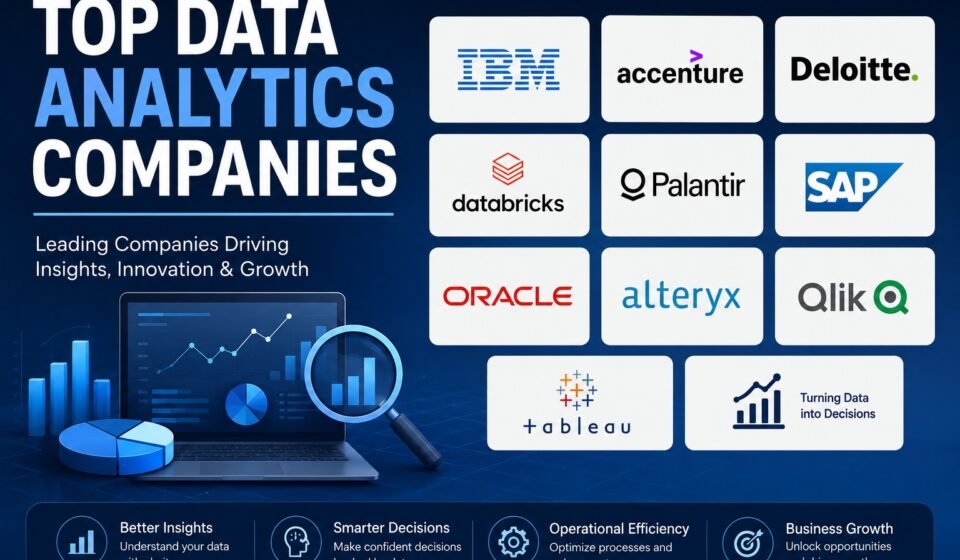
The most commonly known vendors in the field are IBM, Accenture, Deloitte, Databricks, Palantir, SAP, Oracle, Alteryx, Qlik, and Tableau. They each have their advantages, making your decision dependent on what your company requires.
Which company is best for big data analytics?
No single product wins across the board. Databricks is especially pertinent to contemporary large-scale big data and AI workloads, but IBM, Oracle, Palantir, and others are more general with their capabilities for analytics, data management, AI, and enterprise products.
What do data analytics companies do?
They deliver software and platforms, consulting or services, which assist enterprises in collecting, preparing, integrating, analyzing, visualizing, and interpreting data.
Are healthcare data analytics companies different from general analytics providers?
They can be. Health analytics demands extra care in dealing with confidential information, privacy, security, and healthcare-related processes. It is therefore important to assess not only the analytics capabilities but also the health requirements.
Which analytics company is best for dashboards?
Tableau is particularly well recognized for data visualization and dashboards. Qlik, IBM, Oracle, SAP, and other solutions offer dashboards and business intelligence functionality.
Can small businesses use enterprise analytics platforms?
Yes. Yet, small businesses need to take into account implementation difficulty, pricing, user requirements, and scalability.
Is AI necessary for data analytics?
No. Traditional business intelligence, reporting, visualization, and statistics may provide businesses with huge benefits. Yet, AI may make analytics faster and easier due to the possibility of automation, natural language processing, prediction, and insight extraction.
How do I choose among data analytics companies?
Begin by stating your objectives and sources of data. After that, compare integration abilities, security, scalability, AI functions, usability, implementation needs, pricing, and support for the customers.
Conclusion
This market for data analytics spans from worldwide consultancy firms to specialized software companies. IBM, Accenture, Deloitte, Databricks, Palantir, SAP, Oracle, Alteryx, Qlik, and Tableau all have their unique advantages.
The best service provider would entirely depend on what your firm is looking to achieve. A big company may require data engineering, governance, cloud services, and artificial intelligence solutions. The marketing team may only require visualization and insight. The healthcare firm may be concerned with security and compliance issues. The event firm may focus on registration, attendance, and customer engagement.
The secret lies in starting with the business challenge and following up by identifying the technology that addresses the challenge.
With AI and automation advancing further, analytics will play an increasingly central role in the business decision-making process. Businesses which lay good foundations today will be in a position to utilize predictive analytics, AI, and real time insight tomorrow.
To summarize, the best data analytics companies are not always the same for all businesses. The ideal company should combine dependable technology, good data management, valuable analytics, security, scalability, and business value.