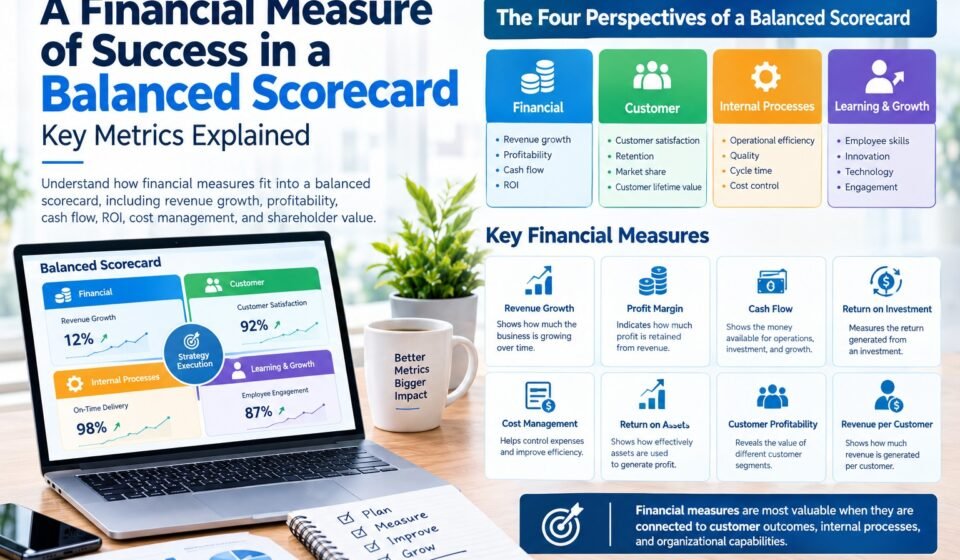

Financial performance is one of the most important ways businesses evaluate whether their strategies are producing results. Revenue, profit, cash flow, costs, and return on investment can tell management whether the organization is creating financial value.
However, financial results alone do not always explain why performance is improving or declining.
This is where the balanced scorecard becomes useful. A balanced scorecard places financial measures alongside customer, internal-process, and learning-and-growth or organizational-capacity measures to create a broader view of organizational performance.
Understanding a financial measure of success in a balanced scorecard therefore requires looking at both financial outcomes and the strategic activities that influence those outcomes.
This article explains the financial perspective, important financial measures, how to choose the right KPIs, and how financial metrics can be connected with the other balanced scorecard perspectives.
What Is the Financial Perspective of a Balanced Scorecard?
The financial perspective focuses on the organization’s financial performance and use of financial resources.
For a private-sector company, financial objectives may include:
- Increasing revenue
- Improving profitability
- Reducing costs
- Increasing cash flow
- Improving return on investment
- Increasing shareholder value
- Improving asset utilization
The exact objectives depend on the organization’s strategy.
The Balanced Scorecard Institute identifies the financial perspective as one of the core perspectives of the balanced scorecard and explains that it assesses financial performance and how effectively financial resources are used.
For more background, you can review The Four Perspectives of the Balanced Scorecard from the Balanced Scorecard Institute.
Why Are Financial Measures Important?
Financial measures provide information about the results of business activity.
For example, a company may invest heavily in:
- Marketing
- Employee training
- Technology
- Product development
- Customer service
- Process improvements
Eventually, management needs to understand whether those investments are contributing to the organization’s strategic and financial objectives.
Financial metrics can help answer questions such as:
- Is revenue increasing?
- Are profit margins improving?
- Are costs under control?
- Is the company generating sufficient cash?
- Are investments producing acceptable returns?
- Is the business using its assets effectively?
However, financial measures generally describe outcomes rather than all of the activities that produce those outcomes.
That is one reason the balanced scorecard includes additional perspectives.
Harvard Business Review’s The Balanced Scorecard—Measures that Drive Performance explains the limitation of relying exclusively on traditional financial measures and the need for broader performance indicators.
What Is a Financial Measure of Success in a Balanced Scorecard?
There is no single financial metric that works for every organization.
The appropriate measure depends on the company’s strategy, industry, lifecycle stage, and financial objectives.
For example, a growing company may prioritize revenue growth and market expansion, while a mature organization may focus more heavily on profitability, cash generation, and return on capital.
Common financial measures include:
- Revenue growth
- Net profit margin
- Operating profit
- Gross margin
- Cash flow
- Return on investment
- Return on assets
- Economic value
- Cost reduction
- Revenue per customer
The important point is that the measure should be connected to a strategic objective.
1. Revenue Growth
Revenue growth is one of the most straightforward financial measures.
It shows whether the organization is increasing the amount of revenue it generates over time.
For example:
Previous-year revenue: $10 million
Current-year revenue: $12 million
Revenue growth: 20%
Revenue growth can be useful for companies pursuing market expansion, new customers, new products, or geographic growth.
However, revenue growth should not be viewed in isolation.
A company can increase revenue while simultaneously experiencing declining margins or negative cash flow.
Therefore, revenue is often more useful when evaluated alongside profitability and cash-flow measures.
2. Profit Margin
Profit margin measures how much profit remains after relevant costs are deducted from revenue.
A basic net profit margin can be calculated as:
Net Profit Margin = Net Profit ÷ Revenue × 100
For example, if a company generates $5 million in revenue and $500,000 in net profit:
$500,000 ÷ $5,000,000 × 100 = 10%
The company has a 10% net profit margin.
Profitability can help management understand whether revenue is translating into financial returns.
Different businesses may use different profitability measures, including:
- Gross profit margin
- Operating profit margin
- Net profit margin
- EBITDA margin
The appropriate metric depends on the organization’s strategy and reporting requirements.
3. Operating Costs
Cost management is another common financial objective.
Organizations may want to reduce unnecessary expenses while maintaining product quality and customer experience.
Possible measures include:
- Total operating costs
- Cost per unit
- Cost per customer
- Cost-to-revenue ratio
- Administrative expenses
- Production costs
- Customer acquisition costs
A reduction in costs can improve profitability, but cost reduction should not automatically be considered positive.
For example, cutting customer support costs could reduce expenses while also damaging customer satisfaction and retention.
A balanced scorecard helps organizations examine these relationships rather than looking at financial results separately.
4. Cash Flow
Profitability and cash flow are not the same thing.
A business can report accounting profit while experiencing cash-flow pressure.
Cash-flow measures can therefore provide another important view of financial performance.
Common measurements include:
- Operating cash flow
- Free cash flow
- Cash conversion
- Cash-flow growth
- Cash-flow margin
Cash flow can be especially important for businesses that require significant working capital or investment.
Management can use cash-flow information to understand whether the organization’s operations are generating sufficient financial resources.
5. Return on Investment
Return on investment, commonly called ROI, measures the return generated from an investment relative to its cost.
A basic calculation is:
ROI = Net Return ÷ Investment Cost × 100
For example, if a company invests $100,000 in a project and generates $125,000 in net return:
$125,000 ÷ $100,000 × 100 = 125%
The exact calculation used in business reporting can vary depending on how return and investment are defined.
ROI can be useful when comparing investments, projects, campaigns, or strategic initiatives.
However, organizations should consider the timeframe and assumptions behind the calculation.
6. Return on Assets
Return on assets, or ROA, measures how effectively an organization generates profit from its asset base.
A simplified formula is:
ROA = Net Income ÷ Average Total Assets × 100
For businesses with substantial physical or financial assets, ROA can provide useful information about asset utilization.
It can help management examine whether investments in assets are contributing appropriately to financial performance.
7. Customer Profitability
Not all customers contribute the same amount of financial value.
A company may generate significant revenue from a customer while also spending heavily to acquire, serve, or retain that customer.
Customer profitability can therefore be a useful financial measurement.
Possible considerations include:
- Customer revenue
- Acquisition costs
- Support costs
- Service costs
- Discounts
- Retention costs
- Expansion revenue
This measurement can be particularly useful when combined with customer-related indicators.
For example, a high-value customer with strong satisfaction and high product adoption may represent a different strategic situation from a high-revenue customer requiring unusually high service costs.
8. Revenue per Customer
Revenue per customer can help businesses understand changes in customer value.
A simple calculation is:
Revenue per Customer = Total Revenue ÷ Number of Customers
This metric can be useful for subscription businesses, SaaS companies, agencies, and other customer-based business models.
It can also be combined with:
- Customer retention
- Customer acquisition
- Expansion revenue
- Customer lifetime value
- Product adoption
This creates a more complete view of financial and customer performance.
9. Cost Reduction
Cost reduction can be an important strategic objective when an organization is trying to improve efficiency or protect margins.
For example, a company could target:
- 5% reduction in administrative expenses
- 8% reduction in production costs
- 10% reduction in processing costs
However, cost-reduction targets should be connected with operational and customer measures.
If a cost reduction causes service quality to fall, the financial improvement may not produce sustainable strategic value.
Financial Measures Should Connect With Other Perspectives
One of the defining characteristics of a balanced scorecard is that financial measurements should not operate independently.
The traditional framework considers four perspectives:
- Financial
- Customer
- Internal business processes
- Learning and growth
The Balanced Scorecard Institute describes these perspectives as different lenses for understanding organizational performance and value creation.
For example:
Learning and growth: Improve employee skills
↓
Internal process: Improve operational efficiency
↓
Customer: Improve customer experience
↓
Financial: Increase retention and profitability
This relationship can help management understand how capabilities and processes are expected to contribute to financial outcomes.
Financial Measures and Customer Performance
Customer performance can have a direct relationship with financial results.
Suppose a company wants to improve profitability.
Management may initially choose profit margin as the financial KPI.
But the company may also need to examine:
- Customer satisfaction
- Customer retention
- Customer acquisition
- Product adoption
- Customer complaints
These customer indicators can provide additional information about factors influencing future financial performance.
For a more detailed customer-level framework, you can also connect this article to your customer success scorecard article.
This creates a useful relationship between customer health measurements and the financial perspective of the balanced scorecard.
Financial Measures and Internal Processes
Internal processes can influence financial performance through efficiency, quality, speed, and cost.
For example, a manufacturing company may have a financial objective of improving profit margin.
Relevant internal-process indicators could include:
- Production cost per unit
- Defect rate
- Production cycle time
- Equipment utilization
- Waste percentage
- Order-processing time
If process efficiency improves, the company may reduce costs or increase output.
However, management should verify that operational improvements are actually contributing to strategic and financial results.
Financial Measures and Learning and Growth
Employee capabilities, technology, organizational knowledge, and infrastructure can influence the organization’s ability to execute its strategy.
For example, a company may invest in employee training.
Training itself is not necessarily a financial outcome.
Instead, it may contribute to:
Employee skills → Better processes → Better customer service → Higher retention → Improved financial results
This is why balanced scorecards can include both leading and lagging indicators.
Financial results may show what happened, while operational and capability measures can help explain factors contributing to future results.
Leading vs. Lagging Financial Measures
Understanding leading and lagging indicators can make a balanced scorecard more useful.
Lagging Indicators
Lagging indicators measure outcomes that have already occurred.
Examples include:
- Revenue
- Profit
- Profit margin
- Cash flow
- ROI
Leading Indicators
Leading indicators provide information about activities or conditions that may influence future results.
Examples may include:
- Customer adoption
- Employee training
- Product usage
- Sales pipeline
- Process efficiency
- Customer engagement
A strong measurement system can use both types.
The financial perspective often contains important lagging indicators, while the other perspectives can help provide insight into the drivers behind those results.
How to Choose the Right Financial KPI
Businesses should not automatically select every financial metric available.
Instead, start with the strategic objective.
Step 1: Define the Financial Objective
For example:
Objective: Improve profitability.
Step 2: Select a Relevant KPI
Possible KPIs include:
- Net profit margin
- Operating margin
- Gross margin
- Cost-to-revenue ratio
Step 3: Define the Target
For example:
Current: 12%
Target: 16%
Step 4: Identify Supporting Measures
The company may then examine:
- Production cost
- Customer retention
- Average order value
- Employee productivity
- Product mix
Step 5: Assign Ownership
A responsible department or executive should monitor the objective and coordinate action.
Step 6: Review Performance
Performance should be reviewed regularly and compared with the target.
The Balanced Scorecard Institute’s framework similarly emphasizes strategic objectives, KPIs, targets, initiatives, and alignment rather than simply collecting measurements.
Example of a Financial Balanced Scorecard
Consider a fictional software company that wants to increase sustainable profitability.
Its scorecard might look like this:
| Perspective | Objective | KPI | Target |
|---|---|---|---|
| Financial | Increase profitability | Net profit margin | 18% |
| Financial | Grow revenue | Revenue growth | 15% |
| Customer | Improve retention | Customer retention | 92% |
| Internal Process | Improve efficiency | Support resolution time | Under 4 hours |
| Learning & Growth | Improve employee capability | Training completion | 95% |
The financial objectives show the desired business outcomes.
The customer, internal-process, and learning-and-growth objectives provide additional information about factors that may contribute to those outcomes.
Example: Improving Profitability
Suppose the software company notices that its profit margin has declined.
A simple financial dashboard might only show:
Profit margin: 18% → 14%
A balanced scorecard provides opportunities for deeper investigation.
Management could examine:
Customer
- Has customer churn increased?
- Has customer satisfaction declined?
- Has customer acquisition become more expensive?
Internal Processes
- Have support costs increased?
- Are operational processes less efficient?
- Has infrastructure spending increased?
Learning and Growth
- Are employees receiving the required training?
- Has employee turnover increased?
- Are new systems being adopted effectively?
This broader view can help management investigate potential contributors instead of reacting only to the final financial result.
Financial Measures for Different Business Stages
The most useful financial KPI can change as a company develops.
Startup
A startup may focus on:
- Revenue growth
- Cash runway
- Customer acquisition cost
- Burn rate
- Recurring revenue
Growth-Stage Business
A growing company may emphasize:
- Revenue growth
- Gross margin
- Customer retention
- Recurring revenue
- Operating costs
Mature Business
A mature organization may place greater emphasis on:
- Profitability
- Cash flow
- Return on assets
- Return on investment
- Cost efficiency
- Shareholder value
This is why there is no universal financial KPI that should appear on every balanced scorecard.
Common Mistakes When Measuring Financial Success
Focusing Only on Revenue
Revenue growth can look positive while profitability deteriorates.
Always consider the costs associated with generating additional revenue.
Measuring Too Many Financial KPIs
A scorecard can become difficult to manage if it includes every available financial metric.
Choose indicators that relate directly to strategic objectives.
Ignoring Nonfinancial Indicators
Financial results alone may not explain the factors affecting future performance.
Customer, process, and organizational-capability measures can provide additional context.
Setting Unrealistic Targets
Targets should be challenging enough to encourage improvement but realistic enough to support meaningful management.
Failing to Assign Ownership
A financial objective without an accountable owner can become a reporting exercise rather than a management priority.
How Financial Measures Relate to Balanced Scorecard Success
A successful balanced scorecard does not treat financial metrics as isolated numbers.
Instead, financial objectives should fit within the organization’s overall value-creation story.
This is where the broader balanced scorecard success stories from our previous article can be useful. Real-world examples demonstrate how organizations have adapted the framework to different strategies and operating environments.
Similarly, understanding the balanced scorecard critical success factors can help organizations determine whether their financial KPIs are strategically aligned, measurable, actionable, and supported by leadership.
When Financial Measures Need to Change
Financial measures should be reviewed when the organization’s strategy changes.
For example, a company moving from rapid expansion to profitability may change its primary financial objectives.
The organization may shift from:
Revenue growth → Profitability → Cash generation
Similarly, a company entering a new market may introduce new measures related to:
- Market revenue
- Regional profitability
- Customer acquisition costs
- Market-specific investment
- Return on expansion spending
The scorecard should therefore evolve alongside strategy.
Frequently Asked Questions
What is a financial measure of success in a balanced scorecard?
A financial measure of success is a KPI used to evaluate the organization’s financial results or financial resource management. Examples include revenue growth, profit margin, cash flow, ROI, cost reduction, and return on assets.
What are the financial measures in a balanced scorecard?
Common financial measures include revenue growth, profitability, cash flow, return on investment, operating costs, asset utilization, and customer profitability. The appropriate measures depend on the organization’s strategy.
Why are financial measures important in a balanced scorecard?
Financial measures show important business outcomes, but they are used alongside customer, internal-process, and learning-and-growth or organizational-capacity measures to provide a broader view of performance.
Is profit the most important balanced scorecard financial measure?
Not necessarily. Profit may be highly relevant for one organization, while another may prioritize revenue growth, cash flow, return on investment, or cost efficiency. The appropriate KPI depends on the organization’s strategy.
Should a balanced scorecard only measure financial performance?
No. Financial performance is one perspective of the traditional balanced scorecard. The framework also considers customer, internal-process, and learning-and-growth perspectives.
How many financial KPIs should a balanced scorecard have?
There is no universal number. Organizations should select enough financial measures to represent important strategic objectives without creating unnecessary complexity.
Conclusion
Understanding a financial measure of success in a balanced scorecard starts with recognizing that financial performance is only one part of the overall strategic picture.
Revenue, profit margin, cash flow, ROI, cost management, and other financial measures can show whether an organization’s strategy is producing financial results. However, customer behavior, internal processes, employee capabilities, and technology can also influence those results.
The most useful balanced scorecards connect these areas rather than treating them as separate reports.
Start by defining the organization’s financial objectives, select KPIs that directly support those objectives, establish realistic targets, and connect financial outcomes with the customer, internal-process, and organizational-capability measures that influence them.
When financial measures are connected to strategy and regularly reviewed alongside the other scorecard perspectives, they become more useful for understanding both current performance and the factors that can influence future results.


[…] Customer success should also connect with broader business performance. Metrics such as retention, customer lifetime value, and revenue growth can help show whether customer improvements are contributing to financial performance. For a deeper explanation of financial KPIs, see a financial measure of success in a balanced scorecard. […]
[…] Financial KPIs are an important part of a balanced performance system because they show whether strategic improvements are producing measurable business results. Businesses can learn more about these metrics in a financial measure of success in a balanced scorecard. […]
[…] can help organizations determine whether strategic initiatives are creating business value. See a financial measure of success in a balanced scorecard for a detailed explanation of these financial […]