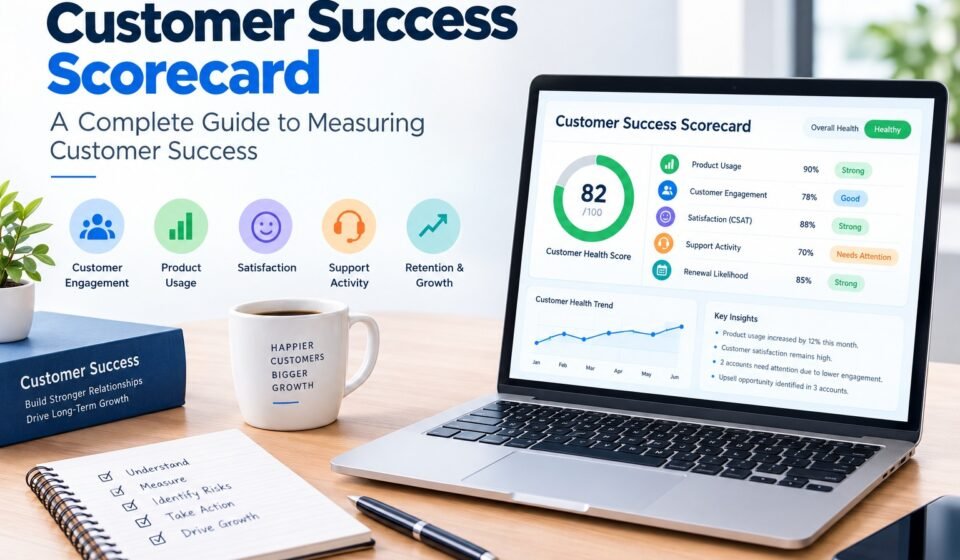
Customer Success Scorecard: A Complete Guide to Measuring Customer Success

Customer success teams need more than individual metrics to understand whether customers are getting value from a product or service. Looking at retention, engagement, support tickets, product usage, and customer feedback separately can make it difficult to see the complete picture.
A customer success scorecard brings these different signals together in one structured framework. It helps customer success teams monitor customer health, identify potential risks, measure progress, and decide where additional support may be needed.
A well-designed scorecard can also help managers create consistent customer success processes across different accounts. Instead of relying only on personal judgment, teams can use measurable indicators to understand which customers are healthy, which may need attention, and which have opportunities for expansion.
Customer success should also connect with broader business performance. Metrics such as retention, customer lifetime value, and revenue growth can help show whether customer improvements are contributing to financial performance. For a deeper explanation of financial KPIs, see a financial measure of success in a balanced scorecard.
What Is a Customer Success Scorecard?
A customer success scorecard is a structured system used to measure and monitor the health, engagement, satisfaction, and overall progress of customers.
The scorecard normally combines several customer-related metrics into a single view. Depending on the business model, these metrics can include:
- Product usage
- Customer engagement
- Customer satisfaction
- Support activity
- Renewal likelihood
- Contract value
- Adoption of important features
- Customer feedback
- Business outcomes
- Expansion opportunities
The purpose is not simply to assign a number to every customer. The main goal is to create a consistent way of understanding customer health and identifying important changes over time.
For example, a SaaS company might give greater importance to product adoption and login frequency, while a professional services company may focus more heavily on project progress, satisfaction, communication, and business outcomes.
Why Is a Customer Success Scorecard Important?
Customer success teams often manage dozens or hundreds of accounts. Without a standardized measurement system, it can become difficult to determine which customers require immediate attention.
A scorecard provides a common framework.
1. Identifies At-Risk Customers
A significant drop in product usage, customer engagement, or satisfaction can indicate that a customer is experiencing problems.
A scorecard allows teams to monitor these changes and investigate them before they become larger issues.
For example, if a customer’s product usage falls significantly for several consecutive weeks, the customer success manager can contact the account and determine whether there is a technical, training, adoption, or business problem.
2. Measures Customer Health
Customer health is one of the most important concepts in customer success.
A customer may have a large contract but still be at risk if they are not using the product effectively. Another customer may have a smaller contract but demonstrate strong engagement and consistent product adoption.
A customer success scorecard can combine these different signals to provide a broader picture of customer health.
3. Creates Consistency Across the Team
Different customer success managers may otherwise evaluate accounts differently.
One manager might consider frequent product usage a strong indicator, while another may focus primarily on customer conversations.
A standardized scorecard gives the entire team a common measurement framework.
4. Supports Customer Retention
Retention is closely connected to customer value.
When teams understand whether customers are receiving value, they can take action when engagement or satisfaction starts declining.
The scorecard does not guarantee retention, but it can help teams identify warning signs earlier.
5. Helps Prioritize Customer Success Activities
Customer success managers have limited time.
A scorecard can help them determine which accounts require immediate attention and which accounts can continue through normal engagement processes.
This is particularly useful when a team manages a large customer base.
What Should a Customer Success Scorecard Include?
There is no single scorecard that works for every company. The metrics should reflect the company’s business model, customer journey, and desired outcomes.
However, several categories are commonly useful.
Product Usage
Product usage measures how actively customers are using the product or service.
Possible measurements include:
- Login frequency
- Number of active users
- Feature adoption
- Sessions per month
- Usage frequency
- Number of completed workflows
- Adoption of new features
For a SaaS business, product usage may be one of the strongest indicators of customer engagement.
Customer Engagement
Engagement measures the level of interaction between the customer and the company.
Possible indicators include:
- Meetings attended
- Email engagement
- Training participation
- Webinar attendance
- Customer success calls
- Executive meetings
- Responses to customer communications
Low engagement does not automatically mean that a customer is unhappy. It should be considered alongside other signals.
Customer Satisfaction
Customer satisfaction can provide direct feedback about how customers perceive the product or service.
Businesses may use:
- Customer Satisfaction Score (CSAT)
- Net Promoter Score (NPS)
- Customer surveys
- Feedback forms
- Review ratings
- Qualitative customer comments
These measurements can provide useful context that behavioral data alone may not reveal.
Support Activity
Support interactions can also provide important information.
A sudden increase in support tickets may indicate technical problems, usability issues, or insufficient training.
Useful metrics include:
- Number of support tickets
- Ticket frequency
- Resolution time
- Reopened tickets
- Escalations
- Critical incidents
However, a high number of support requests does not always indicate an unhealthy customer. Some highly engaged customers naturally interact with support more frequently.
Renewal and Contract Information
Commercial information can be included when appropriate.
Examples include:
- Renewal date
- Contract value
- Contract duration
- Renewal status
- Expansion potential
- Product usage compared with contract size
These indicators help customer success teams understand the commercial context surrounding an account.
How to Build a Customer Success Scorecard
Creating an effective scorecard does not require dozens of metrics. In many cases, a smaller group of meaningful indicators is more useful.
Step 1: Define Customer Success
Start by deciding what success means for your customers.
Ask questions such as:
- What outcome are customers trying to achieve?
- What does successful product adoption look like?
- What behaviors indicate that customers are receiving value?
- What problems commonly lead to churn?
- What milestones should customers reach?
Your answers should determine which metrics belong in the scorecard.
Step 2: Select Relevant Metrics
Choose metrics that directly relate to customer outcomes.
For example, a software company might track:
| Category | Example Metric |
|---|---|
| Product usage | Weekly active users |
| Adoption | Key feature usage |
| Engagement | Customer meetings |
| Satisfaction | CSAT |
| Support | Open tickets |
| Commercial | Renewal status |
| Outcome | Customer-specific business goal |
Avoid adding metrics simply because the data is available.
Step 3: Assign Appropriate Weighting
Not every metric has the same importance.
For example, product adoption may have a greater influence on customer health than the number of meetings held with a customer.
A business could assign different weights to its indicators based on historical customer behavior.
The weighting system should be reviewed periodically to determine whether it actually helps identify healthy and at-risk accounts.
Step 4: Establish Score Ranges
Businesses can create simple ranges to make customer health easier to understand.
For example:
- Healthy: Strong adoption and positive engagement
- Needs Attention: Some warning signs are present
- At Risk: Significant problems require action
The exact thresholds should be based on the company’s customer data rather than arbitrary numbers.
Step 5: Connect Scores to Actions
A score is most useful when it leads to an action.
For example:
Healthy customer: Continue normal engagement and identify opportunities for additional value.
Customer needing attention: Review recent changes and contact the customer to understand potential problems.
At-risk customer: Create a specific recovery plan and involve the appropriate internal teams.
This makes the scorecard an operational tool rather than just a reporting dashboard.
Customer Success Scorecard Example
Consider a fictional SaaS company that provides project management software.
Its scorecard could include the following:
| Metric | Weight | Current Status |
|---|---|---|
| Product adoption | 30% | Strong |
| Key feature usage | 20% | Moderate |
| Customer engagement | 15% | Strong |
| Customer satisfaction | 15% | Strong |
| Support activity | 10% | Moderate |
| Renewal status | 10% | Strong |
The company could review these indicators regularly and investigate major changes.
For example, if product adoption falls while support tickets increase, the customer success manager may want to investigate whether the customer is facing a technical or usability issue.
The scorecard should support the conversation rather than replace it.
Customer Success Scorecard vs. Customer Health Score
These two concepts are related but are not necessarily identical.
A customer health score usually provides a summarized indication of whether an account appears healthy or at risk.
A customer success scorecard can be broader. It can contain the individual metrics, goals, progress indicators, and other information used to understand that health assessment.
Customer metrics can also become part of a broader balanced scorecard framework. For practical examples of how organizations use this framework across different industries and strategic objectives, see these balanced scorecard success stories.
Think of the scorecard as the framework and the health score as one possible output of that framework.
Common Customer Success Metrics
Businesses can select different metrics depending on their objectives.
Some commonly used customer success metrics include:
Customer Retention Rate
Retention measures how many customers remain with the company over a specific period.
Churn Rate
Churn measures the rate at which customers stop using or purchasing a product or service.
Customer Lifetime Value
Customer Lifetime Value estimates the total value a business may receive from a customer during the relationship.
Net Promoter Score
NPS measures customers’ willingness to recommend a company or product.
Customer Satisfaction Score
CSAT measures customer satisfaction with a specific interaction, product, service, or experience.
Product Adoption
Product adoption measures whether customers are using the product and its important capabilities.
These metrics can be combined within a broader success scorecard when they are relevant to the company’s customer journey.
How Technology Can Improve Scorecard Management
Managing scorecards manually can become difficult as the number of customers increases.
Customer success platforms and CRM systems can help teams collect information from different sources and display it in one location.
For example, customer data may come from:
- CRM software
- Product analytics
- Customer support systems
- Billing platforms
- Survey tools
- Communication platforms
Integrating these sources can reduce manual work and help teams identify changes more quickly.
When selecting technology, businesses should focus on data accuracy and actionable reporting rather than simply collecting more information.
Common Mistakes to Avoid
A scorecard can become less useful when it is unnecessarily complicated.
Tracking Too Many Metrics
More metrics do not automatically produce better insights.
A scorecard containing dozens of indicators can make it difficult for customer success managers to determine what actually matters.
Focus on metrics that have a clear connection to customer outcomes.
Using the Same Scorecard for Every Customer
Different customers may have different objectives.
An enterprise customer and a small business customer may use the same product differently.
The core framework can remain consistent while specific goals and metrics are adjusted.
Ignoring Qualitative Information
Numbers cannot explain everything.
Customer conversations, feedback, complaints, and business changes can provide important context.
Use quantitative metrics together with qualitative information.
Treating the Score as a Final Answer
A score should be treated as an indicator, not an unquestionable conclusion.
A customer may receive a healthy score while experiencing an important issue that is not yet reflected in the available data.
Customer success managers should use the scorecard as a starting point for investigation.
How Often Should You Review a Customer Success Scorecard?
The appropriate review frequency depends on the customer and business model.
For high-value or high-risk accounts, teams may monitor important signals continuously or review them weekly.
For lower-touch accounts, a monthly review may be sufficient.
A useful approach is to establish different review schedules based on customer value, lifecycle stage, risk level, and engagement model.
The important thing is consistency.
How to Improve Your Customer Success Scorecard Over Time
A scorecard should evolve as the business learns more about its customers.
Review historical customer data and ask:
- Which metrics changed before customers churned?
- Which behaviors were associated with successful renewals?
- Which indicators produced false warnings?
- Which customer segments behave differently?
- Which metrics are no longer useful?
This process allows the company to improve its scoring model based on evidence rather than assumptions.
It can also be helpful to compare scorecard results with actual customer outcomes. If customers categorized as healthy frequently churn, the model may need to be adjusted.
Frequently Asked Questions
What is the purpose of a customer success scorecard?
The purpose is to organize important customer health and success indicators into a consistent framework. It helps teams monitor customer progress, identify potential risks, and prioritize customer success activities.
What metrics should be included in a customer success scorecard?
Common metrics include product usage, feature adoption, customer engagement, satisfaction, support activity, renewal information, and customer-specific business outcomes.
How is a customer success scorecard different from a health score?
A health score typically summarizes the overall condition of a customer account. A scorecard can contain the broader set of metrics and information used to evaluate that condition.
How often should customer success scores be updated?
It depends on the business and customer segment. High-value accounts may require frequent monitoring, while lower-touch customers may be reviewed monthly or at important lifecycle milestones.
Can small businesses use customer success scorecards?
Yes. Small businesses can use simple scorecards with a few meaningful metrics. A complex customer success platform is not required to establish a basic measurement framework.
Should every customer have the same scorecard?
Not necessarily. Businesses can maintain a consistent core framework while adjusting specific metrics based on customer segment, product usage, contract type, or customer goals.
Conclusion
A customer success scorecard provides a structured way to understand whether customers are receiving value and where they may need additional support.
The most effective scorecards are not necessarily the most complicated. They focus on a manageable number of meaningful indicators, connect those indicators to customer outcomes, and help customer success teams take appropriate action.
Start by defining what customer success means for your business. Then select the metrics that best demonstrate progress toward those outcomes. Review the results regularly, compare them with actual customer outcomes, and refine the scorecard as your understanding improves.
When used correctly, a scorecard can become an important part of a customer success strategy by turning scattered customer information into a more organized and actionable view.



[…] already tracks customer health separately, you can also connect your strategy framework with a customer success scorecard to create a more detailed view of customer-related […]
[…] a more detailed customer-level framework, you can also connect this article to your customer success scorecard […]
[…] example, a business might use a customer success scorecard to […]