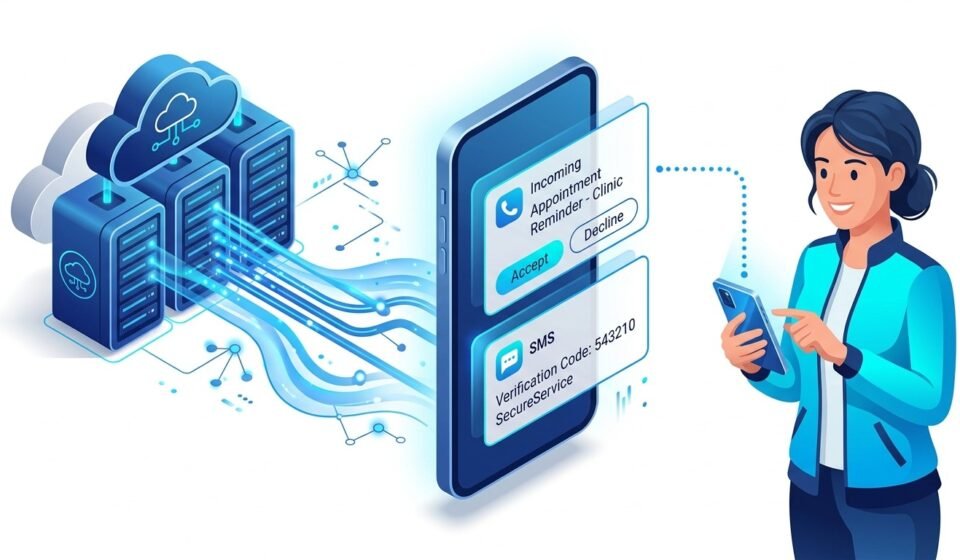

If you have ever received a phone call from a number you do not recognize and wondered, “What is A2P calling?”, you are not alone. The term A2P calling is becoming increasingly common as businesses use cloud phone systems, automated dialing platforms, CRM software, and communications APIs to contact customers.
A2P stands for Application-to-Person. In simple terms, it describes communication initiated through software or an application and delivered to a person. Although A2P is most commonly associated with business messaging, the term is also used in the communications industry when discussing automated or application-driven voice calls.
This creates some confusion because A2P calling, A2P messaging, and A2P 10DLC are not exactly the same thing.
A2P 10DLC is specifically a U.S. carrier framework for application-to-person SMS and MMS traffic sent using standard 10-digit long-code numbers. Businesses using these numbers for messaging generally need to register their brand and campaign and comply with carrier requirements.
This guide explains what A2P calling means, why you may receive an A2P call, how A2P calling detection works, what A2P calling prevention involves, and what you should know when an A2P 10DLC texting number calls you after a missed call.
Quick Answer: What Is A2P Calling?
A2P calling generally refers to a phone call initiated by an application, automated communications system, business software, or cloud telephony platform rather than someone manually dialing from a personal phone.
For example, a company might use software to automatically call customers about:
- Appointment reminders
- Delivery updates
- Customer support
- Account notifications
- Payment reminders
- Verification processes
- Service alerts
- Sales or marketing campaigns
However, the term should not be confused with A2P 10DLC.
A2P 10DLC is primarily a U.S. messaging compliance system for SMS/MMS sent through 10-digit long-code numbers. A 10DLC number may also support voice, but the 10DLC registration framework concerns messaging traffic.
What Does A2P Calling Mean?
The easiest way to understand A2P calling is to break down the acronym.
A2P = Application-to-Person.
Instead of a person manually entering a phone number and pressing the call button, software can initiate communication with the recipient.
Imagine a doctor’s office with thousands of appointments. Rather than having employees individually call every patient, the office can use a communications platform to automatically contact patients.
The same concept can be used by:
- Banks
- Healthcare providers
- Delivery companies
- Retailers
- SaaS businesses
- Customer-service departments
- Appointment platforms
- Insurance companies
- E-commerce businesses
A2P communication is therefore not automatically suspicious or illegal. Legitimate businesses use automated communications every day.
The important issue is how the communication is generated, why it is being made, whether the recipient consented where required, and whether applicable telecommunications and telemarketing rules are being followed.
A2P Calling vs. P2P Calling
One useful distinction is between A2P and P2P.
P2P: Person-to-Person
P2P communication occurs when one individual communicates directly with another individual.
For example:
You call your friend from your mobile phone.
A2P: Application-to-Person
A2P communication occurs when software or an application initiates communication with an individual.
For example:
A company’s automated system calls you to remind you about an appointment.
The distinction becomes especially important in messaging.
U.S. carriers define A2P messaging as messages sent from an application rather than another individual. Twilio notes that communications such as marketing messages, appointment reminders, chatbots, notifications, and one-time passwords can fall into A2P messaging.
What Is A2P 10DLC?
A2P 10DLC stands for:
Application-to-Person 10-Digit Long Code.
A 10DLC number is essentially a standard U.S. local phone number, such as a number with a 415, 212, or 310 area code.
The A2P 10DLC framework allows businesses to use these local-looking numbers for application-generated messaging while providing carriers with information about the sender and messaging campaign.
The system exists partly because ordinary long-code numbers were historically designed around person-to-person communication, while businesses increasingly began using them to send large volumes of automated messages.
Carriers introduced A2P 10DLC registration to improve trust, reduce unwanted messaging, and provide approved businesses with appropriate messaging throughput.
Does A2P 10DLC Apply to Phone Calls?
This is one of the most important points in this topic.
A2P 10DLC is fundamentally a messaging framework.
If a business sends SMS or MMS messages to U.S. recipients through a 10-digit long-code number, A2P 10DLC registration and carrier requirements can apply. Twilio’s current documentation states that U.S. SMS/MMS sent through long-code numbers requires A2P 10DLC registration.
A 10DLC number can also be voice-enabled. Twilio describes 10DLC numbers as supporting both messaging and voice.
But this does not mean:
“Every phone call from an A2P 10DLC number is automatically an A2P 10DLC message and follows the same registration rules.”
Voice calls have their own regulatory and carrier requirements.
For telemarketing and prerecorded calls, U.S. businesses may need to consider rules under the Telephone Consumer Protection Act (TCPA), the Telemarketing Sales Rule (TSR), Do Not Call requirements, consent requirements, caller-ID rules, and applicable state laws.
What Is A2P Calling on iPhone?
If you see an unfamiliar call on an iPhone and the number appears to be associated with a business, automated service, or cloud communications provider, you might wonder:
“What is A2P calling on iPhone?”
The iPhone itself does not create a special type of phone call called A2P calling.
Instead, the call may have originated from a business communications platform or automated calling system.
For example:
- A customer schedules an appointment.
- The company’s software records the appointment.
- The software connects to a communications provider.
- The communications platform initiates an outbound call.
- The recipient’s iPhone receives the call.
From the recipient’s perspective, it looks like an ordinary incoming phone call.
The underlying difference is how the call was initiated, not the type of iPhone being used.
Why Did an A2P Number Call Me?
There are several possible explanations.
1. Appointment reminder
A medical practice, salon, restaurant, or service company may automatically call customers before an appointment.
2. Customer notification
A business may call about an order, delivery, account, or service.
3. Verification
Some platforms use automated voice calls as part of account verification.
4. Customer support
A company may use a cloud phone system to return a customer call.
5. Sales or marketing
Some businesses use automated or software-assisted systems for outbound sales.
6. Wrong number
The business may have incorrect customer information.
7. Spoofed caller ID
The displayed number may not actually belong to the organization making the call.
The FCC specifically identifies caller-ID spoofing as an issue associated with unwanted calls and allows consumers to report unwanted calls and suspected spoofing.
What Is A2P Calling Detection?
A2P calling detection refers to technology and network-level processes used to identify calls that appear to originate from automated, business, or application-driven calling systems.
There is no single universal A2P calling detection algorithm used by every carrier.
Instead, telecommunications providers can analyze multiple signals.
These can include:
- Calling patterns
- Call volume
- Call duration
- Call frequency
- Caller-ID information
- Number reputation
- Customer complaints
- Call-answer behavior
- Historical traffic
- Authentication information
- Whether the number has been reported as spam
The objective is generally to distinguish legitimate business traffic from unwanted or abusive traffic.
How Does A2P Calling Detection Work?
Consider a company that suddenly starts placing thousands of calls every hour.
A carrier may observe:
- The same number making unusually high volumes of calls.
- A large percentage of calls going unanswered.
- Very short calls.
- Recipients repeatedly reporting the number.
- Calling patterns associated with known spam behavior.
These signals can contribute to a carrier or call-protection provider classifying the traffic as suspicious.
This can eventually result in:
- Spam warnings
- Call filtering
- Call blocking
- Reduced call completion
- Number reputation problems
This is why legitimate businesses need to think about call quality, consent, identification, and calling practices, rather than simply increasing outbound volume.
What Is A2P Calling Prevention?
A2P calling prevention can refer to two different things.
For consumers
It means preventing unwanted automated or business calls from reaching your phone.
Possible measures include:
- Using your phone’s call-blocking features
- Enabling carrier spam protection
- Using reputable call-filtering services
- Blocking individual numbers
- Reporting unwanted calls
- Avoiding interaction with suspicious automated calls
The FTC recommends hanging up on illegal robocalls rather than pressing buttons to speak with an operator or supposedly remove yourself from the list, because interacting with an illegal robocall can sometimes lead to more unwanted calls.
For businesses
A2P calling prevention can mean preventing legitimate automated calling traffic from being classified as spam.
Businesses can reduce the risk by:
- Calling people who have an appropriate reason to receive the call.
- Maintaining accurate customer records.
- Honoring Do Not Call requests.
- Using appropriate caller identification.
- Avoiding excessive call frequency.
- Monitoring complaints.
- Following applicable consent requirements.
- Using reputable telecommunications providers.
A2P 10DLC Texting Number That Called Me
A common situation looks like this:
You receive a missed call from a local-looking number. You search the number and discover that it is associated with an A2P 10DLC texting service.
This can be confusing.
A 10DLC number can support both SMS messaging and voice, depending on how it is configured.
Therefore, discovering that a number is an A2P 10DLC number does not automatically mean the call was fraudulent.
The number might belong to:
- A legitimate business
- A customer-support system
- A delivery company
- An appointment service
- A software company
- A marketing platform
- A small business using cloud communications
However, the existence of a legitimate-looking local number does not prove that the caller is legitimate either.
Caller ID can be spoofed, and consumers should evaluate the context of the call rather than trusting the displayed number alone. The FCC specifically provides complaint channels for unwanted calls and spoofed numbers.
A2P 10DLC Texting Number After a Missed Call: Compliance Rules
Another common scenario is:
- You receive a call from a business number.
- You don’t answer.
- You receive a text message from the same number.
- The text says something such as “Sorry we missed you” or asks you to reply.
Does the missed call automatically make the text compliant?
No.
A missed call by itself does not automatically establish permission for subsequent marketing messages.
If a business sends SMS through a U.S. 10DLC number, the messaging itself can fall under A2P 10DLC carrier requirements. Businesses must properly register applicable campaigns and follow carrier messaging policies.
Registration is only one part of compliance.
Businesses also need to consider:
- How the recipient opted in
- What the recipient agreed to receive
- Whether the message is informational or marketing
- Whether the sender is accurately identified
- Opt-out requirements
- Message content
- Applicable federal and state laws
- Carrier policies
In other words:
A missed call is not a substitute for appropriate messaging consent.
Is an A2P Call Legal?
There is no simple “yes” or “no” answer.
A2P technology itself is not inherently illegal.
Businesses legitimately use automated calling technology for many purposes.
The legality depends on factors such as:
- The purpose of the call
- Whether the call is prerecorded
- Whether an autodialer is involved
- Whether the recipient provided the required consent
- Whether the number is subject to Do Not Call restrictions
- Whether the caller is telemarketing
- Applicable federal regulations
- Applicable state regulations
The FTC states that most prerecorded telemarketing calls require prior written authorization from the consumer.
The FTC’s Telemarketing Sales Rule also places restrictions on Do Not Call practices, calling hours, caller identification, abandoned calls, and prerecorded-message calls.
A2P Calling Compliance: What Businesses Should Know
Businesses using automated calling systems should build compliance into the entire calling workflow.
Obtain appropriate consent
Where applicable, obtain the correct form of consent before making automated or prerecorded calls.
Maintain Do Not Call records
Businesses conducting telemarketing should maintain processes for honoring consumer requests not to receive calls.
Identify the caller
Consumers should be able to understand who is calling and why.
Avoid misleading caller ID
Businesses should not use deceptive caller identification practices.
Monitor call frequency
Calling the same person repeatedly can create consumer complaints and may create regulatory problems.
Keep records
Businesses should maintain appropriate records of:
- Consent
- Opt-outs
- Call attempts
- Campaign information
- Customer requests
- Number ownership
- Calling activity
Review state requirements
Federal requirements are not the entire compliance picture. State laws can impose additional requirements.
One-to-One Consent and A2P Calls
Consent is particularly important for automated marketing calls.
The FCC adopted a one-to-one consent rule intended to prevent lead generators from treating one consumer’s consent as permission for numerous unrelated sellers to contact that person.
The FCC’s consumer guide says that, under the rule, each seller making telemarketing robocalls or robotexts must obtain the consumer’s prior express written consent for that seller, with the rule taking effect January 27, 2025.
This is particularly relevant to lead-generation websites.
For example, a consumer should not assume that entering a phone number into one comparison form gives dozens of unrelated companies unlimited permission to make automated marketing calls.
How to Stop Unwanted A2P Calls
If you are receiving unwanted automated calls, start with simple defensive measures.
1. Don’t engage with suspicious calls
If you answer and hear a suspicious recorded message, consider hanging up.
2. Don’t provide personal information
Never provide passwords, verification codes, banking details, or other sensitive information simply because a caller claims to represent a company.
3. Verify the company independently
If the caller claims to be from a bank, retailer, government agency, or another organization, find the organizations official contact information yourself.
Do not rely solely on the number displayed on your phone.
4. Block the number
Your smartphone and carrier may provide tools for blocking unwanted numbers.
5. Enable spam protection
Many modern smartphones and carriers offer spam detection or call-screening features.
6. Report suspicious calls
The FCC accepts complaints involving unwanted calls, texts, and caller-ID spoofing.
A2P Calling vs. Robocalling
These terms are related but not interchangeable.
A2P calling
Describes communication initiated through an application or software system.
Robocalling
Generally refers to calls involving an automated or prerecorded message.
An A2P call could involve a live agent using a business communications platform, while a robocall involves automated messaging.
Likewise, an automated business call might be A2P, but not every A2P communication is a robocall.
This distinction is important because regulations can depend heavily on the actual technology and purpose of the call.
A2P Calling vs. A2P Messaging
| Feature | A2P Calling | A2P Messaging |
|---|---|---|
| Communication | Voice | SMS/MMS |
| Initiated by software | Often | Yes |
| Can use business numbers | Yes | Yes |
| A2P 10DLC framework | Not automatically | Yes, for applicable U.S. 10DLC messaging |
| Consent may matter | Yes | Yes |
| Spam detection | Yes | Yes |
| Caller/message filtering | Yes | Yes |
| Opt-out requirements | Depending on use case | Commonly required for applicable messaging |
| Carrier policies | Yes | Yes |
The critical takeaway is that A2P 10DLC should not be treated as a universal compliance label for every automated phone call.
Why A2P Calling Can Be Flagged as Spam
Even legitimate businesses can encounter spam labeling.
Potential reasons include:
- High outbound volume
- High complaint rates
- Repeated calls
- Poor calling practices
- Low answer rates
- Number reputation problems
- Inaccurate caller information
- Suspicious calling patterns
- Caller-ID problems
Carriers and call-protection systems are increasingly focused on identifying unwanted communications.
For businesses, this means that maintaining a clean calling reputation is becoming just as important as having a working phone number.
How Businesses Can Reduce A2P Spam Classification
Businesses should focus on quality rather than simply maximizing call volume.
A practical strategy includes:
- Use legitimate phone numbers.
- Clearly identify the business.
- Call customers for a legitimate reason.
- Maintain appropriate consent records.
- Honor opt-out requests quickly.
- Avoid excessive repeated calls.
- Monitor customer complaints.
- Review call analytics.
- Use reputable communications providers.
- Keep customer data accurate.
Businesses should also separate marketing campaigns from transactional communications so that the purpose and consent requirements are easier to manage.
Frequently Asked Questions
What’s A2P calling?
A2P calling generally means a phone call initiated through an application, software platform, automated communications system, or business calling infrastructure.
It is not automatically synonymous with spam or fraud.
What is A2P calling?
A2P calling means Application-to-Person calling. Software initiates the communication toward an individual rather than one individual manually calling another.
What does A2P calling mean on an iPhone?
It means the incoming call may have originated from a business application or automated communications platform. The iPhone itself is not what makes the call A2P.
What is A2P calling detection?
A2P calling detection involves identifying automated or application-generated calling patterns using signals such as call volume, frequency, caller reputation, complaints, and other network information.
What is A2P calling prevention?
For consumers, it means using blocking, filtering, and reporting tools to reduce unwanted automated calls. For businesses, it means following appropriate calling practices to prevent legitimate traffic from being classified as spam.
Is an A2P 10DLC number a scam?
Not necessarily. A2P 10DLC is a legitimate U.S. framework for business application-to-person messaging over 10-digit long-code numbers. A number associated with A2P 10DLC can belong to a legitimate business.
However, you should still verify unexpected calls independently.
Why did an A2P 10DLC texting number call me?
A 10DLC number can be voice-enabled, so the number may be used for both texting and calling.
The call could be from a legitimate business, an automated service, or potentially an unwanted or spoofed caller.
Does a missed call give a company permission to text me?
No, not automatically. A missed call by itself should not be treated as blanket consent for subsequent marketing texts. U.S. 10DLC messaging also has carrier registration and compliance requirements.
Final Thoughts
A2P calling is becoming increasingly important as businesses move customer communications from traditional telephone systems to cloud-based applications and communications APIs.
The most important distinction is between A2P calling and A2P 10DLC messaging.
A2P calling generally describes software- or application-driven voice communication. A2P 10DLC, on the other hand, is specifically a U.S. framework for application-generated SMS/MMS traffic over 10-digit long-code numbers. A 10DLC number can also support voice, but that does not mean every call made through that number is governed by the A2P 10DLC messaging registration framework.
For consumers, the safest approach is to treat unexpected calls carefully, verify the caller independently, and use available spam-blocking and reporting tools.
For businesses, the priority should be consent, transparency, accurate caller identification, appropriate calling frequency, Do Not Call compliance, and carrier requirements. The FTC continues to enforce rules against illegal robocalls and deceptive telemarketing practices, while the FCC continues to address unwanted calls, texts, and caller-ID spoofing.
That combination of technical and regulatory awareness helps businesses communicate with customers without unnecessarily exposing them, or themselves, to unwanted-call and compliance problems.