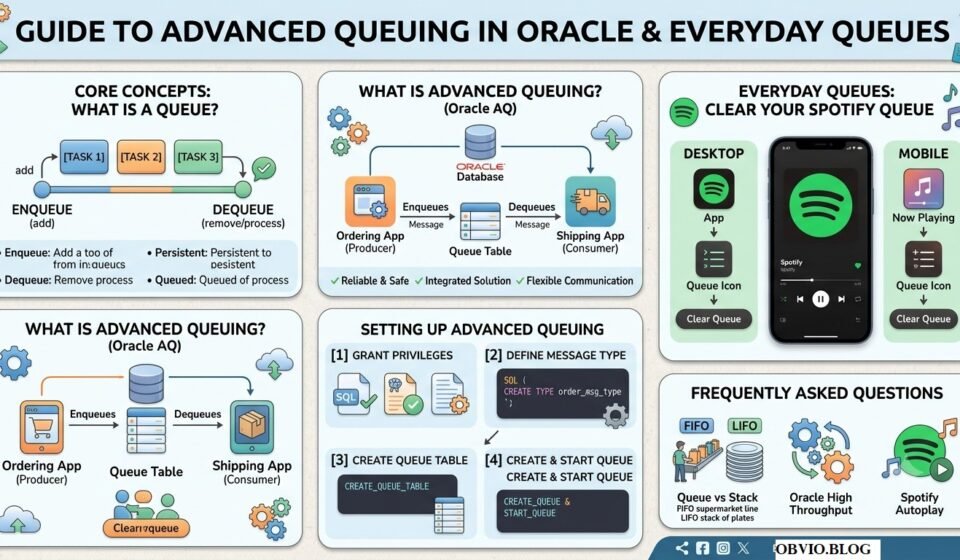

A knowledge of how queues work in an enterprise relational database or in any mobile application is one of the fundamental requirements that every developer, database administrator, or tech enthusiast needs to know.
Though the concept of a queue may appear as basic as standing in a queue in a supermarket, queuing systems in software engineering provide the very basis of asynchronous processing, microservices, and event-driven architectures.
This tutorial provides an all-encompassing introduction to the advanced queue operations in the Oracle Database environment. We will discuss some of the basics of queuing, terminologies, spelling, and day-to-day activities such as handling consumer music app queues.
1. Core Concepts: Queue Fundamentals & Terminology
However, before delving into intricate designs of databases, we will try to understand the very basics of what queuing means in technological environments.
Queue Definition & Meaning for Queue
Definition of a queue in the context of computer science can be given as a linear structure intended to store elements until they get processed.
The first and foremost concept about queue can be based on the FIFO (First-In, First-Out) idea.
       [ ENQUEUE ]  ----------------------------------->  [ DEQUEUE ]
   Incoming Messages --->  [ Msg 3 ]  [ Msg 2 ]  [ Msg 1 ] ---> Consumer Processing
                                    QUEUE TABLE
- Enqueuing: The process of putting a message into the rear of the queue.
- Dequeuing: The process of extracting a message from the front of the queue.
- Persistence: Ensuring that messages are written to non-volatile memory or database tables so that they survive crashes.
What Does Queued Mean?
If an item, task, or request is flagged as queued, it indicates that the request has been received by the system and put on hold until an idle background worker, thread, or consumer picks it up for processing.
How to Spell Queue
The word is spelled Q-U-E-U-E.
Fun Fact: “Queue” is famously known as the only word in the English language that retains its original pronunciation even when you remove its last four letters (“Q”).
2. What is Advanced Queuing?
Oracle Advanced Queues (or AQ), which stands for Oracle Advanced Queuing or DBMS_AQ, is a business-level message-oriented middleware solution that is built directly within the Oracle Database Engine.
Oracle Advanced Queues was first implemented in Oracle 8i and enhanced extensively from Oracle 9i to its current versions (19c/23c).
+------------------------------------------------------------------+
|                          ORACLE DATABASE                         |
|                                                                  |
|   +-------------------+    PL/SQL / AQ    +------------------+   |
|   | Producer App      | === Enqueue ===> | Queue Table      |   |
|   | (Payment Service) |                  | (Persistent Msg) |   |
|   +-------------------+                  +--------+---------+   |
|                                                   |              |
|                                               Dequeue            |
|                                                   v              |
|   +-------------------+                  +------------------+   |
|   | Consumer App      | <================| Subscriber /     |   |
|   | (Inventory System)|                  | Event Listener   |   |
|   +-------------------+                  +------------------+   |
+------------------------------------------------------------------+
Key Capabilities of Enterprise Advanced Queuing
- Transactional Messaging: Messages get queued and de-queued as part of the usual SQL transactions (compliant to ACID properties). In case a transaction fails, the message will be in its original state.
- Persistence of Messages: Since the messages are in database tables (Queue Tables). They will survive power failure and hardware/network failure.
- Multiple Message Consume Patterns: Point-to-Point (one message is consumed by one receiver) and Publish-Subscribe (messages are received by multiple consumers) patterns supported.
- Message Transformation: The system has inbuilt features for automatic conversion of payloads.
- Variety of Payloads: Support for Standard SQL datatypes, XML, RAW, JSON, and User-defined Datatypes (UDTs).
3. Why Use Database-Integrated Advanced Queuing?
Classic message brokers (for instance, RabbitMQ and Apache ActiveMQ) need additional management of the cluster, special back-up procedures, and complex two-phase commit for synchronization with the relational database.
The implementation of queuing in Oracle offers a number of structural benefits:
| Feature | External Message Broker | Oracle Advanced Queuing |
| Data Integrity | Requires two-phase commits | Single database transaction (ACID) |
| Persistence | File-based or external storage | Native database table storage |
| Management | Separate admin toolsets | Standard SQL, PL/SQL, and Oracle Enterprise Manager |
| Security | Independent auth framework | Inherits database RBAC and encryption |
| Backup/Recovery | Requires separate sync mechanisms | Backed up automatically via RMAN |
4. Setting Up Advanced Queuing: A Step-by-Step Primer
Steps to start working with the Oracle AQ in version 9i and higher:
1.Granting System Privileges: Task of the Database Administrator.
Prior to creating any objects of queues, make sure that the target database user schema has necessary administrative privileges for Oracle AQ.
SQL
-- Grant administrative privileges to the application user
GRANT EXECUTE ON DBMS_AQ to app_user;
GRANT EXECUTE ON DBMS_AQADM to app_user;
GRANT AQ_ADMINISTRATOR_ROLE TO app_user;
2.Define the Message Payload Type:Schema Object Setup.
Design an Object Type for the payload data of your queue system.
SQL
-- Create an object payload for order notifications
CREATE OR REPLACE TYPE order_msg_type AS OBJECT (
    order_id      NUMBER,
    customer_id   NUMBER,
    order_status  VARCHAR2(30),
    order_date    DATE
);
/
3.Create the Queue Table:DBMS_AQADM Execution.
Design the actual table where the queued messages will be stored.
SQL
BEGIN
  DBMS_AQADM.CREATE_QUEUE_TABLE(
    queue_table        => 'app_user.order_queue_table',
    queue_payload_type => 'app_user.order_msg_type',
    multiple_consumers => FALSE, -- Set TRUE for Publish/Subscribe model
    compatible         => '8.1.0'
  );
END;
/
4.Create and Start the Queue:Lifecycle Management.
Create the logical queue on your queue table and allow message processing.
SQL
BEGIN
  -- Create the queue object
  DBMS_AQADM.CREATE_QUEUE(
    queue_name  => 'app_user.order_processing_queue',
    queue_table => 'app_user.order_queue_table'
  );

  -- Start queue for Enqueue and Dequeue operations
  DBMS_AQADM.START_QUEUE(
    queue_name => 'app_user.order_processing_queue',
    enqueue    => TRUE,
    dequeue    => TRUE
  );
END;
/
5. Enqueueing and Dequeueing Messages
Once your queue becomes active, the applications will send (enqueue) and receive (dequeue) messages through a regular PL/SQL interface.
1. Enqueueing a Message
SQL
DECLARE
  v_enqueue_options    DBMS_AQ.enqueue_options_t;
  v_message_properties DBMS_AQ.message_properties_t;
  v_message_handle     RAW(16);
  v_payload            order_msg_type;
BEGIN
  -- Construct the payload
  v_payload := order_msg_type(10045, 8821, 'PENDING', SYSDATE);

  -- Enqueue the message
  DBMS_AQ.ENQUEUE(
    queue_name          => 'app_user.order_processing_queue',
    enqueue_options     => v_enqueue_options,
    message_properties  => v_message_properties,
    payload             => v_payload,
    msgid               => v_message_handle
  );

  COMMIT; -- Transactional commitment
END;
/
2. Dequeueing a Message
SQL
DECLARE
  v_dequeue_options    DBMS_AQ.dequeue_options_t;
  v_message_properties DBMS_AQ.message_properties_t;
  v_message_handle     RAW(16);
  v_payload            order_msg_type;
BEGIN
  -- Set wait conditions (e.g., wait up to 10 seconds for a message)
  v_dequeue_options.wait := 10;

  -- Dequeue the message
  DBMS_AQ.DEQUEUE(
    queue_name          => 'app_user.order_processing_queue',
    dequeue_options     => v_dequeue_options,
    message_properties  => v_message_properties,
    payload             => v_payload,
    msgid               => v_message_handle
  );

  -- Process payload output
  DBMS_OUTPUT.PUT_LINE('Processed Order ID: ' || v_payload.order_id);

  COMMIT;
EXCEPTION
  WHEN OTHERS THEN
    IF SQLCODE = -25228 THEN
      DBMS_OUTPUT.PUT_LINE('No message received within timeout period.');
    ELSE
      RAISE;
    END IF;
END;
/
6. End-User Queues: Clear Your App Queue (Spotify Example)
When developers program their systems to use advanced queuing within an enterprise architecture. Everyday users constantly deal with temporary playback queues in practical programs such as Spotify.
If you were looking for instructions to clear queue spotify or how to clear spotify queue, then take a look at the following instructions:
Clear Queue on Spotify Desktop (Mac / Windows / Web)
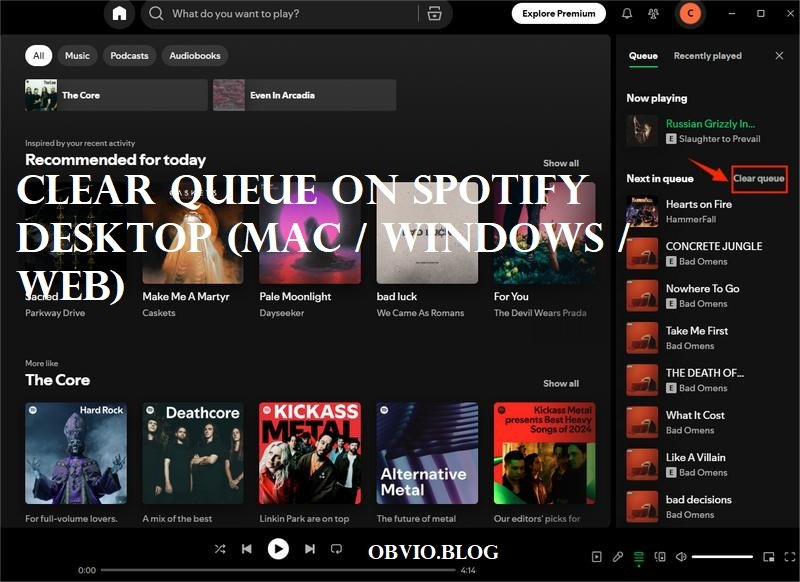
- Launch the Spotify app.
- Click the Queue button (looks like three horizontal lines with a little play button) in the bottom right corner of the control panel.
- Look for the “Next in queue” option.
- Click on the Clear queue button next to the title of this option.
Clear Queue on Spotify Mobile (iOS / Android)
- Expand to Full Screen by tapping on the Now Playing tab at the bottom of the screen.
- Select the Queue tab located at the bottom-right corner.
- Tap the “Clear queue” option under the “Next in Queue” section.
- (In order to delete specific songs from the queue) Tap the circular box for each song and select Remove at the bottom-left corner.
Frequently Asked Questions (FAQs)
What is the primary difference between a queue and a stack?
In case of a queue, FIFO is employed (First In First Out). A queue is one which processes items based on the order of their addition. On the other hand, in case of a stack, LIFO is applied (Last In First Out).
Can Oracle Advanced Queuing handle high throughput?
Yes. Today, sophisticated queuing systems include parallel processing, array-oriented enqueue/dequeue operations, and partitioned queue tables.
Why are my songs still playing after I clear my Spotify queue?
Clearing your queue removes only those tracks that you have manually queued. However, if Autoplay is activated from app settings, then Spotify automatically adds similar tracks once your current playlist ends.
How do I drop an Advanced Queuing table in Oracle?
You need to clear the associated queues first and then proceed with dropping the queue table:
SQL
BEGIN
  DBMS_AQADM.STOP_QUEUE(queue_name => 'app_user.order_processing_queue');
  DBMS_AQADM.DROP_QUEUE(queue_name => 'app_user.order_processing_queue');
  DBMS_AQADM.DROP_QUEUE_TABLE(queue_table => 'app_user.order_queue_table');
END;
/
Conclusion
Regardless of whether you are managing microservices in a distributed fashion within an Oracle relational database or tuning your personal music playlist, knowledge of queuing mechanics is crucial. Advanced queuing within enterprise databases provides reliable and transactional messaging that removes the hassle of having a separate messaging system infrastructure. Utilizing built-in database technologies such as standard SQL, PL/SQL, and DBMS_AQADM, one can develop an efficient system.