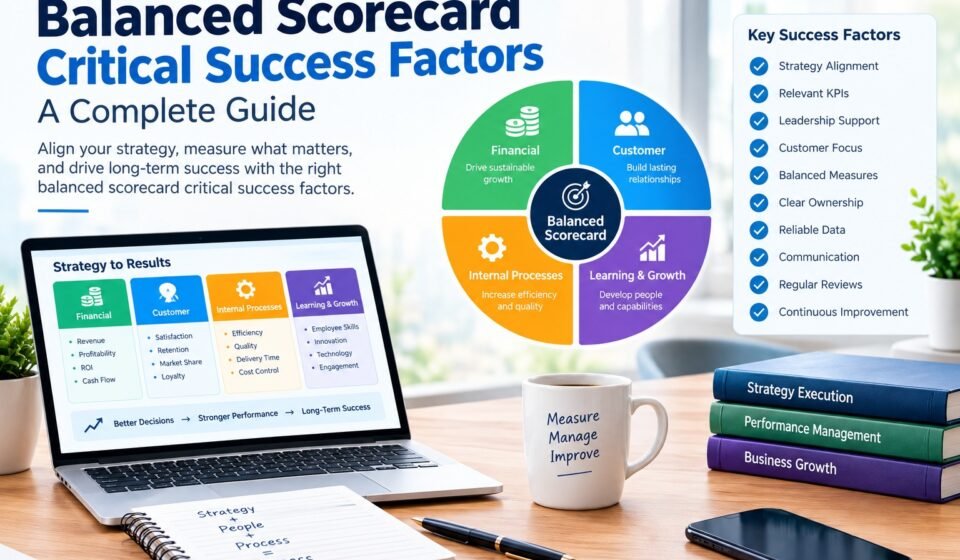

Businesses need reliable ways to understand whether their strategies are producing the desired results. Revenue, profit, customer satisfaction, employee development, operational efficiency, and other measures can all provide useful information, but looking at these areas separately may not give managers a complete view of organizational performance.
A balanced scorecard provides a structured way to connect business strategy with measurable objectives and performance indicators. However, simply creating a scorecard does not guarantee that it will be useful.
Understanding the balanced scorecard critical success factors is important because these factors determine whether the scorecard becomes a practical management tool or simply another reporting document.
An effective balanced scorecard should connect measurements to the organization’s strategy, use meaningful performance indicators, involve leadership, communicate objectives clearly, and encourage continuous improvement.
What Is a Balanced Scorecard?
A balanced scorecard is a strategic performance management framework that helps organizations translate their strategy into objectives, measures, targets, and initiatives.
The traditional framework developed by Robert Kaplan and David Norton considers four major perspectives:
- Financial
- Customer
- Internal business processes
- Learning and growth
These perspectives allow organizations to consider both current results and the capabilities that can contribute to future performance. Harvard Business Review describes the framework as a way to look at financial results while also monitoring customer, internal-process, and learning-and-growth factors.
For more background, readers can explore the concept of a balanced scorecard through the original work of Kaplan and Norton.
Why Do Balanced Scorecards Sometimes Fail?
A balanced scorecard can fail when organizations treat it as a collection of KPIs instead of a strategic management system.
For example, a company might create dozens of metrics covering sales, finance, operations, customer service, and employees. However, if those metrics are not connected to the company’s strategic objectives, managers may struggle to understand what the numbers actually mean.
Common problems include:
- Too many KPIs
- Poorly defined objectives
- Metrics that do not support strategy
- Lack of leadership involvement
- Unrealistic targets
- Poor communication
- Inconsistent data
- No action after performance reviews
- Failure to update the scorecard
This is why organizations should focus on the balanced scorecard critical success factors before building a large collection of measurements.
1. Clear Connection Between Strategy and Objectives
One of the most important success factors is strategic alignment.
Every major objective on the scorecard should have a logical connection to the organization’s strategy.
For example, suppose a company wants to become the market leader through superior customer service.
Its scorecard might include objectives such as:
- Improve customer response time
- Increase customer satisfaction
- Reduce service errors
- Improve employee training
- Increase customer retention
Each objective should contribute to the broader strategy.
A scorecard becomes much more useful when employees can understand why a particular metric matters and how improving it supports organizational goals.
2. Strong Leadership Support
Leadership involvement is another critical factor.
A scorecard should not be treated as a project belonging only to the finance, HR, analytics, or strategy department.
Senior leaders should understand the purpose of the scorecard and use it when discussing organizational performance.
Leadership support can include:
- Setting strategic priorities
- Approving objectives
- Reviewing performance
- Allocating resources
- Removing organizational barriers
- Communicating expectations
- Supporting corrective actions
When leadership regularly uses scorecard information during strategic discussions, employees are more likely to recognize its importance.
Kaplan and Norton have also described the balanced scorecard as more than a measurement exercise, emphasizing its role in management and strategy execution.
3. Relevant and Measurable KPIs
Another important factor is selecting the right key performance indicators.
A KPI should provide meaningful information about progress toward an objective.
For example, if an organization wants to improve customer experience, possible measurements could include:
- Customer satisfaction
- Customer retention
- Response time
- Resolution time
- Customer complaints
- Repeat purchases
The organization does not necessarily need every metric.
A smaller number of relevant indicators may be easier to manage and interpret than a dashboard containing dozens of unrelated measurements.
Financial KPIs are an important part of a balanced performance system because they show whether strategic improvements are producing measurable business results. Businesses can learn more about these metrics in a financial measure of success in a balanced scorecard.
What Makes a Good KPI?
A useful KPI should generally be:
- Relevant to a strategic objective
- Clearly defined
- Measurable
- Consistent
- Understandable
- Available within a reasonable timeframe
- Actionable
The KPI should also have a clear owner who understands what needs to happen when performance changes.
4. Balance Between Financial and Nonfinancial Measures
The word “balanced” is important.
A scorecard should not focus exclusively on financial results.
Financial measures can show the results of decisions and activities, but nonfinancial indicators can provide information about areas that contribute to future performance.
For example, a business could track:
Financial
- Revenue growth
- Profit margin
- Cash flow
- Return on investment
Customer
- Customer satisfaction
- Retention
- Customer complaints
- Market share
Internal processes
- Production efficiency
- Delivery time
- Quality levels
- Process errors
Learning and growth
- Employee training
- Employee capabilities
- Technology adoption
- Innovation
This combination gives managers a broader view of performance.
For additional context, the Harvard Business Review discussion of financial performance measures explains why financial indicators can be complemented by operational measures.
5. Meaningful Customer Measures
Customer performance should have a clear place in many balanced scorecards.
Businesses need to understand whether their products, services, and processes are creating value for customers.
Possible customer indicators include:
- Customer satisfaction
- Customer retention
- Customer acquisition
- Customer complaints
- Customer loyalty
- Product adoption
- Customer lifetime value
However, customer metrics should be connected to the company’s strategy.
For example, a premium service company may place significant emphasis on service quality and customer satisfaction, while a low-cost business may place greater emphasis on affordability, efficiency, and retention.
If your organization already tracks customer health separately, you can also connect your strategy framework with a customer success scorecard to create a more detailed view of customer-related performance.
6. Clearly Defined Internal Processes
A company cannot achieve strategic objectives without effective internal processes.
Internal-process measurements help managers understand how efficiently the organization operates.
Depending on the business, these could include:
- Production time
- Order processing time
- Delivery accuracy
- Defect rates
- Operational costs
- Response times
- Automation rates
- Compliance rates
The goal is not to measure every process.
Instead, organizations should identify the processes that have the strongest connection to their strategic objectives.
For example, if fast delivery is a major competitive advantage, delivery time and order accuracy may deserve greater attention.
7. Employee Learning and Development
Learning and growth is another important component of the traditional balanced scorecard.
Employees, systems, knowledge, and organizational capabilities can influence an organization’s ability to execute its strategy.
Possible indicators include:
- Employee training hours
- Skills development
- Employee engagement
- Staff retention
- Technology adoption
- Internal promotion
- Innovation activity
This perspective is particularly important when the company’s strategy depends on specialized knowledge or new capabilities.
For example, a technology company launching a new product may need employees to develop new technical and customer-support skills.
8. Realistic Targets
A KPI without a meaningful target is difficult to interpret.
Targets should provide a clear indication of what the organization is trying to achieve.
For example:
Objective: Improve customer service
KPI: Average response time
Current performance: 10 hours
Target: 4 hours
Timeframe: Six months
This gives the organization something measurable to work toward.
However, targets should be realistic.
If targets are consistently impossible to achieve, employees may stop treating the scorecard as a useful management tool.
9. Clear Ownership and Accountability
Every important scorecard objective should have an owner.
Ownership does not mean that one person is responsible for everything related to a metric. Instead, it establishes who is responsible for monitoring performance and coordinating action.
For example:
| Objective | KPI | Owner |
|---|---|---|
| Improve customer retention | Retention rate | Customer Success |
| Reduce production errors | Defect rate | Operations |
| Improve profitability | Profit margin | Finance |
| Improve employee capability | Training completion | HR |
| Increase product adoption | Feature adoption | Product |
Clear ownership reduces confusion and makes performance discussions more actionable.
10. Consistent and Reliable Data
The quality of a scorecard depends heavily on the quality of its data.
If different departments calculate the same KPI differently, managers may receive conflicting information.
Organizations should establish clear definitions for important measurements.
For example, the business should define exactly what counts as:
- A customer
- A retained customer
- An active user
- A completed order
- A support case
- A qualified lead
Data should also come from reliable systems whenever possible.
Automation can reduce manual errors and make regular reporting easier.
11. Effective Communication
Employees need to understand what the scorecard means and why it matters.
Simply publishing a dashboard is not enough.
Organizations should communicate:
- Strategic objectives
- Important KPIs
- Target values
- Performance expectations
- Individual responsibilities
- Review schedules
- Corrective actions
Employees should also understand how their work contributes to larger organizational objectives.
When people can see the connection between their daily responsibilities and strategic goals, the scorecard becomes easier to use.
12. Regular Performance Reviews
A scorecard should be reviewed regularly.
The review schedule can vary depending on the organization.
Some operational metrics may be reviewed weekly, while strategic objectives may be reviewed monthly or quarterly.
A typical review might include:
- What are we trying to achieve?
- What is our current performance?
- Are we meeting the target?
- What has changed?
- Why did performance change?
- What action is required?
- Who owns the action?
- When should the result be reviewed?
This turns measurement into a management process.
13. Actionable Performance Information
One of the most important balanced scorecard critical success factors is the ability to turn measurement into action.
A metric has limited value if managers simply look at it and move on.
Suppose customer retention falls from 92% to 85%.
The scorecard should lead to questions such as:
- Which customer segments are affected?
- When did the decline begin?
- Are there common reasons for cancellation?
- Has product usage changed?
- Are support issues increasing?
- What actions can improve retention?
The purpose of the scorecard is therefore not just to report performance. It should help managers make informed decisions.
14. Continuous Improvement
A balanced scorecard should not remain unchanged forever.
Business strategies evolve. Customer expectations change. New technologies become available, and some KPIs become less useful.
Organizations should periodically review their scorecards.
Questions to consider include:
- Are these KPIs still relevant?
- Are targets still realistic?
- Are we measuring the right outcomes?
- Which metrics are no longer useful?
- Have strategic priorities changed?
- Are employees using the scorecard effectively?
- Are scorecard results leading to action?
Continuous review helps keep the scorecard aligned with the organization’s current strategy.
15. Keep the Scorecard Simple
Complexity is one of the common reasons performance-management systems become difficult to use.
An organization may be able to track hundreds of measurements, but that does not mean all of them belong on the strategic scorecard.
A practical scorecard should make important information easier to understand.
Instead of displaying every available metric, focus on the measurements that help answer important strategic questions.
For example:
Strategic objective: Improve customer loyalty
Primary KPI: Customer retention
Supporting indicators: Customer satisfaction, complaints, product adoption
This structure makes the relationship between objectives and measurements easier to understand.
Balanced Scorecard Critical Success Factors Checklist
Before launching or reviewing a balanced scorecard, organizations can use the following checklist:
- Is the scorecard connected to the company’s strategy?
- Are strategic objectives clearly defined?
- Are KPIs relevant to those objectives?
- Are financial and nonfinancial measures balanced?
- Are customer outcomes included?
- Are internal processes measured?
- Are learning and growth considered?
- Does senior leadership support the system?
- Does every important objective have an owner?
- Are targets realistic?
- Is the underlying data reliable?
- Do employees understand the scorecard?
- Are performance reviews conducted regularly?
- Does the scorecard lead to action?
- Is the system reviewed and improved over time?
If several answers are “no,” the scorecard may need to be redesigned or simplified.
Example of a Balanced Scorecard
Consider a fictional software company that wants to improve profitability while increasing customer loyalty.
Its scorecard could look like this:
| Perspective | Strategic Objective | KPI | Target |
|---|---|---|---|
| Financial | Improve profitability | Profit margin | 20% |
| Customer | Increase loyalty | Retention rate | 90% |
| Internal Process | Improve service | Resolution time | Under 4 hours |
| Learning & Growth | Improve employee skills | Training completion | 95% |
The company could then review these measures regularly and investigate significant changes.
For example, if employee training increases but customer satisfaction remains unchanged, management may need to investigate whether the training program is addressing the right skills.
This is where the balanced scorecard becomes more than a dashboard. It creates a framework for asking better strategic questions.
Balanced Scorecard vs. KPI Dashboard
A KPI dashboard and a balanced scorecard are related, but they are not necessarily the same thing.
A KPI dashboard can display operational metrics from different parts of a business.
A balanced scorecard is typically more closely connected to strategic objectives and provides a structured view across multiple perspectives.
For example, a sales dashboard might focus heavily on:
- Leads
- Sales calls
- Opportunities
- Conversion rates
- Revenue
A balanced scorecard may connect sales performance with customer outcomes, internal processes, employee capabilities, and financial objectives.
The key difference is the strategic relationship between objectives and measurements.
How to Improve Balanced Scorecard Success
Organizations can improve their chances of success by treating the scorecard as an ongoing management process. Looking at balanced scorecard success stories can also help businesses understand how other organizations have connected strategy, KPIs, and performance management in practice.
Start with strategy rather than metrics.
Define the outcomes the organization wants to achieve, then identify the measurements that can demonstrate progress.
Next, assign ownership and establish realistic targets.
After implementation, review performance consistently and use the information to identify problems, opportunities, and corrective actions.
Organizations can also use strategy maps to visualize relationships between strategic objectives. Kaplan and Norton developed strategy maps as a way to show how intangible assets and internal processes can contribute to desired outcomes.
Frequently Asked Questions
What are the critical success factors of a balanced scorecard?
Important factors include strategic alignment, leadership support, relevant KPIs, balanced financial and nonfinancial measures, clear ownership, reliable data, realistic targets, communication, regular reviews, and continuous improvement.
What makes a balanced scorecard successful?
A balanced scorecard is more likely to be useful when its measurements are directly connected to strategy and managers use the information to make decisions and take action.
How many KPIs should a balanced scorecard have?
There is no universal number. The organization should use enough KPIs to represent important strategic objectives without making the scorecard unnecessarily complicated.
What are the four perspectives of a balanced scorecard?
The traditional framework uses financial, customer, internal business process, and learning and growth perspectives.
Why is leadership important for a balanced scorecard?
Leadership helps establish strategic priorities, provide resources, review performance, and communicate the importance of the scorecard throughout the organization.
Should a balanced scorecard include financial measures?
Yes. Financial measures are an important part of the traditional balanced scorecard, but they are considered alongside customer, internal-process, and learning-and-growth measures.
Conclusion
Understanding the balanced scorecard critical success factors is essential for organizations that want to use performance measurement as part of strategy execution.
A successful scorecard starts with clear strategic objectives and then connects those objectives to relevant KPIs, targets, owners, and actions. It should provide a balanced view of financial results, customer outcomes, internal processes, and organizational capabilities.
Leadership support, reliable data, clear communication, regular reviews, and continuous improvement are equally important.
Most importantly, a balanced scorecard should not become a collection of numbers that employees review without taking action. Its real value comes from helping people understand strategic priorities, identify performance gaps, and make better-informed management decisions.


[…] is closely related to the balanced scorecard critical success factors discussed in our previous article. Those factors include strategic alignment, relevant KPIs, […]
[…] understanding the balanced scorecard critical success factors can help organizations determine whether their financial KPIs are strategically aligned, […]