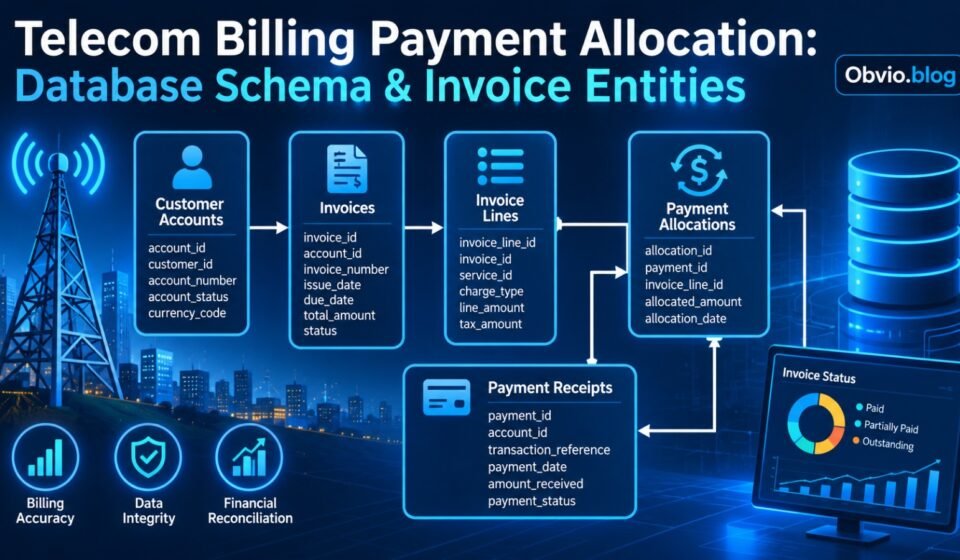
Telecom Billing Payment Allocation: Invoice Entities, Database Fields, and Schema Design

Introduction
A telecom billing system must manage thousands or even millions of customer transactions, including monthly subscriptions, mobile data usage, voice calls, roaming charges, device installments, taxes, and additional services.
Managing these transactions requires more than generating invoices and recording payments. A billing database must also understand which payment belongs to which invoice, how much money has been applied, and what balance remains outstanding.
This is where telecom billing payment allocation invoice entity fields database design becomes important.
Payment allocation connects customer payments with outstanding invoices or individual invoice items. It allows a billing platform to track partial payments, multiple invoices, outstanding balances, payment reversals, and financial reconciliation.
A well-designed database typically uses four important entities:
- Customer Accounts
- Invoices
- Payment Receipts
- Payment Allocations
Depending on the billing requirements, an additional Invoice Lines entity provides more detailed financial tracking.
This guide explains the relationships between these entities, their database fields, SQL implementation, allocation methods, and important data integrity requirements.
1. What Is Payment Allocation in Telecom Billing?
Payment allocation is the process of assigning received money to one or more outstanding invoices, bills, or individual billing items.
For example, consider a telecom customer who receives a monthly invoice of $120.
The invoice contains:
| Billing item | Amount |
|---|---|
| Monthly mobile plan | $50 |
| Mobile data usage | $20 |
| International calls | $15 |
| Device installment | $25 |
| Taxes | $10 |
| Total | $120 |
The customer makes a payment of $80.
The billing system must determine how that $80 should be distributed across the outstanding charges.
Depending on the company’s allocation policy, the system might apply the payment to the oldest charges first, allocate it to the complete invoice, or distribute it across individual invoice lines.
After allocation, the system records:
- Original payment amount: $80
- Allocated payment amount: $80
- Remaining payment amount: $0
- Original invoice amount: $120
- Outstanding invoice balance: $40
This information allows the billing platform to maintain accurate customer balances.
According to Oracle Communications Billing and Revenue Management, payments can be allocated at account, bill, or item level. The appropriate approach depends on the billing configuration and business requirements.
2. Telecom Billing Payment Allocation Entity Relationship Diagram
An entity relationship diagram (ERD) describes how customer accounts, invoices, invoice lines, payment receipts, and payment allocations connect within a relational database.
A practical conceptual structure looks like this:
                  CUSTOMER_ACCOUNTS
                         |
                    1    |    N
                         |
                      INVOICES
                         |
                    1    |    N
                         |
                    INVOICE_LINES
                         |
                    1    |    N
                         |
                  PAYMENT_ALLOCATIONS
                         |
                    N    |    1
                         |
                  PAYMENT_RECEIPTS
                         |
                    N    |    1
                         |
                  CUSTOMER_ACCOUNTS
The relationships can be explained as follows:
- One customer account can generate multiple invoices.
- One invoice can contain multiple invoice lines.
- One payment receipt can have multiple payment allocation records.
- One invoice line can receive allocations from multiple payments.
- The payment allocation table connects payments with the invoice lines they settle.
This creates a many-to-many relationship between payment receipts and invoice lines.
For systems that only require invoice-level allocation, the allocation table can reference invoice_id instead of invoice_line_id.
The database should choose one allocation model or explicitly support both with clear validation rules.
3. Customer Accounts Table
The Customer Accounts table is the foundation of the telecom billing database.
It stores the identity of each billing account and connects customers with their invoices and payment records.
Recommended database fields
| Field | Data type | Purpose |
|---|---|---|
| account_id | UUID | Primary key |
| customer_id | UUID | References customer record |
| account_number | VARCHAR(50) | Unique customer billing number |
| account_name | VARCHAR(150) | Customer or organization name |
| billing_address_id | UUID | References billing address |
| currency_code | CHAR(3) | Account currency |
| account_status | VARCHAR(20) | Active, Suspended, Closed |
| created_at | TIMESTAMP | Account creation date |
| updated_at | TIMESTAMP | Last modification date |
Why is this entity important?
The account entity allows the billing system to identify which customer owns an invoice or payment.
For example, a business customer may have several mobile subscriptions under one account. Instead of maintaining separate customer-level billing records for every subscription, the system can organize invoices and payments through the main billing account.
Larger telecom platforms may also introduce separate billing accounts or bill units to manage different services, subsidiaries, or payment arrangements.
4. Invoices Table
The Invoices table stores the financial summary of each billing document generated during a billing cycle.
An invoice usually represents the total amount a customer must pay for a particular billing period.
Recommended invoice database fields
| Field | Data type | Purpose |
|---|---|---|
| invoice_id | UUID | Primary key |
| account_id | UUID | Customer account reference |
| billing_cycle_id | UUID | Billing cycle reference |
| invoice_number | VARCHAR(50) | Unique invoice number |
| issue_date | TIMESTAMP | Invoice generation date |
| due_date | TIMESTAMP | Payment deadline |
| subtotal_amount | NUMERIC(19,4) | Charges before tax |
| tax_amount | NUMERIC(19,4) | Total applicable taxes |
| total_amount | NUMERIC(19,4) | Complete invoice amount |
| amount_paid | NUMERIC(19,4) | Total applied payments |
| balance_due | NUMERIC(19,4) | Outstanding amount |
| currency_code | CHAR(3) | Invoice currency |
| status | VARCHAR(30) | Current invoice status |
| created_at | TIMESTAMP | Creation timestamp |
| updated_at | TIMESTAMP | Last update timestamp |
Understanding invoice status
An invoice status helps the billing platform determine whether a customer has completed payment.
Common statuses include:
- Draft: Invoice is being prepared.
- Issued: Invoice has been generated and sent.
- Partially Paid: Some money has been allocated, but a balance remains.
- Paid: The complete amount has been settled.
- Overdue: The payment deadline has passed while an amount remains outstanding.
- Written Off: The outstanding balance has been handled through an authorized write-off process.
- Voided: The invoice has been cancelled according to business rules.
The system should calculate invoice status based on its financial state and applicable business rules rather than allowing arbitrary status changes.
Example
Suppose a customer receives an invoice for $150 and makes two separate payments.
| Transaction | Amount |
|---|---|
| Original invoice | $150 |
| First payment | $60 |
| Second payment | $90 |
| Remaining balance | $0 |
The invoice becomes fully paid after both payments have been successfully allocated.
This is particularly important for telecom businesses that allow customers to make payments through different channels.
5. Invoice Lines Table
An invoice can contain several different types of telecom charges.
The Invoice Lines table stores these individual charges instead of keeping all financial information in one invoice record.
This structure is useful when a billing platform needs detailed reporting, service-level reconciliation, or item-level payment allocation.
Recommended database fields
| Field | Data type | Purpose |
|---|---|---|
| invoice_line_id | UUID | Primary key |
| invoice_id | UUID | Parent invoice reference |
| service_id | UUID | Related telecom service |
| charge_type | VARCHAR(30) | Type of billing charge |
| service_type | VARCHAR(80) | Voice, Data, Roaming, etc. |
| description | VARCHAR(255) | Charge description |
| quantity | NUMERIC(12,4) | Units consumed |
| unit_price | NUMERIC(19,4) | Price per unit |
| line_amount | NUMERIC(19,4) | Charge before tax |
| tax_amount | NUMERIC(19,4) | Line-level tax |
| total_line_amount | NUMERIC(19,4) | Charge including tax |
| amount_paid | NUMERIC(19,4) | Amount allocated |
| balance_due | NUMERIC(19,4) | Outstanding line balance |
| created_at | TIMESTAMP | Creation timestamp |
Common telecom invoice line categories
Recurring charges: Monthly subscription fees, data packages, and voice plans.
Usage charges: Charges based on actual mobile data consumption, international calls, SMS messages, and roaming activity.
One-time charges: SIM activation, installation, device purchases, and service changes.
Taxes and adjustments: Applicable government taxes, service credits, discounts, and financial adjustments.
A system should define whether taxes are represented as separate invoice lines or as tax attributes associated with charge lines. It should not accidentally count the same tax twice.
Why invoice-level and line-level allocation are different
Invoice-level allocation is simpler because the payment is matched against the invoice’s total outstanding balance.
Line-level allocation offers more granular control.
For example, a telecom company may need to identify whether a payment settled a device installment, a monthly subscription, or international usage charges.
This distinction can become important when handling disputed charges, tax reporting, refunds, and general ledger reconciliation.
6. Payment Receipts Table
The Payment Receipts table records money received from customers through supported payment channels.
A payment receipt should represent the original financial transaction, not simply the amount applied to an invoice.
A customer may make a payment without specifying an invoice. The system should still be able to record that payment and allocate it later.
Recommended database fields
| Field | Data type | Purpose |
|---|---|---|
| payment_id | UUID | Primary key |
| account_id | UUID | Customer account reference |
| payment_method_id | UUID | Payment method reference |
| transaction_reference | VARCHAR(150) | External gateway reference |
| payment_date | TIMESTAMP | Payment effective date |
| received_at | TIMESTAMP | Time received by the system |
| amount_received | NUMERIC(19,4) | Original payment amount |
| currency_code | CHAR(3) | Payment currency |
| unallocated_amount | NUMERIC(19,4) | Amount not yet allocated |
| payment_status | VARCHAR(30) | Payment processing status |
| idempotency_key | VARCHAR(100) | Duplicate request protection |
| created_at | TIMESTAMP | Creation timestamp |
Supported payment methods
Telecom billing platforms commonly support:
- Credit and debit cards
- Bank transfers
- Direct debit
- Digital wallets
- Mobile money
- Cash payments
- Third-party payment gateways
The payment_method_id should reference a separate payment method entity rather than storing sensitive card or bank details directly in the payment receipt.
Payment status values
A payment can have different statuses depending on the payment processing lifecycle:
- Pending
- Authorized
- Cleared
- Failed
- Partially Reversed
- Reversed
- Refunded
The exact statuses depend on the payment processor and accounting workflow.
A pending or failed transaction should not automatically reduce an invoice’s outstanding balance.
Only an eligible and successfully recognized payment should enter the allocation process.
7. Payment Allocations Table
The Payment Allocations table is the central entity in this database design.
It records how much money from a particular payment has been applied to an invoice or invoice line.
Without this table, a billing platform would struggle to manage one payment covering multiple invoices or multiple payments settling one invoice.
Recommended database fields
| Field | Data type | Purpose |
|---|---|---|
| allocation_id | UUID | Primary key |
| payment_id | UUID | Payment receipt reference |
| invoice_line_id | UUID | Invoice line reference |
| allocated_amount | NUMERIC(19,4) | Applied payment amount |
| allocation_date | TIMESTAMP | Allocation processing date |
| allocation_type | VARCHAR(30) | Automatic or manual |
| allocation_status | VARCHAR(20) | Allocation status |
| allocation_reference | VARCHAR(100) | Reference for tracking |
| created_by | UUID | User or system actor |
| created_at | TIMESTAMP | Record creation time |
For invoice-level allocation, replace invoice_line_id with invoice_id.
Allocation types
Automatic allocation: The billing system applies payments using configured rules.
Manual allocation: An authorized employee chooses which invoices or lines receive the payment.
Reallocation: An existing allocation is reversed or adjusted and the funds are assigned elsewhere.
Suspense allocation: An unidentified or unmatched payment is held until the correct customer or invoice is identified.
Example of multiple allocations
A customer has two unpaid invoices:
| Invoice | Outstanding amount |
|---|---|
| Invoice INV-1001 | $70 |
| Invoice INV-1002 | $50 |
The customer makes a payment of $100.
The allocation table could contain:
| Allocation ID | Payment ID | Invoice | Allocated amount |
|---|---|---|---|
| AL-001 | PAY-100 | INV-1001 | $70 |
| AL-002 | PAY-100 | INV-1002 | $30 |
The resulting balances are:
- INV-1001: $0
- INV-1002: $20
- Remaining unallocated payment: $0
This structure maintains a clear relationship between the original payment and the invoices it settles.
8. How Automatic FIFO Payment Allocation Works
FIFO stands for First In, First Out.
In payment allocation, FIFO generally means applying available customer payments to the oldest eligible outstanding invoice first.
This method can help telecom companies manage overdue accounts and reduce the number of unpaid billing records.
Example
A customer has three outstanding invoices:
| Invoice | Due date | Balance |
|---|---|---|
| INV-101 | January 5 | $40 |
| INV-102 | February 5 | $60 |
| INV-103 | March 5 | $50 |
The customer makes a payment of $80.
The FIFO allocation process works as follows:
- Retrieve all eligible unpaid invoices for the account.
- Sort invoices by due date, with a stable secondary ordering such as invoice ID.
- Select the oldest outstanding invoice.
- Allocate $40 to INV-101.
- Allocate the remaining $40 to INV-102.
- Stop when no payment balance remains.
The final result is:
| Invoice | Original balance | Allocated | Remaining |
|---|---|---|---|
| INV-101 | $40 | $40 | $0 |
| INV-102 | $60 | $40 | $20 |
| INV-103 | $50 | $0 | $50 |
The system must also support alternative allocation policies when required by business agreements or customer instructions.
For example, some telecom companies prioritize invoices based on service type, billing account, or contractual payment rules.
9. SQL Database Schema for Telecom Payment Allocation
The following example demonstrates how the main entities can be implemented using PostgreSQL.
The schema is a practical starting point rather than a complete production billing platform.
Customer accounts
CREATE TABLE customer_accounts (
    account_id UUID PRIMARY KEY,
    account_number VARCHAR(50) UNIQUE NOT NULL,
    account_status VARCHAR(20) NOT NULL,
    currency_code CHAR(3) NOT NULL,
    created_at TIMESTAMPTZ DEFAULT NOW()
);
Invoices
CREATE TABLE invoices (
    invoice_id UUID PRIMARY KEY,
    account_id UUID NOT NULL
        REFERENCES customer_accounts(account_id),

    invoice_number VARCHAR(50) UNIQUE NOT NULL,
    issue_date TIMESTAMPTZ NOT NULL,
    due_date TIMESTAMPTZ NOT NULL,

    total_amount NUMERIC(19,4) NOT NULL,
    amount_paid NUMERIC(19,4) DEFAULT 0,
    balance_due NUMERIC(19,4) NOT NULL,

    status VARCHAR(30) NOT NULL,

    CHECK (total_amount >= 0),
    CHECK (amount_paid >= 0),
    CHECK (balance_due >= 0)
);
Invoice lines
CREATE TABLE invoice_lines (
    invoice_line_id UUID PRIMARY KEY,
    invoice_id UUID NOT NULL
        REFERENCES invoices(invoice_id),

    charge_type VARCHAR(30) NOT NULL,
    service_type VARCHAR(80),

    line_amount NUMERIC(19,4) NOT NULL,
    tax_amount NUMERIC(19,4) DEFAULT 0,
    total_line_amount NUMERIC(19,4) NOT NULL,

    amount_paid NUMERIC(19,4) DEFAULT 0,
    balance_due NUMERIC(19,4) NOT NULL,

    CHECK (total_line_amount >= 0),
    CHECK (amount_paid >= 0),
    CHECK (balance_due >= 0)
);
Payment receipts
CREATE TABLE payment_receipts (
    payment_id UUID PRIMARY KEY,
    account_id UUID NOT NULL
        REFERENCES customer_accounts(account_id),

    transaction_reference VARCHAR(150),
    payment_date TIMESTAMPTZ NOT NULL,

    amount_received NUMERIC(19,4) NOT NULL,
    unallocated_amount NUMERIC(19,4) NOT NULL,

    currency_code CHAR(3) NOT NULL,
    payment_status VARCHAR(30) NOT NULL,

    idempotency_key VARCHAR(100),

    CHECK (amount_received >= 0),
    CHECK (unallocated_amount >= 0),

    UNIQUE (idempotency_key)
);
Payment allocations
CREATE TABLE payment_allocations (
    allocation_id UUID PRIMARY KEY,

    payment_id UUID NOT NULL
        REFERENCES payment_receipts(payment_id),

    invoice_line_id UUID NOT NULL
        REFERENCES invoice_lines(invoice_line_id),

    allocated_amount NUMERIC(19,4) NOT NULL,

    allocation_type VARCHAR(30) NOT NULL,
    allocation_status VARCHAR(20) NOT NULL,

    allocation_date TIMESTAMPTZ DEFAULT NOW(),

    CHECK (allocated_amount > 0)
);
This schema creates the core relationships required to connect customer payments with outstanding invoice lines.
Additional production requirements include account and currency validation, payment reversals, audit history, appropriate indexes, and transaction-level enforcement of allocation limits.
10. Important Database Integrity Constraints
Payment allocation involves multiple financial records. A database must prevent invalid transactions from creating incorrect customer balances.
Several integrity rules are particularly important.
1. Payment allocation limit
The total allocated amount must never exceed the amount available from a payment.
For example:
Original payment:       $100
Allocated amount:       $80
Unallocated amount:     $20
The fundamental rule is:
SUM(valid allocations) <= amount_receivedThe system must account for reversals and cancelled allocations when calculating the valid allocation total.
2. Invoice balance protection
An allocation cannot exceed the outstanding invoice or invoice-line balance.
For example:
Invoice line balance:   $50
Requested allocation:   $70
The transaction must be rejected because the requested allocation exceeds the outstanding balance.
3. Account ownership validation
A payment belonging to one customer account must not be allocated to another account unless the system explicitly supports authorized cross-account transfers.
This requires validating the payment’s account against the account associated with the target invoice.
4. Currency validation
The payment currency and invoice currency must be compatible.
If a customer pays in another currency, the billing platform needs a documented exchange-rate and currency-conversion process.
The original transaction amount, converted amount, exchange rate, and conversion timestamp should be auditable.
5. Transaction consistency
Payment allocation must run inside a database transaction.
The system should:
- Lock the relevant payment record.
- Lock the target invoice-line records.
- Recheck available payment and invoice balances.
- Insert allocation records.
- Update the corresponding financial balances.
- Commit all changes together.
If any operation fails, the transaction should roll back.
PostgreSQL supports row-level locking through SELECT FOR UPDATE, which helps prevent concurrent transactions from modifying the same financial records simultaneously.
Importantly, aggregate limits across multiple allocation rows should not rely on a normal SQL CHECK constraint. They need transactional enforcement through application logic, carefully designed triggers, or another suitable database-level mechanism.
11. Database Indexing for High-Performance Telecom Billing
Large telecom billing databases can process millions of invoice and payment records.
Without appropriate indexing, payment allocation queries can become expensive.
The following indexes provide a useful starting point:
CREATE INDEX idx_invoices_account
ON invoices(account_id);

CREATE INDEX idx_invoices_due_date
ON invoices(account_id, due_date);

CREATE INDEX idx_invoice_lines_invoice
ON invoice_lines(invoice_id);

CREATE INDEX idx_payments_account
ON payment_receipts(account_id);

CREATE INDEX idx_allocations_payment
ON payment_allocations(payment_id);

CREATE INDEX idx_allocations_invoice_line
ON payment_allocations(invoice_line_id);
These indexes help the system:
- Retrieve customer invoices quickly.
- Find outstanding invoices by due date.
- Retrieve invoice lines efficiently.
- Identify payments associated with an account.
- Calculate allocations for a particular payment.
- Review the payment history of individual invoice lines.
For very large databases, additional techniques may include partitioning, query optimization, archival strategies, and carefully maintained summary balances.
Indexes should be selected using actual query patterns and execution plans because excessive indexing also increases storage and write overhead.
12. Handling Payment Reversals, Refunds, and Unallocated Payments
A production telecom billing platform must handle more than successful payments.
Payments can be reversed, refunded, suspended, or received without sufficient invoice information.
These situations require dedicated financial records.
Payment reversals
A payment reversal occurs when an earlier payment must be cancelled or corrected.
For example, a bank transfer may initially appear successful but later be rejected.
The system should preserve the original payment and its allocation history instead of simply deleting the transaction.
A reversal record should contain:
- Reversal ID
- Original payment ID
- Reversal amount
- Reversal reason
- Effective date
- Processing timestamp
- Related allocation references
If the original payment was already allocated, the system must reverse the affected allocations and restore the outstanding invoice balances.
Refunds
A refund returns money to the customer.
Refunds should be recorded separately from ordinary payment allocations because they represent a different financial event.
A refund may be full or partial and should reference the original payment transaction.
Unallocated payments
Sometimes a customer sends money without providing an invoice number or sufficient account information.
Instead of rejecting or incorrectly applying the payment, the billing platform can store it as unallocated or place it in a payment suspense workflow.
Once the correct customer account or invoice is identified, the payment can be allocated.
Oracle BRM provides a useful example of this approach through its payment suspense and deferred allocation functionality.
13. Best Practices for Designing a Telecom Billing Database
A reliable database architecture should consider financial accuracy, operational performance, and future scalability.
Here are important design recommendations.
Use separate entities for payments and allocations. A payment receipt represents money received, while an allocation represents how that money is applied.
Support partial payments. Customers may pay an invoice through multiple transactions. The database must retain the outstanding balance until the invoice is fully settled.
Maintain allocation history. Avoid deleting financial records when allocations are corrected. Preserve reversals and adjustment references.
Use idempotency protection. Payment gateways may send the same notification more than once. Unique transaction references and idempotency keys help prevent duplicate payment records.
Keep monetary precision consistent. Use fixed-precision decimal types instead of floating-point values for financial calculations. Apply currency-specific rounding rules.
Separate payment processing from allocation. A successfully received payment does not necessarily mean that it has been allocated to a particular invoice.
Protect concurrent transactions. Use database transactions, row-level locking, and appropriate isolation controls to prevent double allocation.
Build audit capabilities. Record who or what created an allocation, when it happened, and why a reversal or adjustment occurred.
Monitor reconciliation differences. Compare payment gateway records, payment receipts, allocations, and accounting entries to identify unmatched or inconsistent transactions.
14. Frequently Asked Questions
What is payment allocation in telecom billing?
Payment allocation is the process of applying customer payments to outstanding invoices, bills, or individual billing items. It helps telecom companies maintain accurate balances and financial records.
Which entities are required for a payment allocation database?
The core entities are Customer Accounts, Invoices, Payment Receipts, and Payment Allocations. Invoice Lines are also recommended when detailed charge-level allocation is required.
What is the relationship between invoices and payment allocations?
An invoice can receive payments through multiple allocation records. Likewise, one payment can be distributed across multiple invoices. This creates a many-to-many relationship managed through a payment allocation bridge table.
What is FIFO payment allocation?
FIFO means First In, First Out. The system applies available payments to the oldest eligible outstanding invoices first, following the configured allocation policy.
Can one payment settle multiple telecom invoices?
Yes. A payment allocation table allows one payment receipt to be distributed across several invoices while preserving the amount applied to each invoice.
How should a telecom database handle partial payments?
The system should record the original payment, create an allocation for the amount applied, and update the outstanding invoice balance. The invoice remains partially paid until its eligible balance reaches zero.
Why is invoice-line-level allocation important?
Invoice-line-level allocation provides detailed visibility into how payments settle individual charges, such as subscriptions, roaming, data usage, device installments, and taxes. It is useful for detailed financial reconciliation and dispute management.
How can a telecom billing database prevent duplicate payment allocations?
It can use database transactions, row-level locking, idempotency keys, unique gateway transaction references, and allocation balance validation.
Conclusion
A well-designed telecom billing payment allocation database requires clear relationships between customer accounts, invoices, invoice lines, payment receipts, and payment allocations.
The most important architectural decision is selecting the correct allocation level. So the invoice-level allocation provides a simpler structure, while invoice-line-level allocation offers greater financial detail and control.
By using relational database entities, appropriate SQL data types, transactional processing, indexing, audit records, and allocation validation, telecom companies can build billing platforms that handle partial payments, multiple invoices, reversals, and high transaction volumes reliably.
The goal is not simply to record incoming money. It is to maintain an accurate and auditable connection between every payment received and the financial obligations it settles.