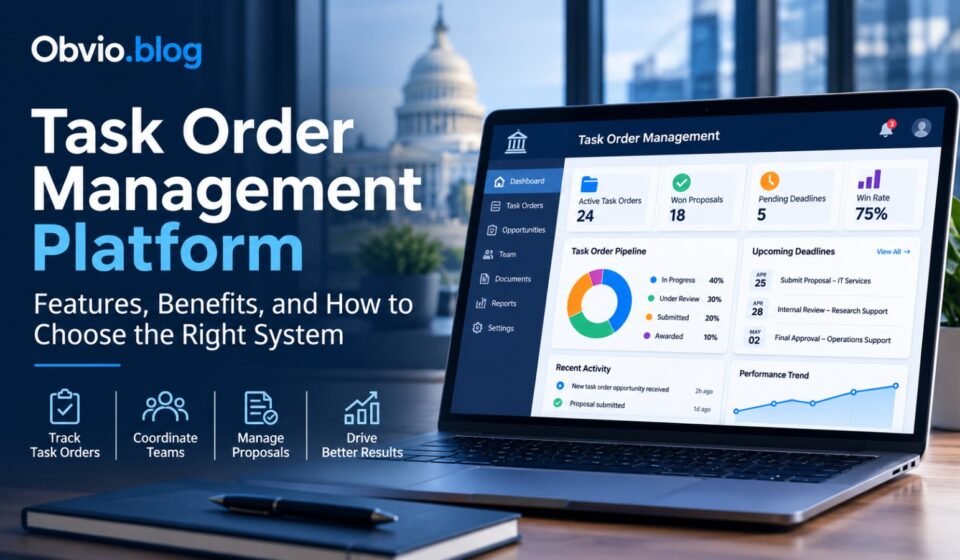
Task Order Management Platform: Features, Benefits, and How to Choose the Right System

Managing multiple contracts, task assignments, proposal deadlines, and team responsibilities can become complicated without a structured system. Government contractors and project management teams often deal with large volumes of task orders, changing requirements, subcontractor coordination, and strict submission deadlines.
Traditional spreadsheets, emails, and disconnected tools can make these processes difficult to control. Important documents may get lost, team members may miss updates, and managers may struggle to understand the progress of individual assignments.
This is where a task order management platform becomes valuable.
A task order management platform provides a centralized environment for organizing contract-related assignments, tracking opportunities, coordinating proposal activities, managing approvals, and monitoring performance. Depending on the software, it can also automate notifications, simplify communication, and provide real-time visibility into ongoing work.
In this guide, we will explore how task order management platforms work, their essential features, their benefits for government contractors, and the factors businesses should consider before choosing a solution.
What Is a Task Order Management Platform?
A task order management platform is a software solution designed to organize, manage, track, and monitor individual task orders throughout their lifecycle.
A task order is generally an assignment issued under an existing contract that defines specific services, deliverables, requirements, pricing arrangements, and performance expectations.
For example, a government agency may establish a long-term contract with several qualified companies. Instead of creating an entirely new contract for every requirement, the agency can issue individual task orders under the existing contract.
Each task order may have different deadlines, technical requirements, budgets, and participating contractors.
A management platform helps organizations handle these assignments through a centralized system.
Depending on its capabilities, the software may allow users to:
- Organize task orders under different contract vehicles.
- Monitor new requests for proposals and quotations.
- Assign responsibilities to internal employees.
- Coordinate subcontractors and external partners.
- Track proposal preparation and submission deadlines.
- Manage documents, approvals, and revisions.
- Monitor contract and task order performance.
- Generate reports for management and decision-making.
Rather than relying on scattered spreadsheets and email conversations, businesses can maintain a more organized process with clear responsibilities and documented progress.
How Does a Task Order Management System Work?
A task order management system typically connects several activities into one coordinated workflow.
Although the exact process depends on the software and organization, most systems follow a similar sequence.
1. Task Order Identification
The process begins when an organization identifies a new task order opportunity or receives a task order request.
For government contractors, these opportunities may arrive through government procurement portals, contract vehicles, or other authorized communication channels.
A centralized platform can help teams collect relevant information, including:
- Task order identification numbers.
- Contract vehicle information.
- Issuing agency.
- Scope of work.
- Proposal submission deadlines.
- Estimated contract value.
- Required qualifications.
- Supporting documents.
Having these details available in one location makes it easier to review new opportunities.
2. Opportunity Evaluation
Not every task order is suitable for every contractor.
Before investing time and resources in a proposal, businesses need to evaluate whether they have the technical capabilities, financial resources, and available personnel to complete the work.
A task order management platform can support this evaluation by organizing opportunity requirements and comparing them with existing company capabilities.
Managers can assess factors such as:
- Technical requirements.
- Available labor categories.
- Estimated labor costs.
- Relevant experience.
- Subcontractor capabilities.
- Proposal preparation time.
- Potential business value.
This information supports more informed bid/no-bid decisions.
3. Team Assignment and Collaboration
Once an organization decides to pursue an opportunity, managers need to identify the employees and partners responsible for preparing the response.
A platform can help assign activities to proposal writers, technical specialists, financial teams, reviewers, and subcontractors.
Each participant can receive specific responsibilities and deadlines.
For example:
| Team member | Responsibility |
|---|---|
| Project Manager | Overall coordination |
| Proposal Writer | Technical proposal preparation |
| Finance Team | Pricing and cost estimates |
| Technical Team | Requirements and solution development |
| Subcontractor | Supporting qualifications and documentation |
| Reviewer | Quality assurance and final review |
This structure reduces confusion and makes accountability easier to maintain.
4. Proposal Preparation and Submission
Proposal preparation often involves multiple documents, revisions, approvals, and communication between different departments.
A task order management system can provide a shared workspace where authorized participants access relevant files, review updates, and contribute to proposal development.
Some advanced platforms also support reusable proposal content, document version control, collaborative editing, and automated workflow activities.
These capabilities help teams reduce repetitive work and maintain consistency across multiple submissions.
5. Performance Tracking and Reporting
After a task order has been submitted or awarded, managers may need to monitor its progress and review performance.
Depending on the platform’s scope, reporting capabilities can include:
- Active task orders.
- Proposal submission status.
- Team participation.
- Upcoming deadlines.
- Contract performance.
- Labor costs.
- Historical bid results.
- Completed assignments.
These reports provide management with a clearer understanding of business activities and operational performance.
Essential Features of a Task Order Management Platform
Not every platform offers the same capabilities. However, several features are particularly important for organizations managing multiple contracts and task order opportunities.
1. Centralized Task Order Dashboard
A centralized dashboard provides an overview of active, pending, completed, and upcoming task orders.
Instead of checking multiple spreadsheets and email conversations, authorized users can review important information from one interface.
A useful dashboard should display:
- Task order names and identification numbers.
- Contract information.
- Current status.
- Assigned team members.
- Important deadlines.
- Pending approvals.
- Submission progress.
This visibility helps managers identify delays and prioritize important assignments.
2. Automated Task Order Monitoring
Monitoring new task order opportunities manually can consume considerable time.
Some platforms provide automated monitoring capabilities that collect incoming notices, organize relevant information, and notify responsible employees.
For example, Federal Compass provides functionality for monitoring task order notices, filtering opportunities, and triggering internal workflows.
Automation can help businesses:
- Reduce repetitive manual checks.
- Identify relevant opportunities faster.
- Receive notifications about new requests.
- Organize supporting documents.
- Reduce the possibility of overlooked deadlines.
However, organizations should confirm which procurement sources their selected platform actually supports.
3. Workflow Automation
Workflow automation allows organizations to establish repeatable processes for managing task orders.
For example, when a new opportunity enters the system, the platform may automatically notify the business development team, create an evaluation assignment, and establish an internal review deadline.
Other automated activities may include:
- Approval requests.
- Proposal review notifications.
- Document submission reminders.
- Assignment updates.
- Deadline alerts.
- Status changes.
These workflows help teams maintain consistency, particularly when managing several opportunities simultaneously.
4. Document Management and Version Control
Task order proposals can involve technical documents, pricing information, compliance records, company qualifications, and subcontractor submissions.
Without proper document management, employees may accidentally use outdated files or overlook required attachments.
A suitable platform should provide:
- Centralized document storage.
- Secure file access.
- Document revision history.
- Version control.
- Approval tracking.
- Supporting file attachments.
- Document submission notifications.
For example, the Task Order Management System (TOMS) Version 1.3 includes document requirements, approval and rejection processes, email notifications, and upload history.
These capabilities are particularly useful when prime contractors coordinate documentation from multiple subcontractors.
5. Subcontractor and Partner Management
Government contracting often involves multiple organizations working together to prepare proposals and deliver services.
A prime contractor may need to evaluate several subcontractors before selecting the most appropriate team for an opportunity.
A task order management platform can centralize partner information and support collaboration between internal employees and external participants.
Useful capabilities include:
- Subcontractor profiles.
- Technical qualification records.
- Labor category information.
- Partner availability.
- Participation requests.
- Document collection.
- Approval workflows.
- Communication history.
Some platforms also allow contractors to compare technical qualifications and labor costs before selecting their participating team members.
This can make team selection more structured and transparent.
6. Task Assignment and Deadline Tracking
A task order may involve dozens of individual activities.
For example, preparing one proposal might require technical research, pricing calculations, document collection, compliance checks, and management approval.
A platform should make it possible to assign each activity to a responsible person and establish a clear deadline.
Important capabilities include:
- Individual task assignments.
- Priority settings.
- Due dates.
- Progress tracking.
- Automated reminders.
- Task reassignment.
- Completion records.
These features help prevent responsibilities from becoming unclear.
7. Reporting and Performance Analytics
Reporting is essential for understanding how efficiently an organization manages its task order pipeline.
A good platform should provide reports that help managers evaluate both current activities and historical performance.
Useful performance indicators include:
- Number of active task orders.
- Proposal completion time.
- Bid and win rates.
- Missed deadlines.
- Team participation.
- Proposal preparation costs.
- Contract performance.
- Subcontractor contribution.
Some systems allow reports to be exported into formats such as PDF, Excel, and Word.
With reliable reporting, managers can identify operational weaknesses and improve future proposal strategies.
Benefits of Using a Task Order Management Platform
Implementing a structured management system can improve several aspects of contract administration and business development.
Improved Organizational Visibility
When information is distributed across multiple tools, managers may struggle to understand the overall status of their task orders.
A centralized platform brings important records, assignments, documents, and deadlines into one environment.
This makes it easier to identify pending work and understand which activities require attention.
Faster Proposal Preparation
Government contractors frequently work under demanding proposal deadlines.
Reusable documents, standardized workflows, centralized information, and automated notifications can reduce unnecessary administrative work.
For example, proposal teams can access previously prepared company information instead of repeatedly requesting the same documents from different departments.
Better Team Coordination
Task order opportunities often require cooperation between several departments and external partners.
A centralized workspace helps participants understand their responsibilities and access the information needed to complete their assignments.
This can reduce communication gaps and improve coordination.
Fewer Administrative Errors
Manual processes increase the possibility of incorrect document versions, missed deadlines, duplicate assignments, and incomplete records.
Automated reminders, document tracking, and structured approval processes can reduce these risks.
However, software does not eliminate the need for human review and compliance checks.
Better Business Decisions
Managers need reliable information before deciding which opportunities to pursue.
By organizing technical qualifications, labor costs, partner information, and historical results, a platform can support more informed business decisions.
Improved Accountability
When responsibilities and deadlines are recorded in one system, managers can identify who is responsible for each activity.
Task histories and progress reports also help organizations understand where delays occur and how processes can be improved.
Task Order Management vs. Work Order Management
The terms task order management and work order management are sometimes used interchangeably. However, they generally refer to different business processes.
Understanding the difference is important when selecting software.
What Is Task Order Management?
Task order management primarily focuses on contract-based assignments and procurement activities.
It is particularly relevant to government contractors, prime contractors, subcontractors, and organizations managing multiple award contracts.
Common activities include:
- Contract vehicle management.
- Task order opportunity tracking.
- Proposal preparation.
- Bid/no-bid evaluation.
- Partner selection.
- Contract documentation.
- Proposal approvals.
- Task order reporting.
What Is Work Order Management?
Work order management focuses on individual operational jobs that need to be completed.
For example, a hotel may need to repair an air conditioning unit, while a manufacturing facility may need to schedule equipment maintenance.
Work order software helps managers create, assign, schedule, and track these activities.
Common capabilities include:
- Maintenance requests.
- Equipment repair assignments.
- Preventive maintenance.
- Technician scheduling.
- Asset tracking.
- Inspection records.
- Parts inventory.
- Maintenance reporting.
Key Differences
| Comparison | Task Order Management | Work Order Management |
|---|---|---|
| Main purpose | Manage contract-based assignments | Manage operational jobs |
| Primary users | Government contractors and procurement teams | Maintenance and facility teams |
| Main activities | Bidding, proposals, approvals | Repairs, inspections, maintenance |
| Important documents | Contracts and proposals | Work instructions and maintenance records |
| Key performance indicators | Win rates and proposal progress | Completion time and equipment downtime |
| Typical environment | Government contracting | Manufacturing, hospitality, facilities |
Both systems help organizations improve accountability and workflow visibility, but their primary objectives are different.
Examples of Task Order and Work Order Management Software
Different software products serve different requirements. The following examples illustrate how platforms approach these management processes.
1. Federal Compass
Federal Compass provides business development and opportunity management solutions for government contractors.
Its task order management capabilities focus on monitoring task order notices, filtering opportunities, automating workflows, and coordinating internal teams.
Its centralized approach is useful for organizations that want better visibility into government contracting opportunities and proposal pipelines.
2. Octant
Octant provides integrated capture, proposal, and IDIQ task order management capabilities.
Its platform focuses on proposal development, contract vehicle management, collaboration with external partners, and reusable proposal information.
The software also supports reporting and coordinated workspaces for organizations managing complex proposal activities.
3. R3 Task Order Factory
R3 Task Order Factory is designed to help federal contractors organize IDIQ task order proposal responses.
Its capabilities include task order pipelines, separate workspaces, standardized activities, proposal assignments, collaborative document development, and reporting.
The platform is particularly relevant to contractors managing high volumes of task order opportunities and multiple participating teams.
4. Task Order Management System (TOMS)
TOMS is designed to help prime contractors coordinate task order activities and subcontractor participation.
Its Version 1.3 capabilities include technical and cost-based team-member evaluation, labor rate management, document approvals, customizable data fields, and performance reporting.
These functions can help prime contractors evaluate potential team members before and after receiving a task order opportunity.
5. Coast
Coast is primarily a work order and maintenance management platform rather than a government task order proposal system.
It provides centralized work order management, maintenance scheduling, asset records, team communication, and reporting.
Its mobile capabilities can be useful for maintenance teams that need to update assignments while working in the field.
6. Snapfix
Snapfix focuses on visual and mobile-first work order management.
Its features include photo-based issue reporting, QR code tagging, recurring maintenance scheduling, task status tracking, multilingual support, and offline functionality.
It is particularly relevant to hospitality, property management, and facility operations.
Important: These platforms should not be treated as direct substitutes. Organizations should compare solutions according to whether they need government contract and proposal management or operational maintenance and work order management.
How to Choose the Right Task Order Management Platform
Selecting the right software requires more than comparing feature lists.
Businesses should evaluate their existing processes, team structure, contract requirements, and future operational needs.
Here are seven important considerations.
1. Understand Your Business Requirements
Start by identifying the main problems your organization wants to solve.
For example:
- Do you struggle to monitor incoming task order opportunities?
- Are proposal deadlines frequently missed?
- Is subcontractor communication difficult?
- Do employees have problems locating the latest documents?
- Do managers lack visibility into proposal progress?
Understanding these challenges will help narrow down the appropriate software category.
2. Evaluate Workflow Customization
Every organization has different approval procedures, proposal stages, and reporting requirements.
Choose a platform that supports customizable workflows, user roles, task assignments, and approval processes.
This will make it easier to adapt the software to your existing operations.
3. Check Document Management Capabilities
Document management should be a major consideration for organizations handling government proposals.
Look for secure storage, version history, controlled access, document approvals, and collaboration features.
Also verify whether the platform supports the file formats and document processes your organization requires.
4. Review Integration Options
Your organization may already use CRM, accounting, document management, and project management systems.
A new platform should work with existing business applications whenever possible.
Depending on your requirements, useful integrations may include:
- Microsoft SharePoint.
- Microsoft Dynamics.
- Salesforce.
- Deltek.
- Document management systems.
- Reporting and analytics tools.
Always confirm integration availability and compatibility with the software provider.
5. Consider Security and User Permissions
Task order information may include sensitive commercial data, financial details, and confidential proposal documents.
Look for role-based access controls, secure authentication, audit logs, encryption, backup procedures, and appropriate data hosting arrangements.
Government contractors should also evaluate applicable agency, contract, and regulatory security requirements.
Do not assume that every commercial platform automatically meets federal security requirements.
6. Compare Pricing and Scalability
Software costs can vary depending on the number of users, required features, integrations, implementation, and support.
Before purchasing, ask providers about:
- Subscription costs.
- User licensing.
- Implementation fees.
- Customization costs.
- Training.
- Technical support.
- Data storage.
- Additional integration charges.
Also consider whether the system can support increasing task order volumes and additional team members as your organization grows.
7. Request a Demonstration
A product demonstration can help your team understand how the software performs in real working conditions.
Ask the provider to demonstrate an actual workflow, such as receiving a task order opportunity, assigning proposal responsibilities, collecting subcontractor documents, reviewing approvals, and generating a report.
This will provide a better understanding of whether the platform fits your business requirements.
Best Practices for Managing Task Orders Effectively
Choosing suitable software is only one part of improving task order management. Organizations also need consistent internal processes.
Consider the following practices.
Standardize your workflows: Establish consistent stages for opportunity evaluation, proposal preparation, internal review, approval, and submission.
Assign clear responsibilities: Every task should have a designated owner, deadline, and expected outcome.
Maintain accurate records: Keep contract information, proposal documents, partner qualifications, and communication histories updated.
Use automated notifications: Set reminders for important deadlines, pending approvals, and required documentation.
Review performance regularly: Analyze completed proposals, missed deadlines, and team performance to identify areas for improvement.
Protect sensitive information: Establish appropriate user permissions and review access to confidential documents.
Keep reusable proposal content updated: Maintain current company qualifications, technical information, past performance records, and standard documentation.
These practices can help organizations establish a more predictable and manageable task order process.
Frequently Asked Questions (FAQs)
1. What is a task order management platform?
A task order management platform is software that helps organizations organize, monitor, and manage contract-based assignments. It can support opportunity tracking, proposal preparation, team coordination, document management, approvals, and performance reporting.
2. Who uses task order management software?
Government contractors, prime contractors, subcontractors, procurement professionals, business development teams, proposal managers, and contract administrators commonly use task order management software.
3. What is the difference between an IDIQ contract and a task order?
An IDIQ contract establishes an overall contractual arrangement for providing supplies or services over a defined period. Individual task orders specify particular requirements issued under that arrangement.
The task order establishes the specific work, applicable terms, and performance expectations for an individual assignment.
4. Can task order management software automate proposal workflows?
Yes. Depending on the platform, it can automate task assignments, notifications, approval requests, document collection, reminders, and workflow status updates.
Some systems also support reusable proposal content and collaborative document development.
5. What features should a task order management system have?
Important features include centralized dashboards, task order tracking, automated notifications, document management, version control, subcontractor coordination, approval workflows, reporting, and role-based access.
The required feature set depends on the organization’s size and contract management needs.
6. Is task order management the same as project management?
No. Project management covers broader activities such as planning, budgeting, resource allocation, and project delivery.
Task order management focuses specifically on organizing and tracking assignments issued under a contract. However, the two processes can overlap when a task order becomes an active project.
7. Can small businesses use task order management platforms?
Yes. Small government contractors can use these systems to organize opportunities, manage proposal activities, coordinate subcontractors, and track deadlines.
However, the software should match the organization’s actual workload and budget.
8. Does task order management software support subcontractors?
Many specialized platforms provide subcontractor profiles, participation requests, document collection, team selection, communication, and approval features.
These capabilities can help prime contractors coordinate multiple organizations involved in a proposal.
9. How does automation improve task order management?
Automation reduces repetitive administrative activities by triggering notifications, assigning workflows, tracking deadlines, and organizing approval processes.
This allows employees to spend more time evaluating opportunities and preparing quality proposals.
Conclusion
Managing multiple contract assignments requires accurate information, clear responsibilities, reliable communication, and consistent workflows.
A task order management platform helps organizations bring these activities together in a centralized environment. From monitoring new opportunities and evaluating proposals to coordinating subcontractors and tracking performance, the right system can improve visibility and reduce administrative complexity.
However, selecting software should always begin with understanding your business requirements. Government contractors need solutions designed for contract vehicles, proposal workflows, and partner collaboration, while maintenance teams need tools focused on operational work orders, equipment, and service activities.
By evaluating essential features, security, integrations, scalability, and reporting capabilities, organizations can choose a platform that supports their current operations and future growth.