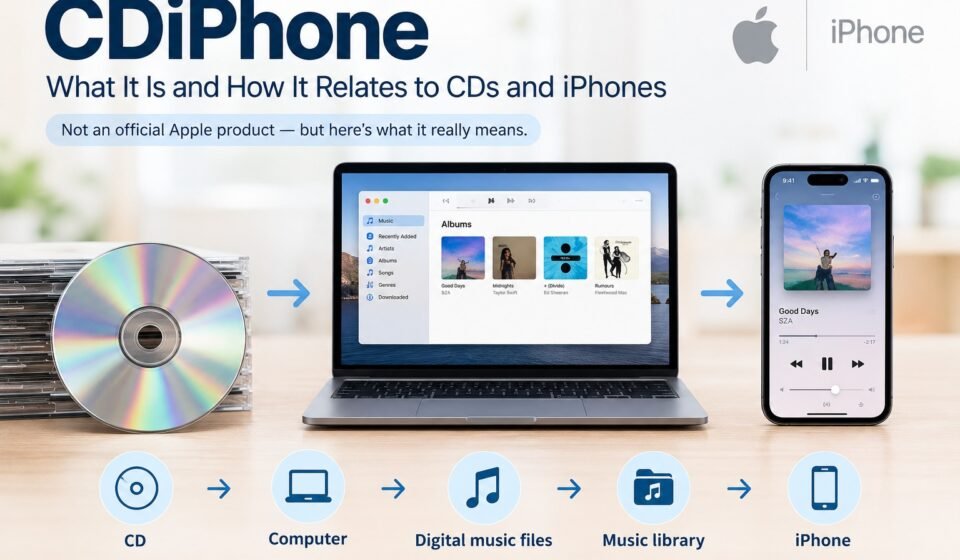

If you have recently searched for cdiphone, you may be wondering whether it is a new Apple device, an iPhone feature, a music-transfer method, or something else entirely.
The confusion is understandable because the term cdiphone appears in different contexts across the web. Some websites use it when discussing the process of putting music from CDs onto an iPhone, while others describe it as a hypothetical device that combines a CD player with a smartphone. There are also discussions where similar wording is confused with older CDMA versions of the iPhone.
The most important fact is simple: Apple has not released an official product called CDiPhone. Apple has used established iPhone model names rather than “CDiPhone,” and there is no confirmed Apple device with a built-in CD drive under this name.
So what does cdiphone actually mean? This guide explains the term, where the confusion comes from, how CDs can be used with an iPhone today, and what you should know before believing claims about a “CD iPhone.”
What Is CDiPhone?
CDiPhone is not an official Apple product name. Instead, it is an informal term that has appeared online in several different contexts.
The word appears to combine two familiar technologies:
- CD — compact disc, traditionally used for music and other digital media
- iPhone — Apple’s smartphone platform
Because the two words are recognizable, people may use “cdiphone” as shorthand when discussing the relationship between physical CD media and modern iPhones.
In practical discussions, the term can refer to the process of transferring music from a CD to an iPhone. In other contexts, it may describe a fictional or conceptual smartphone capable of reading physical discs.
This distinction matters because a number of online articles present CDiPhone as though it were an actual Apple product. There is currently no reliable evidence that Apple has released a device officially named CDiPhone.
Is CDiPhone a Real Apple Product?
No. CDiPhone is not a confirmed official Apple iPhone model.
Apple introduced the original iPhone in 2007 and described it as combining a mobile phone, a widescreen iPod with touch controls, and an Internet communications device. Apple did not introduce it as a CD-based smartphone.
The original iPhone also did not include an optical CD drive. Its design focused on a touchscreen interface, mobile connectivity, digital media and Internet services.
That distinction is important because concept images or articles showing an iPhone with a disc slot do not establish that Apple actually manufactured such a device.
If you encounter a website claiming that Apple sells a “CDiPhone,” look for independent confirmation from Apple’s official website, product documentation, or Apple Newsroom announcements before treating the claim as genuine.
Why Are People Searching for CDiPhone?
There are several possible reasons someone might search for cdiphone.
1. They want to put CD music on an iPhone
This is probably the most practical interpretation of the term.
Many people still own physical music CDs but use an iPhone as their primary music player. That creates an obvious question: how can music stored on a CD be moved onto an iPhone?
The answer involves converting or importing the CD’s tracks into digital audio files and then adding those files to a compatible music library.
2. They are looking for a CD-enabled iPhone
Another possible interpretation is the idea of an iPhone with a built-in CD drive.
This is a conceptual idea rather than an established Apple product. Modern smartphones are designed around flash storage and digital distribution rather than optical discs.
A physical CD drive would require additional hardware, space and mechanical components that are unnecessary for most smartphone use.
3. They encountered the term online
Some users may simply encounter the word cdiphone in an article, forum, video, filename, or search result and want to know what it means.
Because the term does not have one standardized technical definition, the surrounding context is important.
4. They may be confusing it with CDMA iPhones
Another possibility is confusion between “CD iPhone” and CDMA iPhone.
CDMA, or Code Division Multiple Access, was a cellular technology used by some older mobile networks. Earlier iPhone generations were produced in different versions for different network technologies and carriers.
That is different from the idea of a CD-equipped iPhone.
Therefore, CDiPhone and CDMA iPhone should not automatically be treated as the same thing.
CDiPhone vs. a Normal iPhone
A useful way to understand the term is to compare the hypothetical concept with a normal modern smartphone.
| Feature | CDiPhone concept | Modern iPhone |
|---|---|---|
| Official Apple product | No | Yes |
| Built-in CD drive | Hypothetical | No |
| Physical CDs | Central to the concept | Not directly supported |
| Digital music | Yes | Yes |
| Internet connectivity | Concept-dependent | Yes |
| App ecosystem | Concept-dependent | Apple’s iOS ecosystem |
| Flash storage | Concept-dependent | Yes |
| Physical media transfer | Possible through external workflow | Possible through supported digital workflows |
The biggest difference is that a hypothetical CD-enabled phone would attempt to make physical optical media part of the smartphone itself.
Modern iPhones take the opposite approach: music, photos, applications and other content are primarily handled digitally.
Can You Put CD Music on an iPhone?
Yes.
You do not need a fictional CD-equipped iPhone to listen to your existing CD collection on an iPhone.
The general process is:
CD → computer → digital music files → music library → iPhone
A computer with a compatible optical drive can read the audio CD and import its tracks into a digital music library. The resulting files can then be managed and transferred using an appropriate Apple-compatible workflow.
Apple’s original iPhone ecosystem was already designed around computer-based music synchronization. When the first iPhone launched, Apple explained that users could synchronize music and other content between the iPhone and a Mac or PC using iTunes.
This was one of the major differences between an iPhone and older portable CD players.
How to Transfer CD Music to an iPhone
If your goal behind searching for cdiphone is to put your old CDs on your phone, you can follow a basic workflow.
Step 1: Get access to a CD drive
First, you need a computer with a CD/DVD drive capable of reading audio CDs. First, you need a computer with a CD/DVD drive capable of reading audio CDs. Apple explains that you can import music from CDs into your music library using the Music app on Mac.
Many modern computers no longer include built-in optical drives, so an external USB CD/DVD drive may be necessary.
Step 2: Insert the CD
Place the music CD into the computer’s optical drive.
Your music-management software should recognize the disc and display the available tracks.
Step 3: Import the tracks
Import the songs into your digital music library.
During this process, the computer reads the audio data from the CD and stores it as digital music files.
The exact file format and quality settings can vary depending on the software you use.
Step 4: Organize the music
Before transferring the music to your phone, check the metadata.
You may want to correct:
- Artist names
- Album names
- Song titles
- Track numbers
- Album artwork
- Genre
- Release information
Good metadata makes a large personal music collection much easier to navigate.
Step 5: Transfer or sync the music
Once the music is in your digital library, use the appropriate Apple-supported method available for your computer and iPhone.
The important point is that the iPhone is receiving digital music files. It is not reading the physical CD itself.
Does an iPhone Have a CD Drive?
No.
Modern iPhones do not have a built-in optical CD drive.
A CD is a physical optical medium, while an iPhone is designed around solid-state storage, wireless connectivity and digital content.
This is why you cannot simply insert a standard music CD into an iPhone.
A hypothetical accessory could potentially help with external media in certain circumstances, but that should not be confused with an official “CDiPhone” product.
Why Didn’t Apple Put a CD Drive in the iPhone?
There are several practical reasons why a CD drive would make little sense in a modern smartphone.
Size and engineering
A CD is physically much larger than the storage components used inside smartphones.
Adding an optical drive would require additional mechanical hardware and internal space.
Mechanical components
Flash storage has no moving parts. A CD drive requires mechanisms to spin and read a disc.
That adds complexity to a device that is expected to be thin, portable and durable.
Digital distribution
Smartphones increasingly rely on digital downloads, streaming and cloud-connected services.
When the original iPhone launched, Apple was already positioning the device around digital music and Internet connectivity. Apple later introduced the iTunes Wi-Fi Music Store, allowing users to browse, purchase and download music directly to an iPhone or iPod touch over Wi-Fi.
Storage technology
Modern smartphones can store large amounts of information internally without requiring removable optical media.
This makes physical CDs unnecessary for everyday mobile music playback.
Could a CD-Enabled iPhone Ever Exist?
Technically, a manufacturer could design a smartphone with optical media capabilities.
However, that does not mean Apple has done so.
A hypothetical device could potentially include a miniature optical mechanism or use an external CD-reading accessory. Such a product would need to address challenges involving:
- Physical size
- Battery consumption
- Heat
- Mechanical durability
- Disc handling
- Data-transfer speed
- Storage
- Device thickness
- Software support
For most smartphone users, these compromises would provide little benefit compared with simply converting a CD into digital files.
That is why the CDiPhone idea is more interesting as a technology concept than as an actual current Apple product.
CDiPhone and the Return of Physical Media
The popularity of the term is also connected to renewed interest in physical media.
Streaming has made music extremely convenient, but physical CDs still have advantages for some listeners.
Ownership
A physical CD is a tangible item that you can keep in your personal collection.
Offline listening
Once music has been converted into local digital files, you can listen without relying on a streaming connection.
Personal archives
Collectors may have albums, special editions or recordings that are difficult to find on modern streaming services.
Audio quality
CDs use uncompressed PCM audio as the source format, although the quality ultimately depends on how the music is ripped, stored and played.
For listeners who already own a large CD collection, transferring those albums to a phone can be a practical way to combine physical-media ownership with modern mobile convenience.
Is CDiPhone the Same as a CD Player?
No.
A traditional portable CD player is designed specifically to read physical compact discs.
An iPhone is designed primarily as a general-purpose smartphone.
The CDiPhone term sometimes creates confusion because it sounds like the name of a physical device. In reality, there is no established Apple product by that name.
If your goal is simply to play CD music on your iPhone, you need a way to convert the CD tracks into compatible digital audio rather than a “CDiPhone.” Apple’s original iPhone was designed around digital media, Internet connectivity and synchronization rather than physical optical discs.
Common CDiPhone Misunderstandings
“CDiPhone is Apple’s newest iPhone.”
False. There is no confirmed Apple iPhone model officially named CDiPhone.
“You can insert a CD directly into an iPhone.”
False. Modern iPhones do not contain a standard CD drive.
“CDiPhone is an official Apple technology.”
Not confirmed. The term is used informally online and does not correspond to a recognized Apple product or standard.
“CDiPhone means CDMA iPhone.”
Not necessarily. CDMA is a cellular network technology. The term CDiPhone is used differently online and should not automatically be interpreted as CDMA.
“CD music cannot be played on an iPhone.”
False. CD music can be imported into digital form and then played on an iPhone through an appropriate music-management workflow.
What Should You Do If You See a CDiPhone for Sale?
Be careful.
Because cdiphone is not an established Apple product name, a website claiming to sell an official CDiPhone deserves additional scrutiny.
Before buying anything, check:
- The actual manufacturer
- The model number
- The operating system
- The product specifications
- Whether Apple officially lists the product
- The seller’s reputation
- Warranty information
- Independent reviews
- Whether the device is actually an Apple product
Do not assume that a product is made by Apple simply because the word “iPhone” appears in a page title or advertisement.
The History Behind the iPhone’s Digital-Media Approach
Understanding Apple’s original iPhone strategy helps explain why the company never needed a CD drive.
When Apple introduced the iPhone in January 2007, it positioned the device as a combination of a mobile phone, widescreen iPod and Internet communications device.
That was a significant change from traditional mobile phones.
Instead of designing the iPhone around removable physical media, Apple built an ecosystem around digital content, synchronization and software.
Apple also emphasized the relationship between the iPhone and iTunes. Users could synchronize contacts, calendars, music, photos, podcasts, television shows and movies between a computer and the phone. Apple’s original documentation explains how iPhone synchronization worked with iTunes on a Mac or PC.
This approach ultimately became much more practical than putting optical media hardware inside the phone.
Why the CDiPhone Idea Is Still Interesting
Even though there is no official CDiPhone, the idea raises an interesting question about how technology changes.
CDs were once one of the dominant ways people purchased and stored music. Smartphones later became the primary device for accessing digital media.
A hypothetical CD-enabled smartphone would combine these two eras.
It would offer the physical ownership model associated with CDs while providing the convenience of a smartphone.
For collectors and technology enthusiasts, that makes the concept interesting even if it is not a commercial Apple product.
Frequently Asked Questions About CDiPhone
What does cdiphone mean?
Cdiphone is an informal Internet term combining “CD” and “iPhone.” Depending on context, it may refer to transferring CD music to an iPhone, a hypothetical CD-enabled smartphone, or another informal use of the phrase.
Is CDiPhone an Apple product?
No. There is no confirmed official Apple product called CDiPhone. Apple’s official iPhone history and product announcements do not identify such a device.
Does CDiPhone have a CD slot?
There is no official CDiPhone with a confirmed CD slot. Modern iPhones do not include built-in optical CD drives.
Can I transfer my CDs to an iPhone?
Yes. You can use a computer with an optical drive to import the tracks from your CDs into a digital music library and then transfer or sync the music to your iPhone.
Is CDiPhone the same as CDMA iPhone?
No. CDMA refers to a cellular communication technology used by some older iPhone models and mobile networks. CDiPhone is a broader informal term and does not automatically mean CDMA iPhone.
Can an iPhone play music from a CD?
An iPhone cannot normally read the physical CD itself. However, music from a CD can be converted into digital files and played on the iPhone.
Why doesn’t Apple make an iPhone with a CD player?
A built-in CD drive would add mechanical components, physical space and complexity while providing relatively little benefit in an era of digital downloads, streaming and solid-state storage.
Is CDiPhone a new iPhone model?
No. CDiPhone is not an officially announced iPhone model.
Final Verdict: What Is CDiPhone?
The simplest answer is that cdiphone is not an official Apple product.
Instead, it is an informal and somewhat ambiguous term that has developed online around the relationship between compact discs and iPhones. For some people, it describes the idea of transferring music from CDs to an iPhone. For others, it represents a hypothetical smartphone with CD functionality.
The important distinction is between the concept and the actual Apple product lineup.
If your goal is to listen to your CD collection on an iPhone, you do not need a special CDiPhone. You can import the music from your CDs into digital form and then manage it on your iPhone.
And if you see claims about an official Apple “CDiPhone,” check Apple’s official documentation before believing them. Apple’s original iPhone was designed around a combination of mobile communication, digital media and Internet connectivity—not a built-in optical disc drive.