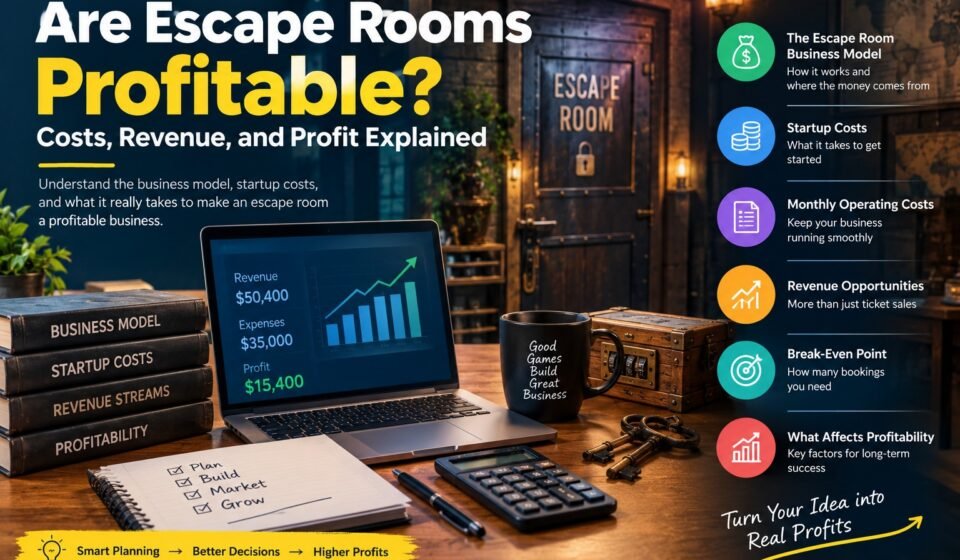

Are escape rooms profitable? This is one of the first questions entrepreneurs ask before investing in an escape room business.
Escape rooms can generate revenue from ticket sales, private bookings, corporate events, birthday parties, group experiences, and other activities. However, profitability depends on much more than the price of a ticket.
Rent, construction, room design, staffing, insurance, marketing, utilities, technology, maintenance, and booking volume can all affect the final profit.
The business also has a unique challenge: every escape room has a limited number of players and sessions. If a room sits empty, that unused capacity represents revenue that cannot be recovered later.
This guide explains the escape room business model, startup costs, operating expenses, revenue opportunities, break-even calculations, and the factors that determine whether an escape room can become profitable.
If you are still researching how to start an escape room business, our complete beginner’s guide covers the planning, location, permits, room design, pricing, and marketing process.
Quick answer: Yes, an escape room business can be profitable, but profitability is not guaranteed. The most important factors are occupancy, pricing, rent, staffing, startup investment, room capacity, and the ability to generate bookings consistently.
How Does the Escape Room Business Model Work?
The basic escape room business model is based on selling timed entertainment experiences.
Customers usually book a specific date and time, arrive at the venue, receive instructions from a game master, and enter a themed room where they solve puzzles and complete a challenge.
The business earns revenue by selling access to those sessions.
For example, imagine an escape room has:
- 8-player capacity
- $35 average price per player
- 6 available sessions per day
If every session were completely booked, the theoretical daily revenue would be:
8 × $35 × 6 = $1,680
Over 30 days, that would equal:
$1,680 × 30 = $50,400
However, this is only theoretical maximum revenue.
Real businesses rarely operate at 100% occupancy every day. Weekdays may be slower, some sessions may have only a few customers, and cancellations or seasonal changes can affect bookings.
This is why occupancy is one of the most important metrics in an escape room business.
What Makes an Escape Room Business Different?
Unlike a traditional retail business, an escape room does not sell unlimited inventory.
A room may have a fixed capacity of six, eight, or ten people and a limited number of sessions per day.
Once a session ends, its unused capacity cannot be sold later.
For example, if a room can accommodate eight people but only four people book the session, the business has sold only half of its available player capacity.
This creates an important relationship between:
Capacity → Occupancy → Revenue → Profit
A business with attractive ticket prices can still struggle if its rooms are frequently empty.
Why Are Escape Rooms So Expensive?
One common question is why are escape rooms so expensive to build and operate.
The answer is that customers see the finished room, but the business owner has to pay for everything behind that experience.
An escape room may require:
- Commercial rental space
- Construction
- Interior walls
- Doors
- Electrical work
- Lighting
- Sound systems
- Cameras
- Sensors
- Locks
- Props
- Puzzle equipment
- Themed decorations
- Safety systems
- Booking software
- Insurance
- Staff
- Marketing
Recent 2026 industry estimates show how widely startup costs can vary. One current estimate places a single-room operation at roughly $55,100–$210,500, while another industry guide estimates $60,000–$150,000 for a single-room build. These are industry estimates rather than guaranteed costs, and the actual amount can vary substantially by location, construction requirements, and room quality.
The largest expense is often not the locks or puzzles themselves.
Construction Can Be Expensive
Commercial space may need to be modified before customers can use it.
This can include:
- Building walls
- Installing doors
- Electrical modifications
- Lighting
- Sound isolation
- Flooring
- Themed interiors
- Reception areas
- Bathrooms or accessibility improvements
- Fire and life-safety work
A basic room and a highly immersive room can therefore have very different budgets.
Technology Adds Another Layer
Modern escape rooms can use technology such as:
- Electronic locks
- Motion sensors
- Automated lighting
- Audio systems
- Cameras
- Control systems
- Projection
- Interactive props
Technology can improve the experience, but it also increases installation, maintenance, and replacement costs.
How Much Does It Cost to Start an Escape Room?
There is no single startup cost that applies to every escape room.
The investment depends on:
- Number of rooms
- Location
- Building condition
- Rent
- Construction requirements
- Theme quality
- Technology
- Furniture
- Insurance
- Permits
- Marketing
- Working capital
One recent 2026 estimate puts total startup costs at approximately $55,100 to $210,500, while another current industry source estimates that a two-room, 2,400-square-foot venue could cost approximately $120,000 to $400,000. The large difference illustrates why entrepreneurs should build a location-specific budget instead of relying on a single industry average.
Common Escape Room Startup Costs
| Expense | What it covers |
|---|---|
| Lease and deposit | Security deposit and initial rent |
| Construction | Walls, flooring, doors and electrical work |
| Room design | Story, puzzles and game development |
| Props | Furniture, clues and themed objects |
| Technology | Sensors, locks, lighting, audio and controls |
| Reception area | Furniture, signage and customer area |
| Insurance | Business and liability coverage |
| Permits | Local licenses and applicable inspections |
| Website | Website development and booking integration |
| Software | Booking and payment systems |
| Marketing | Launch advertising and local promotion |
| Working capital | Cash reserve for early operations |
The U.S. Small Business Administration recommends calculating startup expenses before opening because understanding these costs helps with financial planning, funding decisions, and break-even analysis.
For additional planning, entrepreneurs can review the SBA startup cost guide before preparing their own budget.
Monthly Operating Costs
Startup costs are only part of the financial picture.
After opening, the business has recurring expenses.
Common monthly expenses include:
Rent
Commercial rent can be one of the largest fixed expenses.
A high-rent location may generate more traffic, but the additional bookings need to justify the additional occupancy cost.
Payroll
You may need employees to:
- Welcome customers
- Explain the rules
- Operate games
- Provide hints
- Reset rooms
- Handle bookings
- Clean the venue
- Manage emergencies
Utilities
The business may pay for:
- Electricity
- Water
- Internet
- Heating
- Cooling
Marketing
Marketing expenses can include:
- Google Ads
- Social advertising
- Local SEO
- Website maintenance
- Content creation
- Partnerships
- Promotional campaigns
Maintenance
Escape rooms contain equipment that can eventually break or wear out.
Budget for:
- Replacement props
- Electronics
- Locks
- Lighting
- Furniture
- Repairs
- Cleaning supplies
Booking Software
Online booking systems may involve monthly subscriptions or transaction fees.
All of these costs should be included in your financial model.
How Does an Escape Room Make Money?
Ticket sales are usually the main revenue source, but an escape room can have several additional revenue streams.
1. Individual Ticket Sales
Customers pay per person to participate.
For example:
8 players × $35 = $280 per session
The actual price should be based on local competition, customer demand, experience quality, and operating costs.
2. Private Bookings
Instead of allowing strangers to share a room, you can sell the entire experience to one group.
Private bookings can be attractive for:
- Friends
- Families
- Couples
- Birthday groups
- Tourist groups
3. Corporate Events
Companies may book escape rooms for:
- Team-building activities
- Employee events
- Company celebrations
- Group entertainment
Corporate bookings can also help fill weekday sessions that might otherwise have lower demand.
4. Birthday Parties
Birthday packages can include:
- Private room access
- Extended venue time
- Party space
- Food or drinks where permitted
- Customized experiences
5. Group Packages
You can create packages for:
- Schools
- Universities
- Clubs
- Community organizations
- Large private groups
6. Merchandise and Add-Ons
Depending on the business model, additional revenue could come from:
- Merchandise
- Photos
- Branded products
- Food or beverages
- Special experiences
The availability of these options depends on the venue, local regulations, and business concept.
How to Calculate Escape Room Revenue
A simple revenue calculation starts with:
Number of players × Average ticket price × Number of sessions
For example:
- 8 seats per session
- $35 average ticket
- 5 sessions per day
- 30 operating days
At 100% occupancy:
8 × $35 × 5 × 30 = $42,000 per month
But if average occupancy falls to 50%, the revenue would be approximately:
$42,000 × 50% = $21,000
This example demonstrates why occupancy can have a major effect on revenue.
It also shows why an owner should never build a financial plan around maximum capacity alone.
What Is Escape Room Occupancy?
Occupancy measures how much of your available capacity is actually sold.
Suppose a room has:
- 8 seats
- 5 sessions per day
- 30 operating days
Maximum monthly player capacity:
8 × 5 × 30 = 1,200 player places
If 600 player places are sold, occupancy is:
600 ÷ 1,200 = 50%
Tracking this number helps you understand whether your marketing and pricing strategy are generating enough demand.
You can also measure occupancy by:
- Room
- Day
- Time
- Week
- Month
- Customer type
For example, you may discover that Friday and Saturday evenings are nearly full while Tuesday afternoons are mostly empty.
That information can guide your pricing and promotional strategy.
Are Escape Rooms Profitable?
So, are escape rooms profitable?
They can be, but there is no guaranteed profit margin for every business.
Profit depends on the relationship between revenue and total operating costs.
A simple formula is:
Profit = Revenue − Total Expenses
If an escape room generates $40,000 in monthly revenue but spends $35,000 on operating costs, its operating profit before applicable taxes and other adjustments would be:
$40,000 − $35,000 = $5,000
If expenses increase to $42,000 while revenue remains at $40,000, the business would operate at a $2,000 loss for that period.
This is why revenue alone does not tell you whether the business is profitable.
Understanding the Break-Even Point
One of the most important calculations for an escape room is the break-even point.
The SBA defines break-even as the point where total costs and total revenue are equal. Its basic formula is:
Fixed Costs ÷ (Price − Variable Cost) = Break-Even Units
For an escape room, you can adapt this concept to player bookings.
Example
Suppose:
- Monthly fixed costs = $25,000
- Average revenue per player = $35
- Variable cost per player = $5
Contribution per player:
$35 − $5 = $30
Break-even players:
$25,000 ÷ $30 = 833.33
So the business would need approximately 834 player visits per month to cover these example costs.
This is only an illustration.
Your actual calculation should include your own rent, payroll, insurance, marketing, utilities, booking fees, taxes, debt payments, and other applicable expenses.
You can use the SBA break-even analysis to further understand how fixed costs, selling price, variable costs, and sales volume affect your business.
What Affects Escape Room Profitability?
Several factors can significantly change the financial outcome.
Location
A good location can provide access to more potential customers.
However, a premium location can also have significantly higher rent.
The goal is not simply to find the busiest location.
You need a location where potential customer demand and operating costs make sense together.
Ticket Price
Charging too little can make it difficult to cover costs.
Charging too much can reduce demand if customers do not perceive enough value.
Pricing should consider:
- Competitor prices
- Experience quality
- Local income levels
- Room capacity
- Operating costs
- Customer demand
Occupancy
A room with high capacity but low bookings may underperform.
Increasing occupancy can improve revenue without requiring another physical location.
Labor
A venue that requires too many staff members for its booking volume can have high labor costs.
At the same time, reducing staff too aggressively can damage customer service and safety.
Number of Rooms
More rooms increase potential capacity.
However, they also require additional:
- Construction
- Equipment
- Maintenance
- Cleaning
- Staffing
- Marketing
More rooms do not automatically mean more profit.
Experience Quality
Customers who have a good experience may:
- Leave positive reviews
- Recommend the venue
- Return for another room
- Bring friends
- Share the experience online
Poor experiences can have the opposite effect.
Why Some Escape Rooms Struggle to Make Money
Not every escape room becomes profitable.
Common problems include:
High rent
A location may look attractive but become financially difficult if rent consumes too much revenue.
Low weekday demand
Weekend bookings may be strong while weekday sessions remain empty.
Overbuilding
A business may spend too much on construction and decoration before proving demand.
Poor marketing
An excellent room cannot generate revenue if customers do not know it exists.
Weak reviews
Customers often research entertainment businesses before booking.
A pattern of negative reviews can reduce conversions.
Too many employees
Labor costs can become difficult to manage if staffing is not matched to booking volume.
High maintenance costs
Technology-heavy rooms can require ongoing repairs and replacement.
No working capital
A business can run into trouble if it opens without enough cash reserves to cover the early months.
How to Improve Escape Room Profitability
If you already operate an escape room, improving profitability does not always mean increasing ticket prices.
You can also work on increasing utilization and reducing unnecessary expenses.
Increase Weekday Bookings
Offer targeted promotions for slower periods.
For example:
- Weekday group packages
- Corporate events
- Student events
- Off-peak pricing
- Local partnership promotions
Increase Average Booking Value
Consider packages that increase revenue per customer.
Examples include:
- Private room bookings
- Birthday packages
- Corporate packages
- Multi-room experiences
Reduce Unnecessary Costs
Review expenses regularly.
Look at:
- Software subscriptions
- Advertising
- Utilities
- Supplies
- Maintenance
- Staffing schedules
The goal should be to remove unnecessary costs without damaging the customer experience.
Improve Your Booking Funnel
Make it easy for customers to go from:
Search → Website → Room selection → Date → Payment → Confirmation
Every unnecessary step can create friction.
Your website should clearly show:
- Available rooms
- Themes
- Difficulty
- Duration
- Group size
- Pricing
- Location
- Booking button
Should You Build One Room or Multiple Rooms?
This is an important financial decision.
A single-room operation can have a lower initial investment and simpler operations.
However, it has limited capacity.
Multiple rooms can provide:
- More booking opportunities
- More themes
- Repeat customers
- Higher overall capacity
- Corporate group options
But multiple rooms also require more capital.
A new entrepreneur should compare both scenarios financially instead of assuming that a larger venue will automatically generate more profit.
How Long Does It Take to Recover the Initial Investment?
There is no universal answer.
Imagine an entrepreneur invests $100,000 into an escape room.
If the business generates $5,000 of monthly operating profit, a simple payback calculation would be:
$100,000 ÷ $5,000 = 20 months
But this is only a simplified example.
Actual payback can take longer because profits may fluctuate, the business may have debt payments, equipment may need replacement, and the owner may need to reinvest money into new rooms and marketing.
This is why startup investment should be evaluated alongside realistic revenue and expense projections.
How to Build a More Reliable Financial Forecast
Instead of creating only one forecast, create three.
Conservative scenario
Assume:
- Lower occupancy
- Slower customer growth
- Higher expenses
Expected scenario
Use realistic assumptions based on:
- Competitor pricing
- Local demand
- Available capacity
- Expected marketing performance
Strong-demand scenario
Assume higher bookings while keeping expenses realistic.
Comparing these scenarios can help you understand how sensitive your business is to changes in occupancy and costs.
What Should You Calculate Before Opening?
Before signing a lease or spending heavily on construction, calculate:
Startup investment
How much money is required before opening?
Monthly fixed expenses
How much will you spend even if there are no customers?
Variable costs
Which expenses increase as bookings increase?
Average ticket price
How much revenue does each player generate?
Average group size
How many players typically book together?
Maximum capacity
How many players can your rooms accommodate?
Expected occupancy
How many seats do you realistically expect to sell?
Break-even point
How many players or bookings do you need to cover costs?
Cash runway
How long can the business operate if bookings are below expectations?
These calculations provide a much clearer picture than simply asking whether escape rooms are profitable.
How to Reduce Escape Room Startup Costs
If your initial budget is limited, there are ways to control the investment.
Start With Fewer Rooms
Instead of building four expensive rooms, you could consider starting with one or two well-designed experiences.
Choose a Practical Location
A premium location is not always necessary if customers are willing to travel to the venue.
Use Modular Designs
A flexible design can make future changes easier.
Control Technology Spending
Technology should improve gameplay rather than exist only for decoration.
Test Before Expanding
Prove that customers will pay for your experience before committing to major expansion.
Maintain a Cash Reserve
Do not spend every available dollar on construction.
Working capital can be essential during the early operating period.
Is an Escape Room a Good Investment?
The answer depends on the specific business plan.
An entrepreneur should consider:
- Local demand
- Competition
- Rent
- Startup capital
- Expected occupancy
- Ticket prices
- Staffing requirements
- Marketing costs
- Break-even point
- Expansion opportunities
There is no single profitability figure that applies to every escape room.
Current industry estimates vary substantially, which reinforces the importance of building a financial model for the actual property and market you are considering.
Frequently Asked Questions
Are escape rooms profitable?
Escape rooms can be profitable when revenue from bookings exceeds operating and financing costs. Profitability depends heavily on occupancy, pricing, rent, staffing, startup investment, and customer demand.
Why are escape rooms so expensive?
Escape rooms can be expensive because the business may require commercial construction, themed interiors, technology, puzzles, safety systems, insurance, staffing, and ongoing maintenance.
How much does an escape room cost to start?
Startup costs vary widely. Current 2026 estimates range from tens of thousands of dollars for lean operations to several hundred thousand dollars for larger, highly developed venues.
What is the biggest expense for an escape room?
Construction and room development can represent major portions of the startup budget. Rent, payroll, insurance, and marketing can then become important ongoing expenses.
How do escape rooms make money?
Most revenue comes from customer bookings. Additional revenue can come from private events, corporate groups, birthday packages, group bookings, merchandise, and other services.
How can an escape room increase profit?
Businesses can improve profitability by increasing occupancy, improving pricing, reducing unnecessary costs, attracting corporate and weekday bookings, and increasing the average value of each booking.
What is the break-even point for an escape room?
The break-even point depends on fixed costs, variable costs, ticket price, and sales volume. The SBA’s basic break-even formula is fixed costs divided by price minus variable cost.
Final Thoughts
An escape room can become a profitable entertainment business, but success depends on the numbers behind the experience.
The key questions are not simply how much you can charge or how many rooms you can build.
You should ask:
How many customers can I realistically attract?
What will each booking contribute toward my fixed costs?
How much will the location and staff cost?
How much capital will I need before the business reaches break-even?
What happens if bookings are lower than expected?
A realistic financial model can help answer these questions before you commit significant capital.
The strongest approach is to calculate startup costs, monthly operating expenses, available capacity, expected occupancy, average ticket price, and break-even volume together.
That gives you a much clearer picture of whether the escape room business model makes financial sense for your particular market.



[…] this guide explains the major steps from the initial idea to opening day. Understanding the costs, revenue potential, and break-even point is also important before investing in an escape […]
[…] you are researching an escape room franchise cost, it is important to look beyond the initial franchise fee. The total investment can include venue […]
[…] For a deeper discussion of revenue, expenses, occupancy, and break-even calculations, read our article Are Escape Rooms Profitable? Costs, Revenue, and Profit Explained. […]