
Finding potential customers is easy. Finding the right potential customers is much harder.
A sales team might have thousands of companies in its database, but not all of them require the same investment of time and energy. Some companies align perfectly with your product, have the right budget, use the right technologies, and are actively seeking a solution. Others may look similar but have a low probability of becoming customers.
This is where ICP-based lead scoring comes into play.
ICP stands for Ideal Customer Profile. ICP scoring is a structured method for evaluating potential customers and determining how closely they match the type of company most likely to buy, succeed, and continue using your product or service.
For Revenue Operations teams, prospective customer icp criteria scoring can become a fundamental component of account prioritization, sales development, marketing, and outbound prospecting activities.
What Is an Ideal Customer Profile (ICP)?
An Ideal Customer Profile describes the type of company best suited for your business.
An ICP usually focuses on the company or account rather than the individual person.
For example, a B2B software company might define its ICP as follows:
- B2B SaaS companies
- 100–500 employees
- Annual revenue between $10 million and $50 million
- Headquartered in the United States or Canada
- Uses Salesforce or HubSpot
- Has a dedicated sales team
- Has a Revenue Operations or Sales Operations function
- Actively expanding its sales organization
This definition helps sales and marketing teams understand which accounts should receive the most attention.
An effective ICP should not simply describe any company that could theoretically use your product. Instead, it should identify the companies for which your product offers the best combination of fit, need, purchasing power, and potential value.
What is ICP-based lead scoring?
ICP-based lead scoring is the process of assigning a score to a potential customer based on how well they align with your ICP.
Instead of treating all prospects the same way, you create a scoring model.
For example:
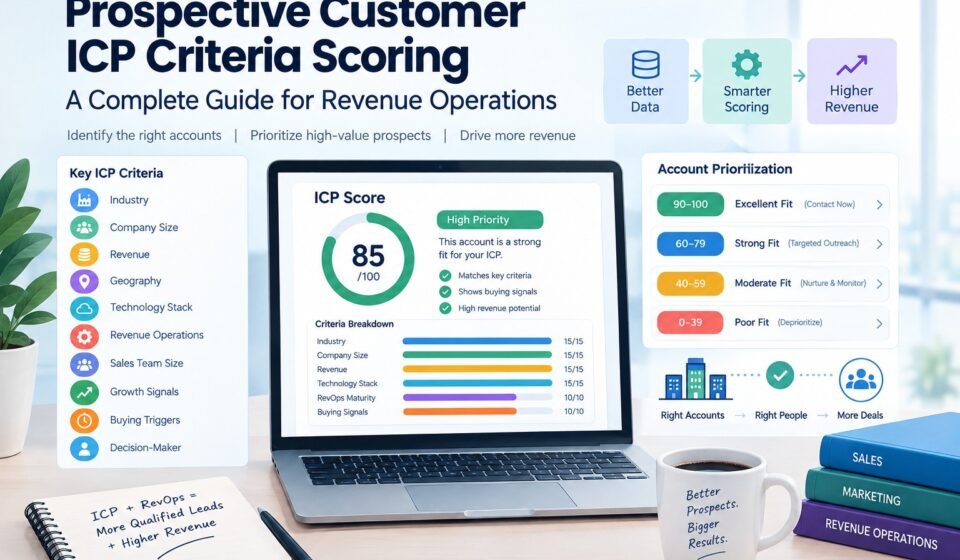
| ICP Criterion | Max Score |
|---|---|
| Industry | 15 |
| Company size | 15 |
| Revenue | 15 |
| Geographic region | 10 |
| Tech stack | 15 |
| Sales team structure | 10 |
| Growth signals | 10 |
| Decision-maker accessibility | 10 |
| Total | 100 |
A company scoring 90 points would be considered an excellent match for the ideal profile.
A company scoring 45 points might not warrant the same level of sales effort.
This provides sales teams with a consistent method for prioritizing prospecting activities.
Why ICP scoring matters
Without an ICP scoring system, sales reps often prioritize prospects based on their own personal judgment.
One salesperson might focus on large enterprises. Another might target companies that have recently received funding. Yet another might simply contact the companies that appear first in a database.
This approach can lead to inconsistent results.
An ICP scoring system creates a shared framework that sales, marketing, and revenue operations teams can all use. It can help companies to:
- Prioritize high-value accounts
- Reduce time spent on prospects that are a poor fit for the offering
- Improve outbound prospecting
- Better define sales territories
- Improve lead qualification
- Align sales and marketing teams
- Enhance account-based marketing
- Identify promising accounts early
- Make CRM data more useful
- Focus sales activity on accounts with the greatest potential
Modern ICP models increasingly combine traditional firmographic data with technology usage, operational signals, and buying triggers, rather than relying solely on company size or industry.
ICP criteria for prospects
An effective ICP scoring model typically includes several categories.
1. Industry
Industry is one of the simplest ICP criteria.
Some products are designed …for specific sectors, while others perform optimally in different areas.
For example, if your product is designed for SaaS sales teams, you might assign higher scores to:
- B2B SaaS
- Sales Tech
- Enterprise software
- Technology services
Conversely, you might assign lower scores to sectors where your product has historically yielded fewer successful customers.
The key is to avoid overly generic definitions.
Instead of defining your ICP simply as “tech companies,” consider a more specific definition, such as “B2B SaaS companies with an outbound sales model.”
2. Company size
Employee count can be a useful indicator for assessing whether a company is a good fit for your product. For example:
| Employees | Score |
| ———| —-: |
| 500–2,000 | 15 |
| 100–499 | 15 |
| 50–99 | 10 |
| 20–49 | 5 |
| Less than 20 | 0 |
The appropriate ranges depend on your business.
A product designed for large enterprises might prioritize companies with thousands of employees, whereas a product intended for startups might target companies with 20–200 employees.
3. Revenue
Revenue is another important criterion, as it can indicate purchasing power.
For example:
- Revenue > $50M → 15 points
- $10M – $49M → 12 points
- $5M – $9M → 8 points
- $1M – $4M → 4 points
- Less than $1M → 0 points
Revenue should not automatically determine whether a prospect is a good fit.
A smaller company can still prove to be an excellent client if it has a strong need and an adequate budget.
4. Geographic Area
Geographic location can be relevant for factors such as:
- Market availability
- Language
- Sales territories
- Regulations
- Currency
- Time zones
- Customer support coverage
For example, a company selling primarily in North America might assign higher scores to companies based in the United States and Canada.
You can also create geographic tiers.
Tier 1: United States and Canada
Tier 2: United Kingdom and Western Europe
Tier 3: Other addressable markets
Tier 4: Markets outside current sales coverage
5. Tech Stack
Technology can be a key indicator for the ICP (Ideal Customer Profile). Suppose your product integrates with Salesforce: a company already using Salesforce might receive a higher score.
Other useful technology signals can include:
- CRM
- Marketing automation platform
- Sales engagement platform
- Data enrichment platform
- Analytics software
- Customer support platform
- Cloud infrastructure
Technology-related information can also help identify opportunities to displace competitors.
For example, if a prospect uses a competing product, the account might receive extra points if your sales strategy involves replacing that rival solution. ## 6. Revenue Operations Structure
Regarding ICP (Ideal Customer Profile) scoring criteria linked to a prospect’s Revenue Operations, the structure of that function itself is particularly relevant.
Look for signals such as:
- Dedicated Revenue Operations team
- Sales Operations team
- Marketing Operations team
- Revenue Operations Lead/Head
- VP of Revenue
- Chief Revenue Officer (CRO)
- Director of Sales Operations
- Revenue Operations Manager
- Presence of multiple sales teams
- Formalized CRM processes
A company with a mature RevOps function might have more sophisticated processes and stricter requirements regarding sales and revenue-generation technologies.
However, this aspect should be viewed as an indicator rather than a universal rule; the weight assigned to it depends on your actual customer data.
7. Sales Team Size
The size of the sales team can reveal a great deal about a prospect.
A company with five employees and a single salesperson may have very different needs compared to an organization with 100 account executives, SDRs, and sales managers. Useful signals include:
- Number of SDRs (Sales Development Representatives)
- Number of AEs (Account Executives)
- Sales managers
- Sales Operations staff
- Revenue Operations staff
- International sales teams
A large sales organization can be a strong indicator of interest in products designed to improve sales productivity or Revenue Operations.
8. Growth signals
Growth is a key element in modern ICP scoring.
Potential growth signals include:
- Recent funding
- Rapid headcount growth
- Opening of new offices
- Expansion into new markets
- New product launches
- Increased hiring in sales
- Appointment of new executives
- Rapid website expansion
These signals can indicate that the company is facing new challenges or has additional budget to invest.
9. Buying triggers
ICP fit indicates who makes a good customer.
Buying triggers help determine when that customer might be ready to buy.
Some examples:
- Launching a new product
- Arrival of a new CRO
- Hiring of a new VP of Sales
- Securing funding
- Switching CRM systems
- Starting to hire SDRs
- International expansion
- Announcement of ambitious growth targets
Recent studies on ICPs highlight how factors such as funding, leadership changes, CRM migrations, and sales hiring serve as useful indicators for prioritizing accounts. # How to create an ICP scoring model for prospects
Creating an ICP scoring model doesn’t have to be complicated.
You can follow these steps.
Step 1: Analyze your best current customers
Start with your existing customer base.
Consider:
- The customers generating the most revenue
- Your longest-standing customers
- Customers with the highest retention rates
- The fastest-growing customers
- Customers who achieved the best results
- Customers generating the most expansion revenue
Then, look for common characteristics.
Ask yourself:
- Which industries do they operate in?
- How many employees do they have?
- What is their revenue range?
- Where are they located?
- What technologies do they use?
- How large are their sales teams?
- What problems drove them to make the purchase?
- Who made the purchasing decision?
This gives you concrete data to define your ICP, rather than being based solely on assumptions.
Step 2: Distinguishing Between Fit and Intent
This is an important distinction.
Fit (or affinity) indicates whether the company matches your ideal customer profile.
Intent indicates whether the company appears ready to buy.
For example:
A company with 500 employees, $50 million in revenue, and the right technology might have an excellent ICP fit.
However, if it currently has no specific pain points and isn’t evaluating solutions, it might not be ready to buy.
Another company might have a slightly lower fit score but has recently hired a new CRO and is rebuilding its Revenue Operations tech stack.
This latter company might warrant immediate attention.
A useful model, therefore, combines ICP fit and buying signals.
Step 3: Assigning Weights
Not all criteria need to carry the same weight.
For example:
| Category | Weight |
|---|---|
| Firmographic fit | 30 |
| Technological fit | 20 |
| Revenue Operations fit | 15 |
| Buying signals | 20 |
| Contact/persona fit | 15 |
| Total | 100 |
The exact percentages should be based on specific company data.
Step 4: Creating Score Tiers
Once the criteria are defined, create clear score tiers.
For example:
| Score | Classification | Recommended Action |
|---|---|---|
| 80–100 | Excellent fit | Priority sales outreach |
| 60–79 | High fit | Standard targeted outreach |
| 40–59 | Moderate fit | Nurturing and monitoring |
The key aspect is linking each score range to a specific action. Current scoring models for Revenue Operations commonly use tiers to determine the intensity of outbound and nurturing activities.
ICP Scoring Example for Potential Customers
Imagine a company selling a Revenue Operations platform. Its ICP is:
- B2B SaaS
- 100–1,000 employees
- Revenue >$10 million
- North America
- Salesforce or HubSpot
- Dedicated RevOps team
- Growing sales organization
Now consider this prospect:
Company: Example SaaS Inc.
- Industry: B2B SaaS → 15/15
- Employees: 350 → 15/15
- Revenue: $30 million → 15/15
- Region: United States → 10/10
- Technology: Salesforce → 15/15
- RevOps team: Yes → 10/10
- Growth signal: Hiring 20 salespeople → 10/10
- Relevant decision-maker identified → 10/10
Total score: 100/100
This account should be treated as a high-priority prospect.
Now imagine another company:
- Industry: Manufacturing
- Employees: 40
- Revenue: $2 million
- Outside the core market
- No dedicated sales operations team
- No compatible technology
- No current buying signals
Its score might be below 40.
Instead of spending valuable SDR time on this company, it could be placed in a lower-priority marketing or nurturing segment. # Account-level vs. contact-level scoring
A common mistake is scoring only the individual contact.
Scoring based on the ICP should normally take into account both the account and the contact.
For example:
A VP of Sales at a company with 20 employees might be the ideal decision-maker, but the company itself might not fit your ICP.
On the other hand, a junior salesperson at a company with 1,000 employees might not be the right contact, but the account could represent an excellent target.
A useful system can therefore include two scores:
Account Fit Score: Does the company match the ICP?
Contact Fit Score: Is this person the right stakeholder?
Combining the two gives your sales team a clearer picture of the prospect’s quality. # Revenue Operations and ICP Scoring
Revenue Operations teams are often responsible for operationalizing the ICP (Ideal Customer Profile) scoring system across the entire revenue generation process.
RevOps can integrate ICP scoring with:
- CRM systems
- Lead routing
- Account prioritization
- Sales territories
- Marketing campaigns
- Account-Based Marketing (ABM)
- SDR workflows
- Reporting
- Forecasting
- Customer Success processes
For example, a company might automatically assign a score to an account the moment a new company is entered into the CRM.
An account with a score of 90 might be automatically assigned to an SDR.
Or an account with a score of 65 might be placed into a nurturing workflow.
An account with a score of 30 might be excluded from high-priority outbound campaigns.
This transforms the ICP from a static document into an operational process.
The importance of CRM data quality
The validity of an ICP score depends on the quality of the data used to calculate it.
If the employee count is outdated, revenue information is incorrect, or firmographic/technographic data is missing, the score can become unreliable.
Revenue teams should regularly check for:
- Missing fields
- Duplicate accounts
- Outdated company information
- Incorrect industry classifications
- Inaccurate employee counts
- Outdated technographic data
- Outdated job titles/roles
- Invalid contacts
Maintaining clean account data is therefore a fundamental aspect of ICP scoring.
How to improve the ICP scoring model
Your initial scoring model doesn’t have to be perfect.
Think of it as a starting point.
After a few months, compare our scores against actual sales results.
Evaluate aspects such as:
- Do high-scoring accounts actually convert into customers more often?
- Do high-scoring accounts generate higher-value contracts?
- Do they move through the pipeline faster?
- Do they remain customers longer?
- Which criteria appear most frequently among won deals (closed-won)?
- Which criteria appear frequently among lost deals (closed-lost)?
If a criterion doesn’t help distinguish won customers from unconverted prospects, consider reducing its weight or eliminating it.
Modern approaches to ICP scoring increasingly suggest validating scoring criteria against historical data from won and lost deals, rather than relying solely on assumptions.
Common mistakes in ICP scoring
Using too many criteria
A scoring model with 50 different criteria might seem sophisticated, but it risks becoming difficult to manage.
Start with the criteria that truly matter.
Assigning the same weight to all criteria
For your business, the industry might be far more important than the company’s geographic location.
Assign different weights where appropriate.
Ignoring buying signals
A company might be a perfect match for your ICP but have no immediate reason to buy.
Incorporate signals related to timing and purchase intent, where relevant.
Evaluating only the contact
An excellent contact at the wrong company still represents a weak opportunity.
Evaluate the account (the company) as well.
Never updating the model
Markets change.
Your best customers today might not exactly match the profile of your best customers two years from now.
Regularly review your ICP scoring model.
Allowing sales reps to ignore the score
The scoring system should support the sales rep’s judgment, not replace it. However, if sales teams consistently ignore the model, investigate the reason why.
Their feedback might reveal that the scoring criteria are flawed or that important information is missing.
A simple 100-point ICP scoring model
Here is a simple starting model for B2B companies:
| Criterion | Points |
|---|---|
| Industry fit | 15 |
| Company size | 15 |
| Revenue | 15 |
| Geographic region | 10 |
| Tech stack | 15 |
| Sales operations maturity | 10 |
| Growth or buying signal | 10 |
| Relevant decision-maker | 10 |
| Total | 100 |
You can adjust these weights based on your own customer data.
For example, if technology compatibility is crucial for your product, increase its weight.
If geographic location is less important, reduce its weight.
Frequently Asked Questions
What is ICP-based scoring for prospects?
ICP (Ideal Customer Profile) scoring is a method of assigning a score to prospects based on how well they match your Ideal Customer Profile. The score helps sales and marketing teams prioritize accounts that are most likely to become valuable customers.
What does ICP mean in sales?
ICP stands for Ideal Customer Profile. It describes the type of company most likely to benefit from your product or service and become a successful, high-value customer.
What criteria should be used for ICP scoring?
Common criteria include industry, company size, revenue, geographic location, tech stack, sales organization, Revenue Operations (RevOps) maturity, growth signals, buying triggers, and the presence of decision-makers.
What is ICP scoring in the context of Revenue Operations?
ICP scoring in Revenue Operations involves using ICP criteria within the broader revenue generation process to identify, classify, route, and prioritize accounts for sales and marketing activities.
What constitutes a good ICP score?
There is no universal “good” score. A 100-point model might classify accounts scoring 80–100 as high-priority, those between 60 and 79 as high-affinity accounts, and those with lower scores as accounts for nurturing or low-priority status. Thresholds should be calibrated based on your own sales data.
Should ICP scoring include purchase intent?
Yes, when reliable intent data is available. ICP affinity indicates whether a company is a good potential customer, whereas buying signals can determine whether the company is ready to buy.
Conclusion
Scoring potential customers based on ICP criteria offers sales and revenue teams a practical method for distinguishing high-value prospects from low-priority accounts.
Instead of asking, “Could this company buy from us?”, teams can ask a more useful question:
“To what extent does this account match the characteristics of our most successful customers, and are there signals indicating a potential readiness to buy?”
An effective scoring model combines company fit, technology, Revenue Operations maturity, decision-maker insights, and buying signals. The best approach is to start with a simple 100-point model, link each score range to a specific sales action, and subsequently refine the model using real customer and pipeline data.
When ICP scoring is continuously tested and refined, it can help Revenue Operations, sales, and marketing teams dedicate more time to the prospects with the greatest potential.