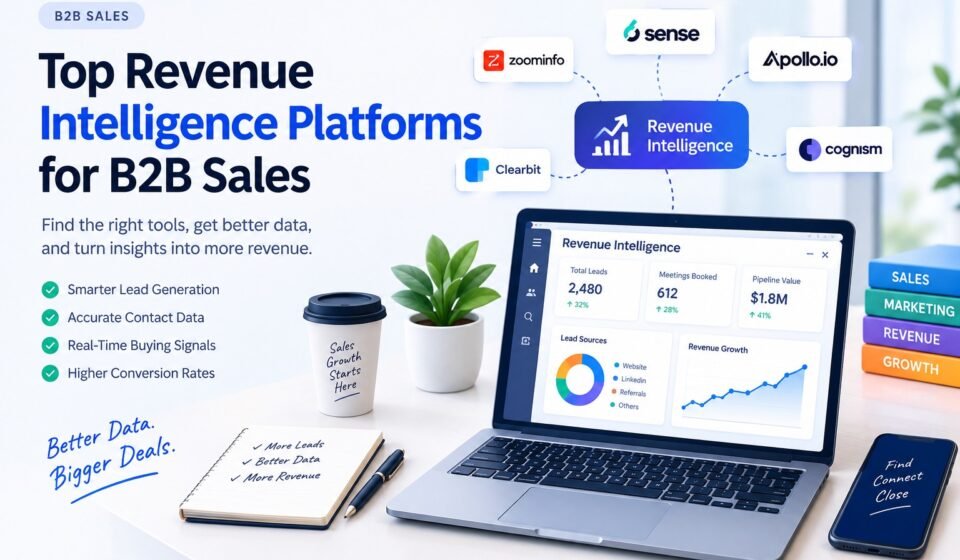

B2B sales teams have access to more data than ever, but having more data does not automatically mean having better sales results. Sales representatives need to know which accounts are worth pursuing, which deals are at risk, which prospects are showing buying signals, and what actions can move opportunities forward.
This is where revenue intelligence platforms for B2B sales come in.
Revenue intelligence software brings together information from CRM systems, sales conversations, emails, pipeline activity, account engagement, and other revenue signals. AI and analytics can then turn that information into insights that help sales teams prioritize opportunities, improve forecasting, and make better decisions.
Modern platforms vary considerably. Some focus heavily on conversation intelligence and deal analysis, while others specialize in forecasting, account intent, sales engagement, or B2B contact data.
In this guide, we compare some of the top revenue intelligence platforms for B2B sales teams in 2026 and explain what each platform is best suited for.
What Is Revenue Intelligence?
Revenue intelligence is the process of collecting and analyzing sales and customer data to understand what is happening across the revenue pipeline.
Instead of relying only on manually updated CRM fields, revenue intelligence platforms can analyze signals from sales calls, emails, meetings, opportunities, account activity, and other sources.
For example, a revenue intelligence platform may help a sales manager identify:
- Deals that have suddenly slowed down
- Opportunities with a high probability of closing
- Accounts showing strong buying intent
- Sales conversations containing important objections
- Reps who need additional coaching
- Pipeline changes that could affect the forecast
- Accounts that may have expansion or retention opportunities
Clari describes revenue intelligence as using automation and machine learning to extract insights from sales calls, CRM systems, and other sales data. Salesforce similarly combines pipeline, forecasting, activity, and account insights within its Revenue Intelligence offering.
The main goal is simple: give revenue teams better information so they can take better action.
Revenue Intelligence vs. Sales Intelligence
The terms revenue intelligence and sales intelligence are sometimes used interchangeably, but they are not exactly the same.
Sales intelligence is generally focused on finding and understanding prospects. It can include:
- B2B contact data
- Company information
- Job titles
- Business emails
- Phone numbers
- Firmographic data
- Technographic data
- Buying signals
- Prospecting information
Revenue intelligence generally focuses more broadly on what happens throughout the revenue process, including:
- Pipeline health
- Deal intelligence
- Sales conversations
- Forecasting
- Rep performance
- Customer engagement
- Revenue risks
- Opportunity management
This distinction matters when choosing a platform.
If your biggest problem is finding qualified prospects, a B2B contact database or sales intelligence platform may be more important.
If your biggest problem is understanding pipeline performance and closing more deals, a revenue intelligence platform may provide more value.
Many modern platforms now combine several of these capabilities.
Top Revenue Intelligence Platforms for B2B Sales Teams
There is no single platform that is best for every B2B organization. The right choice depends on your sales process, team size, CRM, geographic markets, prospecting requirements, and revenue goals.
Here are some of the leading platforms worth evaluating.
1. Gong
Best for: Conversation intelligence, deal intelligence, coaching, and revenue workflows
Gong is one of the best-known platforms in the revenue intelligence category.
Its platform captures and analyzes customer interactions and uses AI to identify important patterns across sales conversations and revenue workflows. Gong currently positions its product as a broader Revenue AI platform covering areas such as engagement, forecasting, enablement, and revenue data.
For B2B sales teams, Gong can help answer questions such as:
- What objections are prospects raising?
- Which deals are showing risk?
- What sales behaviors are associated with successful deals?
- Which opportunities require attention?
- What should a sales representative do next?
Gong is particularly useful for organizations with a significant volume of sales calls and customer interactions.
Why choose Gong?
Gong is a strong option when your organization wants to turn conversations and customer interactions into actionable sales intelligence.
It is especially attractive for larger sales organizations that want structured coaching, deal analysis, forecasting, and revenue workflows.
2. Clari
Best for: Revenue forecasting, pipeline management, and deal inspection
Clari is another major name in revenue intelligence.
The platform focuses heavily on pipeline visibility, forecasting, opportunity management, and revenue orchestration. Its current platform includes capabilities covering forecasting, sales engagement, conversation intelligence, opportunity inspection, and revenue data.
Clari can help revenue leaders understand:
- Which opportunities are at risk
- Whether pipeline coverage is sufficient
- How deals are progressing
- Where revenue leakage may occur
- How pipeline changes affect forecasts
- Which accounts require attention
For companies where forecast accuracy and pipeline visibility are major concerns, Clari can be a strong candidate.
Why choose Clari?
Choose Clari if your biggest challenge is understanding the health of your pipeline and producing more reliable revenue forecasts.
It is particularly relevant for established B2B organizations with structured sales processes and dedicated RevOps or sales operations teams.
3. 6sense
Best for: Account intelligence, buying intent, and B2B revenue teams
6sense takes a slightly different approach from platforms primarily focused on sales conversations.
Its strength is helping B2B organizations understand which accounts are potentially in-market and where buying signals can help sales and marketing teams prioritize accounts.
The platform has built its positioning around AI-powered revenue intelligence and B2B buying signals.
For account-based sales teams, 6sense can help identify:
- Accounts showing buying intent
- Potentially active buying groups
- High-value target accounts
- Changes in account behavior
- Opportunities for sales and marketing alignment
Why choose 6sense?
6sense is worth considering when your sales strategy is strongly account-based and your team needs intelligence before the prospect enters a traditional sales pipeline.
It can be particularly useful for enterprise B2B companies with long sales cycles and multiple stakeholders involved in purchasing decisions.
4. ZoomInfo
Best for: B2B contact data, company intelligence, and sales prospecting
ZoomInfo is particularly relevant to teams searching for best sales intelligence tools for B2B contact data.
Rather than focusing only on what happens after an opportunity enters the pipeline, sales intelligence platforms such as ZoomInfo can help sales teams identify companies and contacts to target.
Typical use cases include:
- Finding decision-makers
- Building prospect lists
- Researching companies
- Enriching CRM records
- Identifying potential buying signals
- Supporting outbound prospecting
This makes ZoomInfo especially relevant for sales organizations where high-quality account and contact intelligence is an important part of the sales process.
Why choose ZoomInfo?
ZoomInfo can make sense for organizations that need a substantial B2B intelligence layer to support prospecting and account research.
However, teams should evaluate data quality for their specific market rather than assuming that every database will have identical coverage.
5. Apollo
Best for: B2B contact data combined with outbound sales execution
Apollo is one of the most relevant tools for teams searching for B2B contact data sales intelligence tools.
Apollo combines prospecting data with sales engagement functionality. Its current database pages state that users can search more than 240 million contacts using more than 65 filters, while its platform also provides enrichment, intent signals, and sales automation capabilities.
This combination is useful because sales teams can move from:
Find prospects → qualify prospects → build lists → enrich data → engage prospects
without necessarily requiring separate tools for every stage.
Apollo can be useful for:
- Email prospecting
- Contact discovery
- Lead generation
- Account research
- CRM enrichment
- Outbound sequences
- Sales automation
Why choose Apollo?
Apollo is particularly attractive for startups, SMBs, agencies, and growing sales teams that want contact data and outbound prospecting capabilities in one platform.
It can also be a practical option when a team wants to test a sales intelligence workflow before investing heavily in multiple enterprise tools.
6. Salesforce Revenue Intelligence
Best for: CRM-native revenue analytics and forecasting
Salesforce Revenue Intelligence is designed for organizations already using Salesforce as their core CRM environment.
The platform provides visibility into pipeline, forecasting, sales performance, account management, and revenue-related analytics. Salesforce describes Revenue Intelligence as a way to bring pipeline, forecasting, and rep-performance visibility together within Sales Cloud.
This approach has an important advantage: the intelligence layer can work directly with information already stored in the CRM.
Sales leaders can use revenue analytics to examine:
- Pipeline performance
- Forecast trends
- Rep activity
- Account performance
- Win rates
- Opportunity data
- Revenue trends
Why choose Salesforce Revenue Intelligence?
If your organization already depends heavily on Salesforce, adding revenue intelligence capabilities within that ecosystem can be more convenient than introducing another completely separate platform.
It is particularly suitable for established organizations that want CRM-native analytics and forecasting.
7. People.ai
Best for: Automated activity capture and revenue intelligence
People.ai focuses on capturing and organizing sales activity so revenue teams can obtain a more complete view of customer and account engagement.
This type of platform can be valuable because CRM records are often incomplete.
Sales representatives may forget to log meetings, emails, calls, or other interactions. Automated activity capture can reduce some of that manual work and give managers a more complete picture of account engagement.
People.ai can be particularly relevant for organizations that want to improve:
- CRM data quality
- Activity visibility
- Account intelligence
- Sales productivity
- Revenue operations
Why choose People.ai?
People.ai is worth considering when the main challenge is not simply a lack of data, but incomplete or inconsistent sales activity data inside the CRM.
8. HubSpot Sales Hub
Best for: Growing B2B teams that want CRM, sales engagement, and analytics together
HubSpot is another option worth considering for smaller and mid-market B2B sales organizations.
Rather than purchasing a highly specialized revenue intelligence system immediately, some teams may prefer a broader sales platform that combines CRM, sales engagement, reporting, and automation.
HubSpot’s sales intelligence approach emphasizes using firmographic, technographic, intent, and contact information to help sales teams prioritize accounts and personalize outreach.
Why choose HubSpot?
HubSpot can be a good fit for teams that want to keep their technology stack relatively simple.
It can work especially well when marketing, sales, and CRM activities are already managed within the same ecosystem.
Quick Comparison of the Top Platforms
| Platform | Best For | Key Strength |
|---|---|---|
| Gong | Enterprise sales teams | Conversation and revenue intelligence |
| Clari | Revenue leaders | Forecasting and pipeline management |
| 6sense | ABM teams | Buying intent and account intelligence |
| ZoomInfo | Prospecting teams | B2B contact and company intelligence |
| Apollo | Outbound sales teams | Contact data + sales engagement |
| Salesforce Revenue Intelligence | Salesforce users | CRM-native revenue analytics |
| People.ai | RevOps teams | Automated activity capture |
| HubSpot Sales Hub | SMB and mid-market | CRM + sales + analytics |
The important point is that these platforms are not identical products.
Some are strongest in revenue intelligence, while others are better classified as sales intelligence, contact-data, intent-data, CRM analytics, or sales engagement platforms.
That distinction should be considered before making a purchasing decision.
What Should B2B Sales Teams Look For?
Before choosing a platform, evaluate the features that directly affect your sales process.
1. Contact Data Quality
For outbound prospecting, contact data quality is critical.
Look for:
- Verified business emails
- Direct phone numbers
- Job titles
- Company information
- Industry data
- Company size
- Geographic information
- Data enrichment
Even the best sales intelligence tools cannot eliminate all inaccurate or outdated data. People change jobs, companies change information, and databases require continuous updating.
Therefore, evaluate actual coverage in your target markets instead of relying only on the size of a vendor’s database.
2. Buying Signals
A good platform should help your team understand more than basic contact information.
Useful signals can include:
- Website activity
- Research behavior
- Hiring activity
- Funding events
- Technology changes
- Engagement activity
- Intent signals
These signals can help sales representatives decide who to contact first.
3. CRM Integration
Your intelligence platform should work with the CRM your sales team already uses.
Check integrations with platforms such as:
- Salesforce
- HubSpot
- Microsoft Dynamics
- Other CRM systems
Poor integration can create duplicate records and disconnected workflows.
4. Data Enrichment
Data becomes less useful when it becomes outdated.
Look for tools that can enrich existing CRM records and update information such as:
- Job title
- Company size
- Industry
- Email address
- Phone number
- Location
- Technology used
This is particularly important for large outbound teams.
5. Outbound Prospecting Features
If your primary objective is generating new business, look beyond basic intelligence.
Useful outbound features include:
- Prospect list building
- Email sequencing
- Contact enrichment
- Lead scoring
- Sales automation
- Buying signals
- CRM synchronization
This is one reason platforms such as Apollo can be attractive: they combine contact data with sales execution capabilities.
How Revenue Intelligence Can Improve B2B Sales
The value of revenue intelligence comes from turning disconnected information into actionable decisions.
For example, imagine a sales team has 500 open opportunities.
Without intelligence, sales managers may rely heavily on CRM stages and rep updates.
With a revenue intelligence platform, the team may identify:
500 opportunities → 100 high-priority opportunities → 30 at-risk deals → 15 immediate actions
The platform does not replace salespeople. Instead, it helps salespeople spend more time on the opportunities that deserve attention.
This can improve several parts of the sales process:
Better Prospect Prioritization
Sales teams can focus their time on accounts that match their ideal customer profile and show meaningful buying signals.
Better Pipeline Visibility
Managers can identify stalled opportunities before they disappear from the pipeline.
Better Forecasting
Revenue leaders can use activity and opportunity signals to build more informed forecasts.
Better Sales Coaching
Conversation intelligence can reveal patterns in successful and unsuccessful sales calls.
Better Outbound Prospecting
B2B contact data and account intelligence can help representatives build more targeted prospect lists.
Revenue Intelligence Is Not a Replacement for Good Data
One important point is often overlooked.
A sophisticated AI platform cannot completely compensate for poor underlying data.
If your contact records are outdated, your CRM is incomplete, or your target accounts are poorly defined, the resulting intelligence may also be unreliable.
A strong B2B sales technology stack should therefore look something like:
Accurate Data → Enrichment → Intelligence → Prioritization → Outreach → Sales Conversations → Pipeline Analysis → Revenue
Each stage supports the next one.
This is why businesses evaluating the best sales intelligence tools for B2B contact data and outbound prospecting should not look only at dashboards or AI features.
They should also evaluate data coverage, accuracy, freshness, integrations, compliance, and workflow compatibility.
How to Choose the Right Platform
The easiest way to choose a platform is to start with the problem you are trying to solve.
Choose Gong if:
Your team needs conversation intelligence, sales coaching, deal analysis, and broader revenue workflows.
Choose Clari if:
Forecasting accuracy and pipeline management are your primary priorities.
Choose 6sense if:
Your organization has an account-based sales strategy and needs buying-intent intelligence.
Choose ZoomInfo if:
Your sales team needs extensive B2B company and contact intelligence for prospecting.
Choose Apollo if:
You want B2B contact data combined with outbound prospecting and sales engagement.
Choose Salesforce Revenue Intelligence if:
Salesforce is already the center of your sales operation and you want CRM-native revenue analytics.
Choose People.ai if:
Your organization needs better sales activity capture and CRM data completeness.
Choose HubSpot Sales Hub if:
You want CRM, sales engagement, automation, and analytics in a broader platform.
Final Thoughts
The top revenue intelligence platforms for B2B sales are becoming more sophisticated as AI changes how sales teams collect, analyze, and act on revenue data.
However, the best platform is not necessarily the one with the biggest database or the most AI features.
Your decision should be based on your specific sales motion.
If you primarily need B2B contact data and outbound prospecting, platforms such as Apollo and ZoomInfo deserve close attention.
If your main challenge is pipeline forecasting and deal management, Clari and Salesforce Revenue Intelligence may be more relevant.
Also, If your team wants conversation intelligence and sales execution insights, Gong is a strong option.
And if your organization depends on account-based marketing and buying-intent signals, 6sense can be a better fit.
Ultimately, the strongest revenue intelligence strategy combines accurate data, reliable signals, a clean CRM, effective sales processes, and a platform that helps your team turn information into action.
The goal is not simply to collect more sales data.
The goal is to identify better opportunities, prioritize the right accounts, improve sales execution, and generate more predictable revenue.



[…] with intelligence features. For teams that want to go beyond contact and sales data, our guide to revenue intelligence platforms for B2B sales explains how revenue intelligence can support the wider sales […]